Chrysophyllum gonocarpum
(Martius & Eichler) Engler
Aguai chico, Angledfruit starapple
iNaturalist· cc-by
(c) Thomaz Ricardo Favreto Sinani, some rights reserved (CC BY)
iNaturalist· cc-by
(c) Thomaz Ricardo Favreto Sinani, some rights reserved (CC BY)
iNaturalist· cc-by
(c) Thomaz Ricardo Favreto Sinani, some rights reserved (CC BY)
Summary
Source: WikipediaChrysophyllum gonocarpum is a tree in the family Sapotaceae, native to South America.
Description
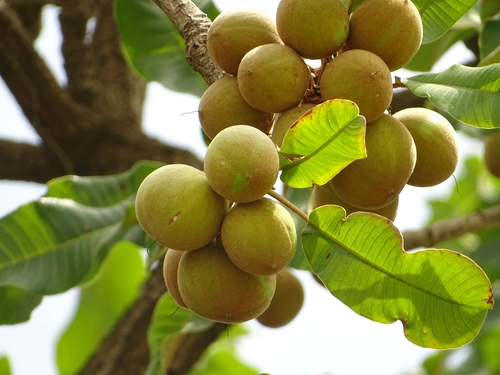
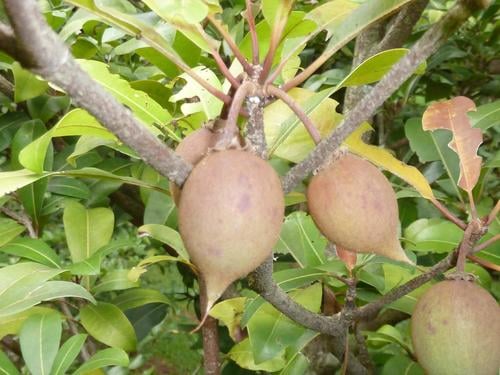
A tree. It grows 8-10 m high. The trunk is 40-50 cm across. It has a dense crown of leaves. The leaves are alternate and in groups near the ends of branches. The leaf stalk is 1.5-2 cm long. The leaves are 14-17 cm long by 4-6 cm wide. They are oval or sword shaped. The fruit is round and 1.5-2 cm across. It is divided into 5 compartments. The seeds are oval.
Edible Uses
The fruit pulp is used in sweet dishes and sold in local markets.
Traditional Uses
The pulp of the fruit is used in sweet dishes.
This uses section is brief — help expand it
Distribution
A tropical plant. In Argentina it grows from sea level to 2,000 m above sea level.
Where It Grows
Argentina, Bolivia, Brazil*, Paraguay, Peru, South America, Uruguay,
Cultivation
Plants can be grown from seed. The ripe fruit are harvested and put in a heap to help the flesh decompose and make the seeds easier to remove. They are then washed with running water. Seeds can be stored for about 6 months. Fresh seed should be planted. They germinate in about 20-30 days.
Propagation
Seed - best sown as soon as it is ripe in individual containers in a shady position. A moderate germination rate is usually attained in 20 - 30 days.
Other Uses
The light brown to pink wood is fine-textured, straight grained, compact, moderately heavy, elastic and durable. Of low durability, susceptible to attacks of termites and fungi. It is difficult to machine since it contains a high content of silica, but finishes well. It is used for construction, boxes and agricultural implements. It has been recommended as a source of pulp for paper making.
Production
Plants grow slowly.
Other Information
The fruit are sold in markets.
Notes
There are about 80-150 Chrysophyllum species. They are mostly in tropical America. There are 44 species in tropical America.
Synonyms
Also Known As
Aguai-guacu, Aguai-da-nena, Aguai-de-serra, Aguay, Bapeba, Bvoi'i, Caxeta, Caxeta-amarela, Coerana, Cuite-branco, Guatambu, Guatambu-de-leite, Guatambu-de-sapo, Japu'iywa, Junita'ywa, Mato-olho, Peroba-branca
References (16)
- Bortolotto, I. M., et al, 2018, Lista preliminar das plantas alimenticias nativas de Mato Grosso do Sul, Brasil. Iheringia, Serie Botanica, Porto Alegre, 73 (supl.):101-116
- Bot. Jahrb. Syst. 12:523. 1890
- Brack, P., et al, 2020, Frutas nativas do Rio Grande do Sul, Brasil: riqueza e potencial alimentício. Native fruits of Rio Grande do Sul, Brazil: richness and potential as food. Rodriguésia 71: e03102018
- Carretero, A. L., 2005, Useful Plants and traditional knowledge in the Tucumano-Boliviano Forest. M. Sc. Thesis Institute of Biological Science University of Aarhus, Denmark p 55
- Ferns, Useful Tropical Plants
Show all 16 references Hide references
- Grandtner, M. M. & Chevrette, J., 2013, Dictionary of Trees, Volume 2: South America: Nomenclature, Taxonomy and Ecology. Academic Press p 130
- Kermath, B. M., et al, 2014, Food Plants in the Americas: A survey of the domesticated, cultivated and wild plants used for Human food in North, Central and South America and the Caribbean. On line draft. p 224
- Kinupp, V. F., 2007, Plantas alimenticias nao-convencionais da regiao metropolitana de Porto Alegre, RS, Brazil p 99
- Lorenzi, H., 2002, Brazilian Trees. A Guide to the Identification and Cultivation of Brazilian Native Trees. Vol. 01 Nova Odessa, SP, Instituto Plantarum p 339
- NYBG herbarium "edible" (Also as Sideroxylon reticulatum Britton)
- Pennington, T.D., 1990, Sapotaceae in Flora Neotropica Monograph 52. New York Botanical Gardens. p 610
- Peres, M. K., 2011, Diasporos do Cerrado Atrativos para Fauna: Chave Interativa Caracterizacao Visual e Relacoes Ecologicas. Masters thesis. Universidade de Brasilia.
- Reis, S. V. and Lipp, F. L., 1982, New Plant Sources for Drugs and Foods from the New York Botanical Garden herbarium. Harvard. p 234
- Scarpa, G. F., 2009, Wild food plants used by the indigenous peoples of South American Gran Chaco: A general synopsis and intercultural comparison. Journal of Applied Botany and Food Quality 83:90-101
- Vasquez, Roberto Ch. & Coimbra, G. S., 1996, Frutas Silvestres Comestibles de Santa Cruz. p 210
- www.colecionandofrutas.org
More from Sapotaceae
Tieghemella heckelii
African mahogany, Cherry mahogany, Dumori butter
Tridesmostemon omphalocarpoides
Van-royena castanosperma
Saffron Boxwood, Yellow Plum, Poison Plum, Milky Plum
Vitellaria paradoxa
Karite-nut, Shea, Shea-buttertree
Vitellaria paradoxa subsp. nilotica
Shea butter tree
Vitellariopsis dispar
Tugela milkwood