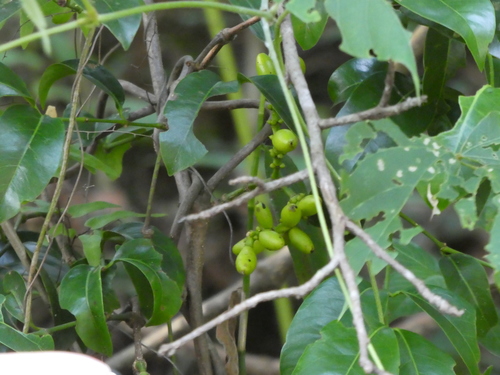
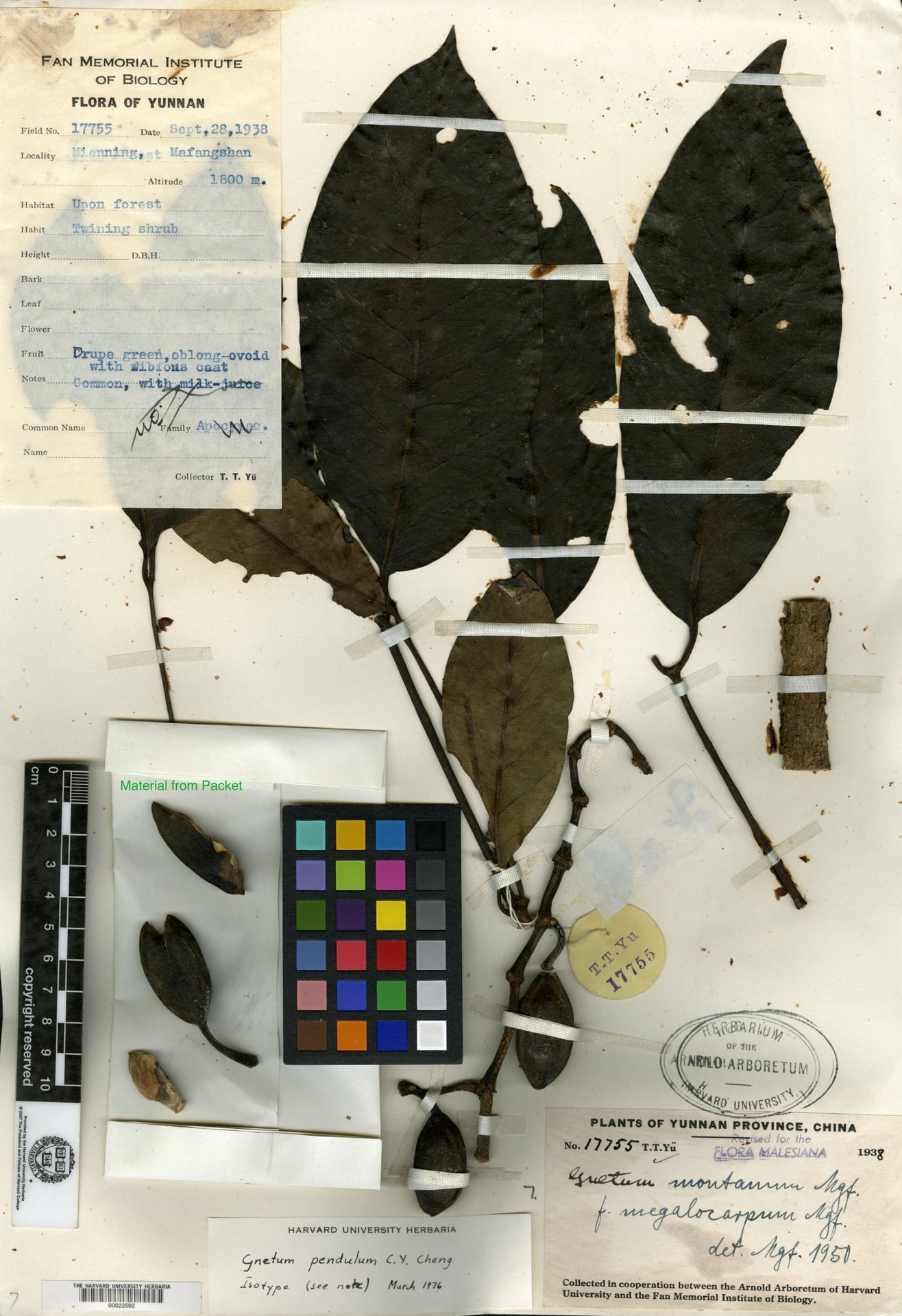
Gnetum latifolium
Blume
Rope gnetum vine
iNaturalist· cc-by-sa
(c) Vinayaraj, some rights reserved (CC BY-SA)
iNaturalist· cc-by-sa
(c) Vinayaraj, some rights reserved (CC BY-SA)
Summary
Source: WikipediaGnetum latifolium is an evergreen plant in the family Gnetaceae with a broad distribution across South East Asia. Although some of its habitat is threatened by logging and forest conversion to crops, its broad distribution afforded it an assessment of "least concern" according to The IUCN Red List of Threatened Species. Several varieties are accepted: Gnetum latifolium var. latifolium Gnetum latifolium var. funiculare Markgr. Gnetum latifolium var. laxifrutescens (Elmer) Markgr. Gnetum latifolium var. longipes (Markgr.) T.H.Nguyên Gnetum latifolium var. macropodum (Kurz) Markgr. Gnetum latifolium var. minus (Foxw.) Markgr.
Description
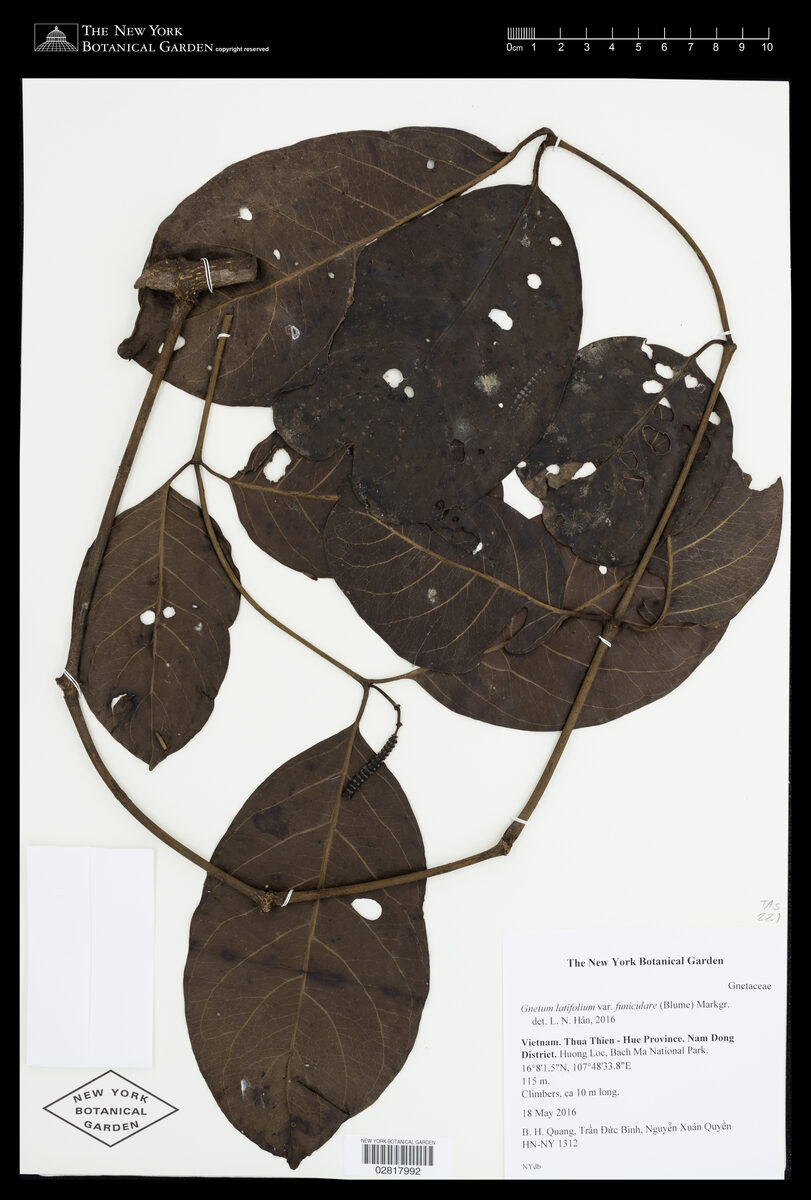
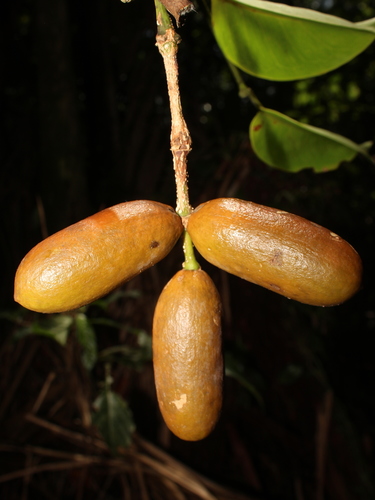
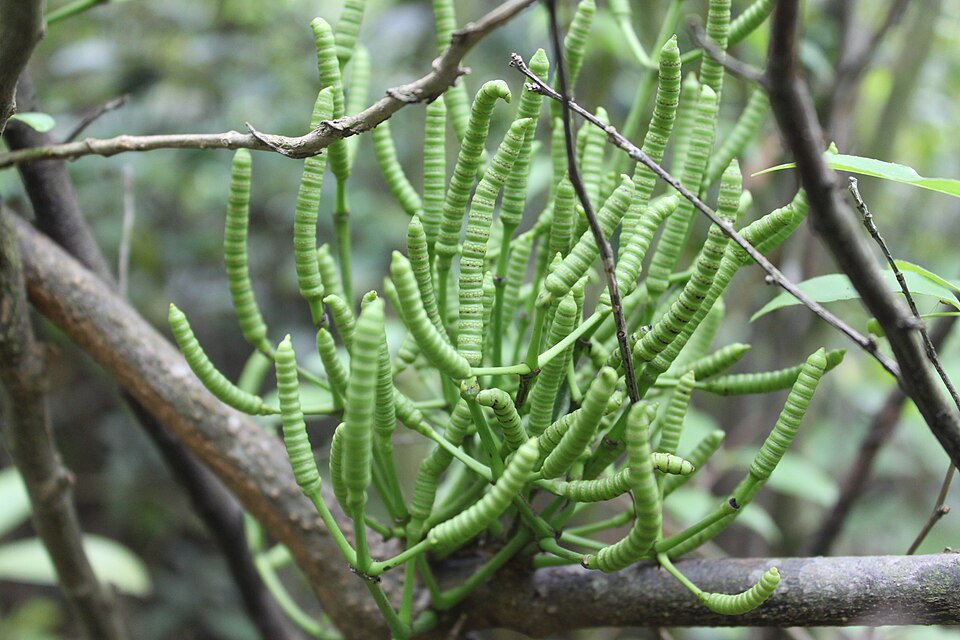
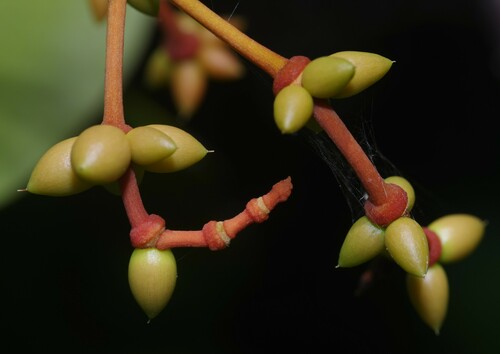
A large semi-climber. It grows from 5 to 20 m long. The branches are in pairs. The leaves are large - leaflets 20 x 56 cm. The spike like flower grows on old wood. The fruit is an oval nut. The outside of the fruit is green but turns red to orange.
Edible Uses
The leaves and fruit are eaten, with seeds being the primary preparation—roasted or boiled.
Traditional Uses
The leaves and fruit are sometimes eaten. The seeds are eaten cooked. They are roasted or boiled.
This uses section is brief — help expand it
Distribution
A tropical plant. It grows in lowlands near mangroves. It can be up to 1,800 m above sea level.
Where It Grows
Andamans, Asia, Cambodia, India, Indochina, Indonesia, Laos, Malaysia, Myanmar, Pacific, Papua New Guinea, PNG, Philippines, SE Asia, Solomon Islands, Thailand, Vietnam,
Cultivation
Plants can be grown from seeds.
Other Uses
The fibre of the inner bark is used for twisting thread, string and cordage. Of excellent quality, it is strong and durable in seawater.
Notes
There are about 28 Gnetum species.
Synonyms
Also Known As
Akar keliat, Akar suburus, Akar tutubo, Banga Itu, Boitu, Day gam la rong, Kwala uku, Kwalo uku, Nubatula, Oyod esoh, Oyod tangkil, Sakilkil, Tangkil, Waro kuku
References (23)
- Ambasta, S.P. (Ed.), 2000, The Useful Plants of India. CSIR India. p 241
- Borrell, O W., 1989, An Annotated Checklist of the Flora of Kairiru Island, New Guinea. Marcellin College. Victoria. P 11, 153.
- Burkill, I.H., 1966, A Dictionary of the Economic Products of the Malay Peninsula. Ministry of Agriculture and Cooperatives, Kuala Lumpur, Malaysia. Vol 1 (A-H) p 1110
- Burkill, I.H., 1966, A Dictionary of the Economic Products of the Malay Peninsula. Ministry of Agriculture and Cooperatives, Kuala Lumpur, Malaysia. Vol 1 (A-H) p 1109 (As Gnetum funiculare)
- Dobriyal, M. J. R. & Dobriyal, R., 2014, Non Wood Forest Produce an Option for Ethnic Food and Nutritional Security in India. Int. J. of Usuf. Mngt. 15(1):17-37
Show all 23 references Hide references
- Evans, B. R, 1999, Edible nut Trees in Solomon Islands. A variety collection of Canarium, Terminalia and Barringtonia. ACIAR Technical Report No. 44 96pp
- French, B.R., 2010, Food Plants of Solomon Islands. A Compendium. Food Plants International Inc. p 72
- Henderson, C.P. and I.R. Hancock, 1988, A Guide to the Useful Plants of the Solomon Islands. Res. Dept. Min of Ag. & Lands. Honiara, Solomon Islands. p 78
- Heyne, K., 1927, p 124 (As Gnetum funiculare)
- Plants of Papua New Guinea LAE herbarium record
- Menninger, E.A., 1977, Edible Nuts of the World. Horticultural Books. Florida p 159
- Milow, P., et al, 2013, Malaysian species of plants with edible fruits or seeds and their evaluation. International Journal of Fruit Science. 14:1, 1-27
- Mohd, N. G. et al, 2014, A Preliminary Flora Survey in Gunung Kajang, Pulau Tioman, Pahang Darul Makmur, Malaysia. Malays. Appl. Biol. 43(2): 17-23
- Naess, A., 2017, A short dictionary of Aiwoo. Asia Pacific Linguistics, ANU.
- Peekel, P.G., 1984, (Translation E.E.Henty), Flora of the Bismarck Archipelago for Naturalists, Division of Botany, Lae, PNG. p 37, 36
- Pham-Hoang Ho, 1999, An Illustrated Flora of Vietnam. Nha Xuat Ban Tre. p 217
- Phon, P., 2000, Plants used in Cambodia. © Pauline Dy Phon, Phnom Penh, Cambodia. p 320
- PROSEA (Plant Resources of South East Asia) handbook, Volume 2, 1991, Edible fruits and nut. p
- Sang, D. T., & Mizoue, K. O. N., 2012, Use of Edible Forest Plants among Indigenous Ethnic Minorities in Cat Tien Biosphere Reserve, Vietnam. Asian Journal of Biodiversity Vol. 3 (1), p 23-49
- Sukarya, D. G., (Ed.) 2013, 3,500 Plant Species of the Botanic Gardens of Indonesia. LIPI p 933
- Tanaka, Y & Van Ke, N., 2007, Edible Wild Plants of Vietnam. Orchid Press. p 84
- Walter, A. & Sam C., 2002, Fruits of Oceania. ACIAR Monograph No. 85. Canberra. p 178, 280
- Wickens, G.E., 1995, Edible Nuts. FAO Non-wood forest products. FAO, Rome. p175