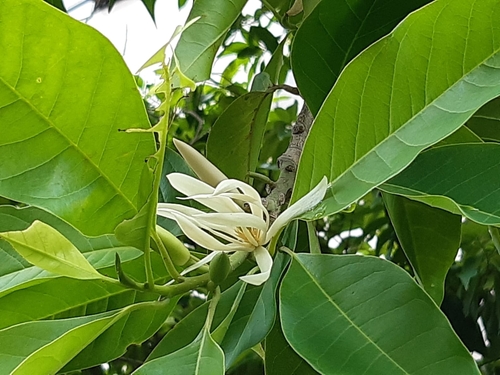
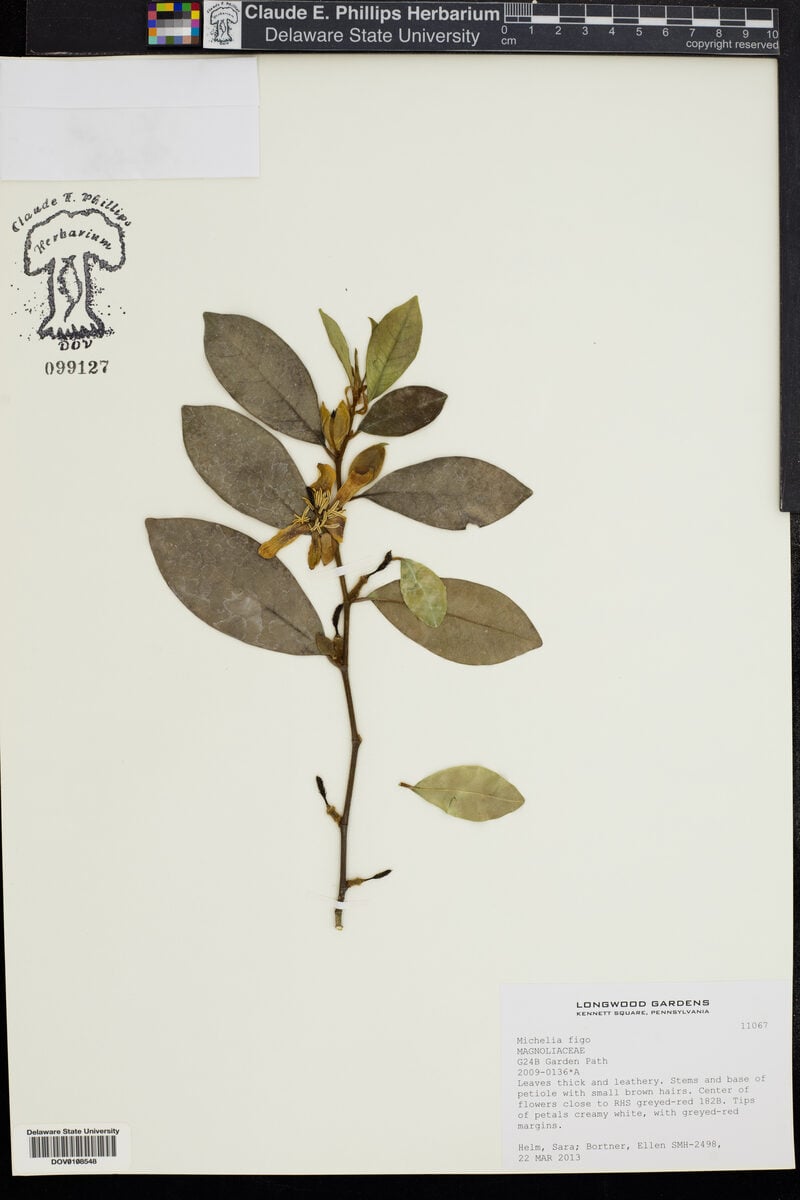
Magnolia champaca
Linn.
Champac, India magnolia tree
iNaturalist· cc-by-sa
(c) Ong Jyh Seng, some rights reserved (CC BY-SA), uploaded by Ong Jyh Seng
iNaturalist· cc-by-nc
(c) rileyrubiadelta, some rights reserved (CC BY-NC)
Summary
Source: WikipediaMagnolia champaca, known in English as champak (), is a large evergreen tree in the family Magnoliaceae. It was previously classified as Michelia champaca. It is known for its fragrant flowers, and its timber used in woodworking.
Description
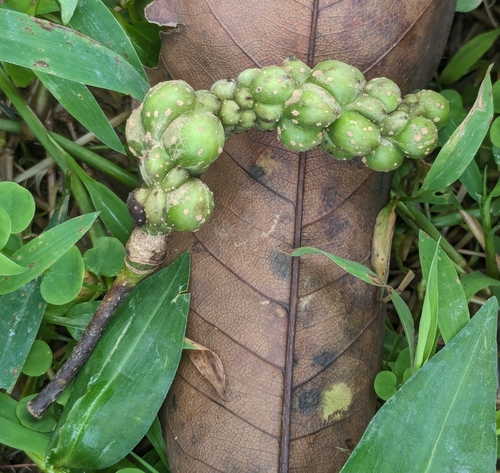
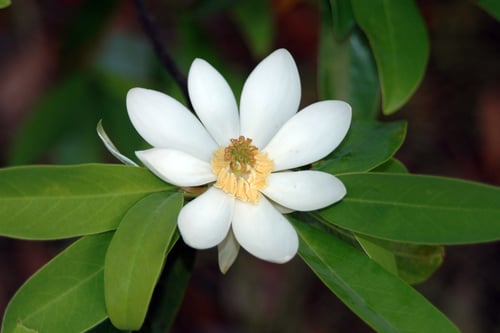
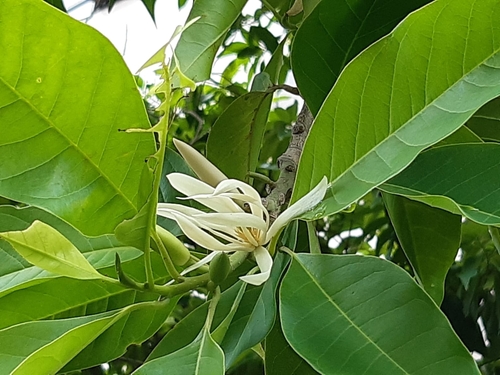
A tree. It is tall and evergreen. It is usually 10-12 m high but can be 30 m high. The trunk is straight. The bark is greenish-brown. The branches bend upwards to form a dense crown. The leaves are smooth and leathery. They are oval or sword shaped. They are slightly hairy on the lower surface. They are 15-25 cm long by 5-8 cm wide. The leaf stalk is grooved. The flowers are golden-yellow. They are 5-6 cm across. They have a sweet smell. The grow singly from the axils of leaves. The fruit occur in a cluster. They are woody and oval. They contain angular seeds with a brown or pink covering. There are 2-6 seeds in a follicle.
Edible Uses
The fruits and seeds are eaten. The flowers are also edible. The bark is sometimes used as a spice and has been recorded as an adulterant for cinnamon.
Traditional Uses
The fruit are recorded as eaten. The bark is sometimes used to adulterate cinnamon.
This uses section is brief — help expand it
Medicinal Uses
The fruit is used in medicine.
Distribution
A tropical plant. It is native to the Himalayas, India and China. It is common all over India. It grows in humid evergreen forest. It gets damaged by hot dry climates. It does best in rich, slightly acid soil. It cannot stand water-logging. It suits hardiness zones 10-11. Melbourne Botanical Gardens. Mt Cootha Botanical Gardens. In XTBG Yunnan.
Where It Grows
Africa, Andamans, Asia, Australia, Bangladesh, Central America, China, Dominican Republic, East Africa, FSM, Hawaii, Himalayas, India, Indochina, Indonesia, Laos, Malaysia, Myanmar, Nepal, Northeastern India, Pacific, Pakistan, Philippines, Pohnpei, SE Asia, Sikkim, Slovenia, Sri Lanka, Thailand, USA, Vietnam, West Africa, West Indies, Zimbabwe,
Cultivation
It is easily grown from seed. Seed should be sown fresh. It can also be grown using stem cuttings.
Propagation
The seeds are oily and quickly lose their viability, so should be sown as soon as possible after harvesting It is best sown in a shady position then moved into more light when the seed has germinated. Germination takes from 5 weeks to 4 months. The germination rate of the seed is generally poor. The seedlings are pricked into containers when 2 to 4 cm tall and left to grow for 1 year in the nursery. They can be planted out when they are 30 to 40 cm in height. Seed storage behaviour is probably orthodox. Seed viability can be maintained by moist storage at 5°c for about 7 months or in pits at 13°c for about 4 months. Grafting. Cuttings. Extracts of girdled and etiolated shoots contained a higher level of root-promoting substances than shoots that were only girdled or fresh shoots. The best rooting (93.3 percent) and survival of rooted layers (92.1 percent) were obtained with pregirdled and etiolated layers treated with indole butyric acid at 5000 ppm.
Other Uses
The flowers yield an essential oil known as champa or champaca oil. It is used in perfumery. Another essential oil, known as Michelia leaf oil, is extracted from the leaves. The sweetly scented flowers are used in India for hair adornment. A yellow dye is obtained from the flowers. Analyses of seeds showed a low kernel content of around 20%. However, the oil content of each kernel is fairly high at 32.2%, which gives it potential for commercial exploitation for oil production for various uses. The leaf extract is toxic to the rice fungus, Pyricularia oryzae. The heartwood is olive-brown turning to dark brown with a greenish tinge upon exposure, it is clearly differentiated from the pale brown, up to 8 cm wide sapwood. The wood is soft, light and even-grained.. The heartwood is strong, durable, and capable of taking a high polish. The grain is straight or slightly interlocked, texture fine to moderately fine and even. Michelia wood is nicely figured and is used for furniture, cabinetwork, carvings, turnery and pattern making; it has also been used for cement-bonded wood-wool board. In India it has been recommended to ring girdle trees about 3 years before felling to prevent possible warping and checking of the wood. The tree is used as fuel wood, the gross energy value of the heartwood is about 21 070 kJ/kg. The tree is used to reforest badly eroded areas in Java. Soil under tree cover shows an increase in pH, soil organic carbon and available phosphorus.
Production
It is fast growing.
Notes
There are 47 Michelia species. They grow in tropical and subtropical Asia. It is grown as an ornamental because of the sweet flowers.
Synonyms
Also Known As
Aule champ, Bolnabat, Cempaka, Chambugan, Champa, Champaga, Champak, Champakamu, Champi, Champo, Chempa, Chempaka, Chompa, Chompoko, Jampa, Jampaka, Kanchana, Kantil, Kawenios, Kola-sampige, Kud-champa, Laran, Lecari, Lochari, Mawk-sam-lung, Mulana, Mulang, Ngoc lan, Ouliachamp, Pechari, Pito-champo, Pivala-champa, Pohon cempaka India, Pohon manglid baros, Sagawa, Sampige, Sapu, Shap, Shembuga, Sona-champa, Titasopa, Tsampaka, Wong lan
References (33)
- Ambasta, S.P. (Ed.), 2000, The Useful Plants of India. CSIR India. p 369 (As Michelia champaca)
- Barwick, M., 2004, Tropical and Subtropical Trees. A Worldwide Encyclopedic Guide. Thames and Hudson p 275 (As Michelia champaca)
- Bole, P.V., & Yaghani, Y., 1985, Field Guide to the Common Trees of India. OUP p 25 (As Michelia champaca)
- Bremness, L., 1994, Herbs. Collins Eyewitness Handbooks. Harper Collins. p 66 (As Michelia champaca)
- Burkill, I.H., 1966, A Dictionary of the Economic Products of the Malay Peninsula. Ministry of Agriculture and Cooperatives, Kuala Lumpur, Malaysia. Vol 2 (I-Z) p 1489 (As Michelia champaca)
Show all 33 references Hide references
- Cundall, P., (ed.), 2004, Gardening Australia: flora: the gardener's bible. ABC Books. p 893 (As Michelia champaca)
- Dharani, N., 2002, Field Guide to common Trees & Shrubs of East Africa. Struik. p 128 (As Michelia champaca)
- Engel, D.H., & Phummai, S., 2000, A Field Guide to Tropical Plants of Asia. Timber Press. p 60, 107 (As Michelia champaca)
- Etherington, K., & Imwold, D., (Eds), 2001, Botanica's Trees & Shrubs. The illustrated A-Z of over 8500 trees and shrubs. Random House, Australia. p 479 (As Michelia champaca)
- Facciola, S., 1998, Cornucopia 2: a Source Book of Edible Plants. Kampong Publications, p 146 (As Michelia champaca)
- Flora of Pakistan. www.eFloras.org (As Michelia champaca)
- Gardner, S., et al, 2000, A Field Guide to Forest Trees of Northern Thailand, Kobfai Publishing Project. p 33 (As Michelia champaca)
- Hedrick, U.P., 1919, (Ed.), Sturtevant's edible plants of the world. p 414 (As Michelia champaca)
- Hibbert, M., 2002, The Aussie Plant Finder 2002, Florilegium. p 196 (As Michelia champaca)
- http://www.botanic-gardens-ljubljana.com/en/plants
- Krishen P., 2006, Trees of Delhi, A Field Guide. DK Books. p 83 (As Michelia champaca)
- Liu, Yi-tao, & Long, Chun-Lin, 2002, Studies on Edible Flowers Consumed by Ethnic Groups in Yunnan. Acta Botanica Yunnanica. 24(1):41-56 (As Michelia champaca)
- Llamas, K.A., 2003, Tropical Flowering Plants. Timber Press. p 250 (As Michelia champaca)
- Miya, M. S. & Gautum, D., 2021, Checklist of floral species at the Institute of Forestry, Pokhara Campus, Pokhara, Nepal. Journal of Institute of Forestry, Nepal 18 (2021) 133-177 (As Michelia champaca)
- Morley, B. & Everard, B., 1970, Wild Flowers of the World. Ebury press. Plate 110 (As Michelia champaca)
- NYBG herbarium "edible" (As Michelia champaca)
- Recher, P, 2001, Fruit Spirit Botanical Gardens Plant Index. www.nrg.com.au/~recher/ seedlist.html p 6 (As Michelia champaca)
- Sahni, K.C., 2000, The Book of Indian Trees. Bombay Natural History Society. Oxford. p 18 (As Michelia champaca)
- Savita, et al, 2006, Studies on wild edible plants of ethnic people in east Sikkim. Asian J. of Bio Sci. (2006) Vol. 1 No. 2 : 117-125 (As Michelia champaca)
- Singh, H.B., Arora R.K.,1978, Wild edible Plants of India. Indian Council of Agricultural Research, New Delhi. p 78 (As Michelia champaca)
- Sp. pl. 1:536. 1753 (As Michelia champaca)
- Staples, G.W. and Herbst, D.R., 2005, A tropical Garden Flora. Bishop Museum Press, Honolulu, Hawaii. p 377 (As Michelia champaca)
- Sukarya, D. G., (Ed.) 2013, 3,500 Plant Species of the Botanic Gardens of Indonesia. LIPI p 374
- Swaminathan, M.S., and Kochnar, S.L., 2007, An Atlas of Major Flowering Trees in India. Macmillan. p 16 (As Michelia champaca)
- Trimanto, & Hapsari L., 2016, Botanical survey in thirteen montane forests of Bawean Island Nature Reserve, East Java Indonesia: Conservation status, bioprospecting and potential tourism. Biodiversitas 17: 832-846. (As Michelia champaca)
- Tsering, J., et al, 2017, Ethnobotanical appraisal on wild edible plants used by the Monpa community of Arunchal Pradesh. Indian Journal of Traditional Knowledge. Vol 16(4), October 2017, pp 626-637
- Valder, P., 1999, The Garden Plants of China. Florilegium. p 134 (As Michelia champaca)
- World Checklist of Useful Plant Species 2020. Royal Botanic Gardens, Kew