Ficus semicordata
Buch.-Ham. ex Smith
Chicken crop fig, Fodder fig, Wedgeleaf fig
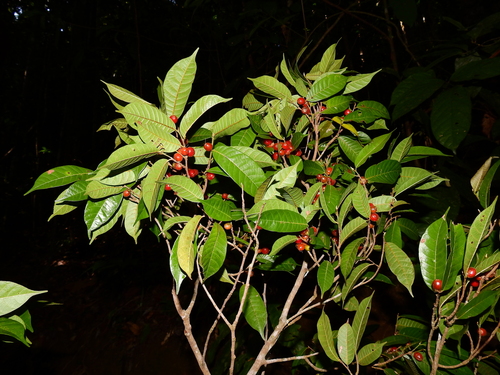
iNaturalist· cc-by-nc-sa
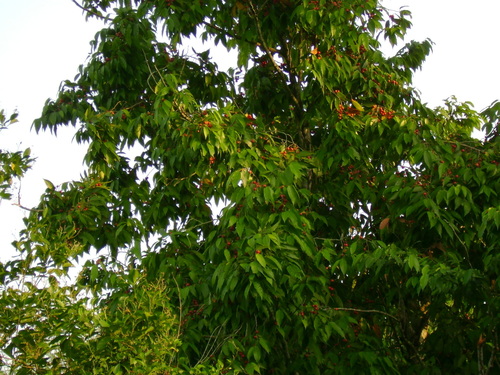
(c) Phuentsho, some rights reserved (CC BY-NC-SA), uploaded by Phuentsho
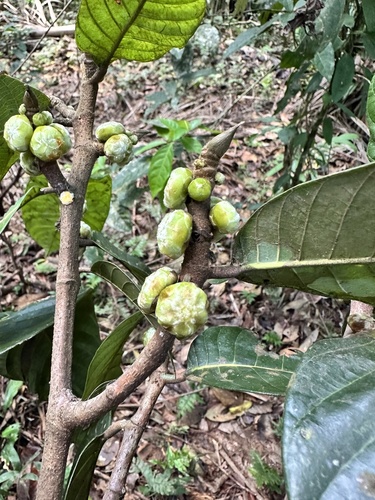
iNaturalist· cc-by-nc
(c) onidiras-iNaturalist, some rights reserved (CC BY-NC)
Summary
Source: WikipediaFicus semicordata, commonly known as the drooping fig, is a small to medium-sized fodder tree of genus Ficus. It bears edible fruit. The figs on the lower part of the leafless branches may develop in leaf litter and humus, and be buried in the surface of the soil, where the seeds germinate. Otherwise birds and other animals distribute the seeds. Ficus semicordata is dioecious, with male and female flowers produced on separate individuals.
Description
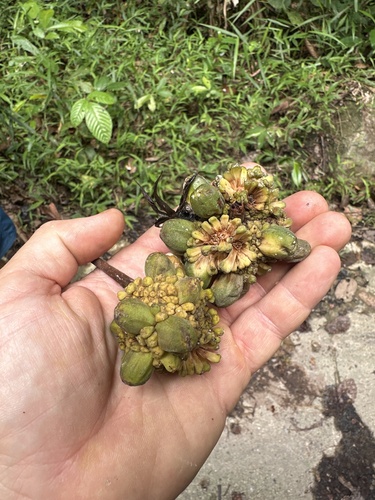
A fig. It is a tree. It grows to about 3-10 m high. The trunk is 15-25 cm across. The crown is flat and umbrella like. The bark is grey and smooth. The small branches are covered with a white or brown covering. The leaf like structure at the base of the leaves is red and sword shaped and 2-3.5 cm long. The leaf stalk is 5-10 mm long and thick. The leaves are alternate. They are 10-28 cm long by 4-12 cm wide. The are sword shaped with a long point. They have a rough texture but are papery. They have teeth in the upper half of the leaf. The base is unequal with 2 lobes. There are 10-14 secondary veins on each side of the main vein. The figs occur in pairs on short stalks on old stems. They can be clustered on leafless scaly branches. They are pear shape and with a rough texture. They are reddish-brown when ripe. They are 1-1.5 cm across.
Edible Uses
Ripe figs are eaten raw or made into jam, while unripe fruit are cooked. Young shoots and leaves are cooked and eaten as vegetables or in soup. Leaves can be stored 4-5 days after harvest.
Traditional Uses
The ripe figs are eaten raw. They are also made into jam. The unripe fruit are cooked. The young shoots and leaves are cooked and eaten as a vegetable. They are also used in soup. The leaves can be stored for 4-5 days after harvest.
Medicinal Uses
The juice of the roots is applied to treat headaches, and is also recommended for fevers and menstrual disorders. The bark, combined with Schima wallichii and Syzygium cumini, is used to treat gastric troubles and peptic ulcers. The immature fruit is used to treat constipation. A paste of the fruit is applied to the forehead to relieve headaches. The latex is used to treat children with fevers.
Distribution
A tropical plant. In Nepal they grow up to 1800 m altitude. They grow in open places. It requires light and humidity. In China they grow on the edges of forests and along trails in S China. They grow between 700-1300 m altitude. In Northeastern India it grows between 1,600-2,100 m above sea level. In XTBG Yunnan.
Where It Grows
Asia, Bangladesh, Bhutan, China, Himalayas, India, Indochina, Laos, Malaysia, Myanmar, Nepal, Northeastern India, Pakistan, SE Asia, Sikkim, Thailand, Tibet, Vietnam,
Cultivation
Plants can be grown from seed or cuttings.
Propagation
Seed - germinates best at a temperature around 20°c. Air layering. Tip cuttings around 4 - 12cm long, taken from lateral branches.
Other Uses
The bark yields a fibre used in making ropes.
Production
In India fruit are available October to January.
Notes
There are about 800-1000 Ficus species. They are mostly in the tropics. There are 120 Ficus species in tropical America. It is grown as a street or shade tree.
Synonyms
Also Known As
Amin-sep, Bommamarri, Bu luo biu, Chiede, Co not, Dieng-thylliang-sang, Drong-ma, Dudila, Dumbur, Garagasa, Gele, Heiri, Heirit, Heiyeet, Hu gan da pa, Jagyadumur, Jahrphali, Ji su zi rong, Joharphali, Ka-dut, Kandrol, Khain, Khaina, Khanayo, Khanew, Khanim, Khaniu, Khaniyo, Khanneu, Khannyo, Khanyu, Kharapatra, Khasrey khaniu, Khenan, Khewan, Khinne, Khinyau, Khiriya, Khon, Khunia, Khurhu, Khurhur, Kokshi, Koronem, Kuku, Kurali, Luobo, Manod nam, Mowa dhu, Mule lum biu, Nua, Perina, Porodumer, Poroh, Ridongsheng, Sadimadi, Sadusi, Sigeiyao, Si guo si, Sorbek gulo, Taikhro, Takuk esing, Taragadi, Teregam, Thaikhro, Tha-phan, Theiput, Toku, Xigu, Xigugu ma
References (72)
- Acharya K. P. and Acharya, R., 2010, Eating from the Wild: Indigenous knowledge on wild edible plants in Parroha VDC of Rupandehi District, Central Nepal. International Journal of Social Forestry. 3(1):28-48
- Ambasta, S.P. (Ed.), 2000, The Useful Plants of India. CSIR India. p 221 (As Ficus cunia)
- Anderson, E. F., 1993, Plants and people of the Golden Triangle. Dioscorides Press. p 211
- Angami, A., et al, 2006, Status and potential of wild edible plants of Arunachal Pradesh. Indian Journal of Traditional Knowledge 5(4) October 2006, pp 541-550 (As Ficus cunia)
- Aryal, K. P. et al, 2009, Uncultivated Plants and Livehood Support - A case study from the Chepang people of Nepal. Ethnobotany Research and Applications. 7:409-422
Show all 72 references Hide references
- Aryal, K. P., et al, 2018, Diversity and use of wild and non-cultivated edible plants in the Western Himalaya. Journal of Ethnobiology and Ethnomedicine (2018) 14:10
- Bajpai, O., et al, 2015, Tree species of the Himalayan Terai region of Uttar Pradesh, India: a checklist. Check List 11(4): 1718
- Bajracharya, D., 1980, Nutritive Values of Nepalese Edible Wild Fruits. Z. Lebensm. Unters. Forsch. 171: 363-366 (As Ficus cunia)
- BARC, 2016, State of Biodiversity for Food and Agriculture in Bangladesh. Bangladesh Agricultural Research Council.
- Baro, D., Baruah, S. and Borthukar, S. K. 2015, Documentation on wild vegetables of Baksa district, BTAD (Assam). Scholars Research Library. Archives of Applied Science Research, 2015, 7 (9):19-2
- Burkill, I.H., 1966, A Dictionary of the Economic Products of the Malay Peninsula. Ministry of Agriculture and Cooperatives, Kuala Lumpur, Malaysia. Vol 1 (A-H) p 1023 (As Ficus cunia)
- Cao, Y., et al, 2020, Ethnobotanical study on wild edible plants used by three trans-boundary ethnic groups in Jiangcheng County, Pu’er, Southwest China. Journal of Ethnobiology and Ethnomedicine (2020) 16:66
- Chase, P. & Singh, O. P., 2016, Bioresources of Nagaland: A Case of Wild 4 Edible Fruits in Khonoma Village Forest. in J. Purkayastha (ed.), Bioprospecting of Indigenous Bioresources of North-East India. p 50
- Cheng, Z., et al, 2022, Ethnobotanical study on wild edible plants used by Dulong people in northwestern Yunnan, China. Journal of Ethnobiology and Ethnomedicine (2022) 18:3
- Dangol, D. R. et al, 2017, Wild Edible Plants in Nepal. Proceedings of 2nd National Workshop on CUAOGR, 2017.
- Delang, C. O., 2007, Ecological Succession of Usable Plants in an Eleven-Year Fallow Cycle in North Lao P.D.R., Ethnobotany Research and Applications. Vol. 5:331-350
- Devi, O.S., P. Komor & D. Das, 2010, A checklist of traditional edible bio-resources from Ima markets of Imphal Valley, Manipur, India. Journal of Threatened Taxa 2(11): 1291-1296 (As Ficus cunia)
- Dutta, U., 2012, Wild Vegetables collected by the local communities from the Churang reserve of BTD, Assam. International Journal of Science and Advanced Technology. Vol. 2(4) p 121
- Flora of China.
- Flora of Pakistan. www.eFloras.org
- Forest Inventory and Planning Institute, 1996, Vietnam Forest Trees. Agriculture Publishing House p 541 (As Ficus cunia)
- Gamble, J. S., 1878, List of trees, shrubs and climbers from Darjeeling. (As Ficus cunia)
- Gangwar, A. K. & Ramakrishnan, P. S., 1990, Ethnobotanical Notes on Some Tribes of Arunachal Pradesh, Northeastern India. Economic Botany, Vol. 44, No. 1 pp. 94-105 (As Ficus cunia var. semicordata)
- Gautam, R. S., et al, 2020, Wild Edible Fruits of Nepal. Int. J. Appl. Sci. Biotechnol. Vol 8(3): 289-304
- Ghimeray, A. K., Lamsal, K., et al, 2010, Wild edible angiospermic plants of the Illam Hills (Eastern Nepal) and their mode of use by local community. Korean J. Pl. Taxon. 40(1)
- Ghorbani, A., et al, 2012, A comparison of the wild food plant use knowledge of ethnic minorities in Naban River Watershed Nature Reserve, Yunnan, SW China. Journal of Ethnobiology and Ethnomedicine; 8:17
- GUPTA, (As Ficus cunia)
- Hedrick, U.P., 1919, (Ed.), Sturtevant's edible plants of the world. p 307 (As Ficus cunia)
- Jeeva, S., 2009, Horticultural potential of wild edible fruits used by the Khasi tribes of Meghalaya. Journal or Horticulture and Forestry Vol. 1(9) pp. 182-192 (As Ficus cunia)
- Jin, Chen et al, 1999, Ethnobotanical studies on Wild Edible Fruits in Southern Yunnan: Folk Names: Nutritional Value and Uses. Economic Botany 53(1) pp 2-14
- Khakurel, D., et al, 2021, Foods from the wild: Local knowledge, use pattern and distribution in Western Nepal. PLOS ONE.
- Khan, D. & Shaukat, S.S., 2006, The Fruits of Pakistan: Diversity, Distribution, Trends of Production and Use. Int. J. Biol. Biotech., 3(3):463-499
- Kumar, A., et al, 2011, Assessment of Diversity in the Genus Ficus L. (Moraceae) of Katerniaghat Wildlife Sanctuary, Uttar Pradesh, India. American Journal of Plant Sciences, 2011, 2, 78-92
- Kunwar, R. M., & Bussmann, R. A., 2006, Ficus (Fig) species in Nepal: a review of diversity and indigenous uses. Lyonia 11(1)
- Kunwar, R.M., et al, 2012, Underutilized Plant Species in Far West Nepal. J. Mt. Sci. (2012) 9:589-600
- Lalfakzuala, R., 2007, Ethnobotanical usages of plants in western Mizoram. Indian Journal of Traditional Knowledge. Vol 6(3) pp 480-493
- Li, S., et al, 2020, Monpa, memory, and change: an ethnobotanical study of plant use in Mêdog County, South-east Tibet, China. Journal of Ethnobiology and Ethnomedicine. (2020) 16:5 p 20
- Liu, Yi-tao, & Long, Chun-Lin, 2002, Studies on Edible Flowers Consumed by Ethnic Groups in Yunnan. Acta Botanica Yunnanica. 24(1):41-56
- Luo, B., et al, 2019, Wild edible plants collected by Hani from terraced rice paddy agroecosystem in Honghe Prefecture, Yunnan, China. Journal of Ethnobiology and Ethnomedicine 15:56
- Manandhar, N.P., 2002, Plants and People of Nepal. Timber Press. Portland, Oregon. p 235
- Manju, S., and Sundriyal, R. C., 2001, Wild Edible Plants of the Sikkim Himalaya: Nutritive Values of Selected Species. Economic Botany 55(3): 377-390
- Mehta, P. S. et al, 2010, Native plant genetic resources and traditional foods of Uttarakhand Himalaya for sustainable food security and livelihood. Indian Journal or Natural products and Resources. Vol 1(1), March 2010 pp 89-96 (Also as Ficus cunia)
- Meitei, L. R., et al, 2022, An ethnobotanical study on the wild edible plants used by forest dwellers in Yangoupokpi Lokchao Wildlife Sanctuary, Manipur, India. Ethnobotany Research and Application 23:15
- Misra S. & Misra M., 2016, Ethnobotanical and Nutritional Evaluation of Some Edible Fruit Plants of Southern Odisha, India. International Journal of Advances in Agricultural Science and Technology, Vol.3 Issue.1, March- 2016, pg. 1-30
- Mon, A. M., 2020, The uses of fig (Ficus) by five ethnic minority communities in Southern Shan State, Myanmar. Journal of Ethnobiology and Ethnomedicine (2020) 16:55
- Mozhui, R., et al, 2011, Wild edible fruits used by the tribals of Dimapur district of Nagaland, India. Pleione 5(1): 56 - 64.
- Mukhia, P.K., et al, 2013, Wild plants as Non Wood Forest Products used by the rural community of Dagana, a southern foothill district of Bhutan, SAARC Journal, 27 pages
- Patiri, B. & Borah, A., 2007, Wild Edible Plants of Assam. Geethaki Publishers. p 137
- Pegu, R., et al, 2013, Ethnobotanical study of Wild Edible Plants in Poba Reserved Forest, Assam, India. Research Journal of Agriculture and Forestry Sciences 1(3):1-10
- Polunin, O., & Stainton, A., 2006, Flowers of the Himalaya, Oxford India Paperbacks. p 370
- Radha, B., et al, 2013, Wild Edible Plant Resources of the Lohba Range of Kedarnath Forest Division (KFD), Garhwal Himalaya, India. Int. Res J. Biological Sci. Vol. 2 (11), 65-73
- Rajkalkshmi, P. et al, 2001, Total carotenoid and beta-carotene contents of forest green leafy vegetables consumed by tribals of south India. Plant Foods for Human Nutrition 56:225-238 (As Ficus cunia)
- Rijal, A., 2011, Surviving on Knowledge: Ethnobotany of Chepang community from mid-hills of Nepal. Ethnobotany Research & Applications 9:181-215
- Sarma, H., et al, 2010, Updated Estimates of Wild Edible and Threatened Plants of Assam: A Meta-analysis. International Journal of Botany 6(4): 414-423
- Savita, et al, 2006, Studies on wild edible plants of ethnic people in east Sikkim. Asian J. of Bio Sci. (2006) Vol. 1 No. 2 : 117-125 (As Ficus cunia)
- Sawian, J. T., et al, 2007, Wild edible plants of Meghalaya, North-east India. Natural Product Radiance Vol. 6(5): p 417 (As Ficus cunia)
- Sharma, G., et al, 2016, Agrobiodiversity in the Sikkim Himalaya. International Centre for Integrated Mountain Development, ICIMOD Working Paper 2016/5 p 20 (As Ficus cunea and var. montana)
- Shi, Y. et al, 2014, An ethnobotanical study of the less known wild edible figs (genus Ficus) native to Xishuangbanna Southwest China. Journal of Ethnobiology and Ethnomedicine. 10:68
- Shin, T., et al, 2018, Traditional knowledge of wild edible plants with special emphasis on medicinal uses in Southern Shan State, Myanmar. Journal of Ethnobiology and Ethnomedicine (2018) 14:48
- Singh, P.K., Singh, N.I., and Singh, L.J., 1988, Ethnobotanical Studies on Wild Edible Plants in the Markets of Manipur - 2. J. Econ. Tax. Bot. Vol. 12 No. 1 pp 113-119 (As Ficus cunia)
- Singh, H.B., Arora R.K.,1978, Wild edible Plants of India. Indian Council of Agricultural Research, New Delhi. p 60
- Sundriyal, M., et al, 2004, Dietary Use of Wild Plant Resources in the Sikkim Himalaya, India. Economic Botany 58(4) pp 626-638
- Sundriyal, M. & Sundriyal, R. C., 2004, Structure, Phenology, Fruit Yield, and Future Prospects of some Prominent Wild Edible Plant Species of the Sikkim Himalaya, India. Journal of Ethnobiology 24(1): 113-138 (As Ficus cunia)
- Taram, M., et al, 2018, Wild Food Plant Resources of Komkar Adi Tribe of Upper Siang District in Arunachal Pradesh, India. Bulletin of Arunachal Forest Research, Vol. 33(2), 27-35
- Tewari, D.N., 1994, Important Plants of India. International Book Distributors, India. p 24
- Thapa, L. B., et al, 2014, Wild Edible Plants used by endangered and Indigenous Raji Tribe in Western Nepal. International Journal of Applied Sciences and Biotechnology. Vol 2(3):243-252
- Tsering, J., et al, 2017, Ethnobotanical appraisal on wild edible plants used by the Monpa community of Arunchal Pradesh. Indian Journal of Traditional Knowledge. Vol 16(4), October 2017, pp 626-637
- Upreti, K., et al, 2010, Diversity and Distribution of Wild Edible Fruit Plants of Uttarakhand. Bioversity Potentials of the Himalaya. p 172
- Uprety, Y., et al, 2011, Plant biodiversity and ethnobotany inside the projected impact area of the Upper Seti Hydropower Project, Western Nepal. Environ. Dev. Sustain. (2011) 13:463-492
- Uprety, Y., et al, 2012, Diversity of use and local knowledge of wild edible plant resources in Nepal. Journal of Ethnobotany and Ethnomedicine 8:16
- World Checklist of Useful Plant Species 2020. Royal Botanic Gardens, Kew
- www.eFloras.org. Flora of China