Buchanania axillaris
(Desr.) Ramamoorthy
Buchanan mango
iNaturalist· cc-by
(c) Siddarth Machado, some rights reserved (CC BY), uploaded by Siddarth Machado
iNaturalist· cc0
no rights reserved
Summary
Source: WikipediaBuchanania axillaris, the Cuddapah almond or Buchanan's mango, (മലയാളം: കുളമാവ്) is a species of flowering plant in the family Anacardiaceae. The native range of this species is India, Sri Lanka.
Description
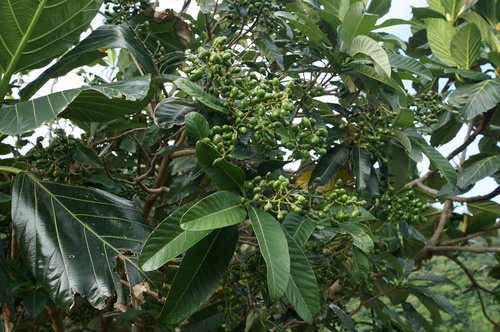
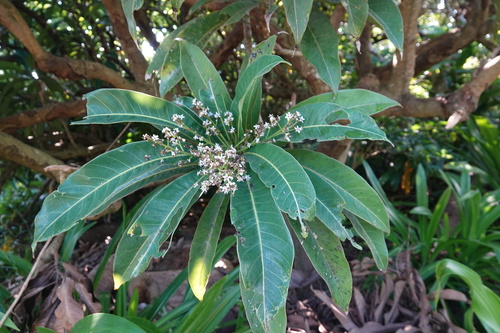
A tree. It grows 10-15 m tall. It loses its leaves during the year. The bark is rough and deeply cracked. The leaves are alternate or in spirals and simple. The leaves are narrowly oblong and rounded at the base. They are 8-15 cm long by 3-5 cm wide. The flowers are 3-6 mm across. They are in branched groups at the ends of branches or in the axils of leaves. They are greenish white. The fruit are an oblique round shape. They are 1.3 cm across. There is one seed.
Edible Uses
Both the ripe fruit and the nuts from the fruit are eaten fresh, and the nuts are also used in drinks. The nuts are commercially sold.
Traditional Uses
The nuts from the fruit are eaten. The ripe fruit are also eaten. The nuts are also included in drinks.
This uses section is brief — help expand it
Medicinal Uses
The kernel of the seeds are edible. The seeds contain 19% proteins, 59.1% fat, 3.8% fibres, 12.1% carbohydrates and minerals at the value of 3 grams per 100 grams and the calorific value of the seeds are 656 K kal/100 g. The seed kernel and bark is used in the form of decoction to treat intrinsic haemorrhage, diarrhoea with blood and as tonic. Seed kernels were made into a powder and used with milk as an aphrodisiac, powder of the bark mixed with honey is useful in dysentery with blood.
Distribution
A tropical plant. It grows in evergreen forests.
Where It Grows
Asia, India, Sri Lanka,
Other Uses
The greyish-brown wood is moderately hard. It is not used.
Other Information
The nuts are sold in shops.
Notes
There are about 25 Buchanania species.
Nutrition
| Part | Moisture | kJ | kcal | Protein | Vit A | Vit C | Iron | Zinc |
|---|---|---|---|---|---|---|---|---|
| Nuts | — | 656 | 19 | — | — | — | — | — |
Synonyms
Also Known As
Cheran maram, Cuddapah almond, Kolamavu, Kulamavu, Mudamaa, Mudamah, Malamavu, Pedda morli, Pedda sara, Piyala, Pulima, Saraparuppu, Sarappappu
References (8)
- Ambasta S.P. (Ed.), 2000, The Useful Plants of India. CSIR India. p 89
- Basha, S. K. M., Ethnobotanical Trees of Sri Lanka Malleswara Wildlife Sanctuary; Eastern Ghats, Andhra Pradesh.
- Chandrashekara, U. M., 2009, Tree species yielding edible fruit in the coffee-based homegardens of Kerala, India: their diversity, uses and management. Food Sec. 1:361-370
- Dobriyal, M. J. R. & Dobriyal, R., 2014, Non Wood Forest Produce an Option for Ethnic Food and Nutritional Security in India. Int. J. of Usuf. Mngt. 15(1):17-37
- Reddy, K. N. et al, 2007, Traditional knowledge on wild food plants in Andhra Pradesh. Indian Journal of Traditional Knowledge. Vol. 6(1): 223-229
Show all 8 references Hide references
- Saidulu, P. et al, 2015, Ethnobotanical Knowledge Studied in Pocharam Wildlife Sanctuary, Telangana, India. Not Sci Biol, 2015, 7(2):164 -170
- Singh, H.B., Arora R.K.,1978, Wild edible Plants of India. Indian Council of Agricultural Research, New Delhi. p 50
- Tamil herbs, 2007, Edible Plants of the Tropical Dry Evergreen Forest.