Asparagus flagellaris
(Kunth) Baker
Hyena thorn
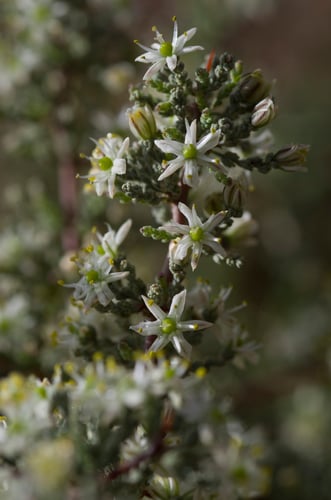
iNaturalist· cc-by-nc-sa
(c) Marco Schmidt, some rights reserved (CC BY-NC-SA), uploaded by Marco Schmidt
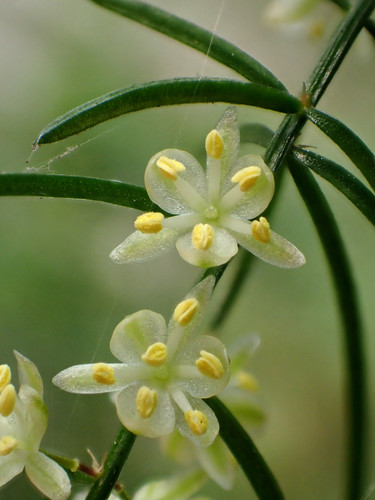
iNaturalist· cc-by-nc-sa
(c) Marco Schmidt, some rights reserved (CC BY-NC-SA), uploaded by Marco Schmidt
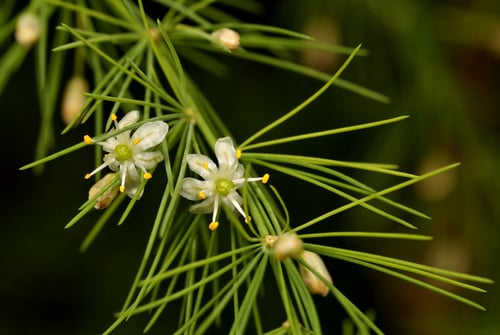
iNaturalist· cc-by-nc
(c) AMADOU BAHLEMAN FARID, some rights reserved (CC BY-NC)
Summary
Source: WikipediaAsparagus flagellaris is a flowering plant that is native to tropical Africa. Like related species, the shoot-tips are eaten as a vegetable. The fruit — juicy orange berries with a sweet taste — are also eaten.
Description
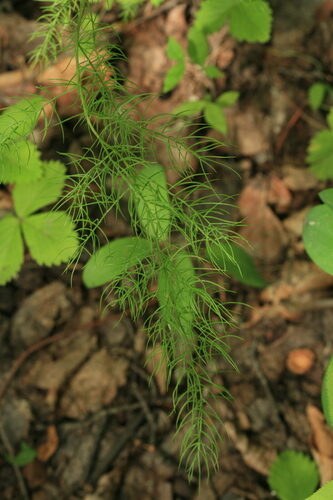
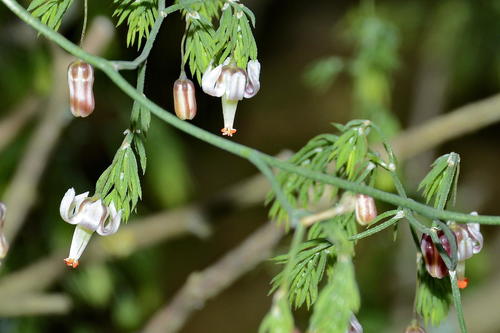
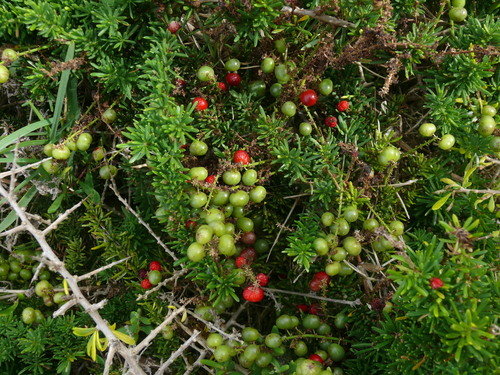
An erect shrub. It grows 2 m tall. It has swollen root tubers. The branches may have spines. The branches arch over. The stems are grey white and without hairs. The leaves are small and like scales. There are leafy needle like structures in clusters along the stem. These have spines that curve back and with white spurs growing beside them. The stems are densely covered with needles 2 cm long. The flowers are white and 4 mm across. They have a scent. They are in groups of 2 or more on flowering stems. The fruit are small orange berries. They are round and have 1 seed.
Edible Uses
The young shoots are eaten as a vegetable. The fleshy root tubers are consumed after several hours of cooking. The fruit is sucked to extract juice.
Traditional Uses
The young shoots are edible. The fleshy root tubers are eaten after several hours cooking. The fruit are sucked to get the juice from the fruit.
This uses section is brief — help expand it
Medicinal Uses
The plant is used as a diuretic and laxative. The roots have a variety of medicinal uses. They are used in various ways as a treatment against syphilis, gonorrhoea and other sexually transmitted diseases - either being macerated and then decocted and drunk; added to food; or used in baths. The roots are boiled, mixed with milk and given to women immediately after childbirth to release the afterbirth. The root is chewed, or macerated and gargled, as a remedy for throat troubles. A root macerate is used against earache, as a treatment for conditions such as haematuria, coughs and schistosomiasis. The macerate is also an ingredient of a complicated technique for the treatment of bubonic plague. A decoction of the roots is used to promote healing of the umbilicus of the newborn, it is mainly applied externally, but a small amount is also placed in the baby's mouth. The branchlets (cladodes) are the main ingredient of a medicine to combat Guinea worm and of an ointment for hair growth. They are eaten to combat stitch. Applied externally, the branchlets are used as a wound medicine, to treat earache and eyesight troubles. The pounded branches, mixed with butter, are used as an ointment for the treatment of haemorrhoids. An embrocation is used against rheumatism and a hot water infusion to arrest diarrhoea. The branchlets, stems or roots are pounded, soaked in water and the infusion drunk 2 - 3 times a day for the treatment of mental disturbance. The seeds are swallowed to prevent eye diseases.
Distribution
A tropical plant. In Tanzania it grows in wooded grasslands at low and medium altitudes. It grows in savannah woodland, palm groves and woodland. It grows up to 2,100 m above sea level and in areas with 1,000-1,800 mm rainfall.
Where It Grows
Africa, Burkina Faso, Cameroon, Central Africa, Congo DR, East Africa, Ethiopia, Gabon, Ghana, Guinea, Guinée, Guinea-Bissau, Kenya, Malawi, Mozambique, Nigeria, Rwanda, Senegal, Sierra Leone, Somali, South Sudan, Tanzania, Uganda, West Africa, Zambia, Zimbabwe,
Cultivation
Plants can be grown from seeds or root suckers.
Propagation
Seed - best sown as soon as it is ripe. Pre-soak stored seed for 12 hours in warm water and then sow in containers in a lightly shaded position. It usually germinates in 3 - 6 weeks at 25°c. Prick out the seedlings into individual pots when they are large enough to handle and grow them on in a sunny position until ready to plant out. The seed can be stored for long periods. Division as the plant comes into growth.
Other Uses
The leaves are used in ointments by native women to stimulate the growth of hair. The wiry stems are used for preparing traps and snares for small animals, and for making cord. The woody stem parts are used for making pencils
Production
The fruit are collected during the dry spells in June-July and December. The shoots are collected during the rainy season.
Notes
There are between 160-300 Asparagus species.
Synonyms
Also Known As
Gi'e fowru, Kadaali, Kasesanhanga, Kasolanhanga, Lukungwisa, Mwinika nguu, Nkila mfwenge, Nsasa mpakasa, Nsielele nseke
References (17)
- Abbiw, D.K., 1990, Useful Plants of Ghana. West African uses of wild and cultivated plants. Intermediate Technology Publications and the Royal Botanic Gardens, Kew. p 30
- Bircher, A. G. & Bircher, W. H., 2000, Encyclopedia of Fruit Trees and Edible Flowering Plants in Egypt and the Subtropics. AUC Press. p 45
- Burkill, H. M., 1985, The useful plants of west tropical Africa, Vol. 3. Kew.
- Dalziel, J. M., 1937, The Useful plants of west tropical Africa. Crown Agents for the Colonies London.
- Fowler, D. G., 2007, Zambian Plants: Their Vernacular Names and Uses. Kew. p 65
Show all 17 references Hide references
- Goode, P., 1989, Edible Plants of Uganda. FAO p 26
- Grubben, G. J. H. and Denton, O. A. (eds), 2004, Plant Resources of Tropical Africa 2. Vegetables. PROTA, Wageningen, Netherlands. p 94
- Irvine, 1952,
- Jardin, C., 1970, List of Foods Used In Africa, FAO Nutrition Information Document Series No 2.p 57
- Latham, P. & Mbuta, A. K., 2014, Useful Plants of Bas-Congo Province, Democratic Republic of Congo. Volume 1. Salvation Army. p 63
- Latham, P. & Mbuta, A. K., 2017, Plants of Kongo Central Province, Democratic Republic of Congo. Volume 1. 3rd ed p 69
- Lim, T. K., 2015, Edible Medicinal and Non Medicinal Plants. Volume 9, Modified Stems, Roots, Bulbs. Springer p 13
- Ojelel, S., et al, 2019, Wild edible plants used by communities in and around selected forest reserves of Teso-Karamoja region, Uganda. Journal of Ethnobiology and Ethnomedicine (2019) 15:3
- Peters, C. R., O'Brien, E. M., and Drummond, R.B., 1992, Edible Wild plants of Sub-saharan Africa. Kew. p 13
- Ruffo, C. K., Birnie, A. & Tengnas, B., 2002, Edible Wild Plants of Tanzania. RELMA p 144
- van der Burg, W.J., 2004. Asparagus flagellaris (Kunth) Baker. [Internet] Record from Protabase. Grubben, G.J.H. & Denton, O.A. (Editors). PROTA (Plant Resources of Tropical Africa / Ressources végétales de l’Afrique tropicale), Wageningen, Netherlands. < http://database.prota.org/search.htm>. Accessed 13 October 2009.
- World Checklist of Useful Plant Species 2020. Royal Botanic Gardens, Kew