Polygonatum odoratum
(Mill.) Druce
Angular Solomon's Seal
wikimedia· cc-by-sa
Myrabella (via Wikimedia Commons)
wikimedia· cc-by
Dr 방원장 (via Wikimedia Commons)
gbif· cc-by-nc
Anna Rauchberger
iNaturalist· cc-by-nc
(c) 空猫 T. N, some rights reserved (CC BY-NC), uploaded by 空猫 T. N
iNaturalist· cc-by-nc
(c) Degtyarev Nikolai Ivanovich, some rights reserved (CC BY-NC), uploaded by Degtyarev Nikolai Ivanovich
iNaturalist· cc-by-nc
(c) 空猫 T. N, some rights reserved (CC BY-NC), uploaded by 空猫 T. N
Summary
Source: WikipediaPolygonatum odoratum (syn. P. officinale), the angular Solomon's seal or scented Solomon's seal, is a species of flowering plant in the family Asparagaceae, native to Europe, the Caucasus, Siberia, the Russian Far East, China, Mongolia, Korea, Nepal and Japan. In the United Kingdom it is one of three native species of the genus, the others being P. multiflorum and P. verticillatum. The genus name Polygonatum comes from the Greek words "poly", meaning "many", and "gonu", meaning "knee joint". This is in reference to the plant's jointed rhizomes. The Latin specific epithet odoratum means "scented".
Description
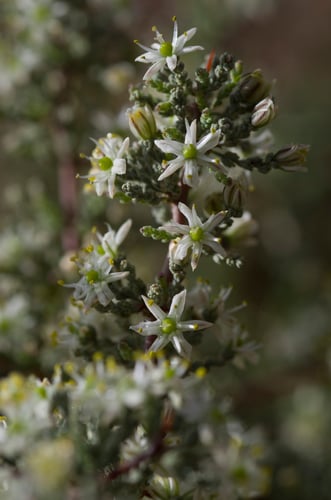
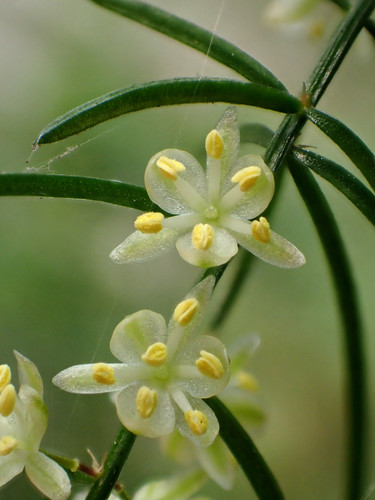
A herb. It has rhizomes or underground stems. They are 5-14 mm thick. The stem arches over. It is 20-50 cm high. It is angled. There are 7-12 leaves which are alternate. The leaf stalk is short. The leaf blade is oval and 5-12 cm long by 3-6 cm wide. It tapers to the tip. The flowering stalk has 1-4 flowers. The flowers hang down. They are yellowish green. The fruit is a berry which is blue black. It is 7-10 mm across and has 7-9 seeds.
Edible Uses
Young shoots are cooked and can be used as an asparagus substitute. The root is also eaten cooked and is rich in starch.
Traditional Uses
The young shoots are parboiled then eaten like asparagus. They are also added to soups. The dried rhizomes are eaten raw or cooked. They are used in dishes and for bread.
Medicinal Uses
Solomon's seal has a long history in herbal medicine, used mainly as a poultice to limit bruising and stimulate tissue repair. The root is antiperiodic, antitussive, cardiotonic, demulcent, diuretic, an energizer, hypoglycaemic, ophthalmic, resolvent, sedative, and tonic. It is used to treat dry throat, dry coughs, and coronary heart disease. This plant is used only in domestic medicine. An infusion acts as a diuretic and metabolic stimulant, though no more than 3 cups per day should be taken, and only over short periods. It can also be applied externally as a poultice for bruises and small wounds, and has been used to remove freckles. The root is harvested in autumn and can be dried for later use. It should not be used internally except under expert supervision.
Known Hazards
Polygonatum odoratum is used in traditional Chinese medicine and Traditional Korean medicine, where it is called yùzhú (玉竹) and dunggulle (둥굴레) respectively. In Korea, the root of the plant is used to make tea. This plant species is described in the work Plantas Medicinales (medicinal plants) of Pius Font i Quer. According to it, its rhizome contains asparagine, mucilage, a cardio-tonic glycoside, saponin, and quinine gluconate. It has been used for intestinal problems and pain, for rheumatism, gout, water retention, and as a diuretic. He says that the scientific medicine has used it to treat diabetes. He also describes a digestive liquor that uses the rhizome of this plant. The young shoots of the plants may be boiled and served like asparagus. The stems, leaves, and berries, however, must be treated with caution, as they are thought to be toxic if consumed in large quantities. Its rhizome contains scattered raphides, but only in the cortex (outer layer).
Distribution
It is a temperate plant. It grows in forests and shaded slopes between 500-3000 m altitude in N China. It suits hardiness zones 3-9. In Sichuan.
Where It Grows
Africa, Asia, Australia, Balkans, Bosnia, Britain, Canada, China, Egypt, Europe, Iran, Japan, Korea, Lithuania, Middle East, Mongolia, North Africa, North America, Russia, Siberia, Slovenia, Spain, Taiwan, Tasmania, Tibet, Turkey, Türkiye,
Cultivation
Plants are grown by division.
Propagation
Seed is best sown as soon as it is ripe in early autumn in a shady part of a cold greenhouse. Stored seed should be sown as early in the year as possible. Germination can be slow, seedlings may not come true to type, and it takes several years to reach a good size. Prick seedlings into individual pots when large enough to handle and grow on in a shady position in the greenhouse for at least their first winter, then plant out in late spring or early summer after the last expected frosts. Divide in March or October. Larger divisions can go directly into permanent positions, while smaller ones are better potted up and grown on in light shade in a cold frame until well established before planting out in late spring or early summer.
Other Uses
None known.
Notes
There are about 50 Polygonatum species. Also put in the family Convallariaceae.
Synonyms
Also Known As
A-li-ya, Amatokoro, Dišeči salomonov pečat, Pokosnica, Torarakex, Yu zhu, Yuzhu
References (26)
- Ann. Scott. Nat. Hist. 226. 1906
- Bremness, L., 1994, Herbs. Collins Eyewitness Handbooks. Harper Collins. p 205
- Brickell, C. (Ed.), 1999, The Royal Horticultural Society A-Z Encyclopedia of Garden Plants. Convent Garden Books. p 817
- Chen, B. & Qiu, Z., Consumer's Attitudes towards Edible Wild Plants, Ishikawa Prefecture, Japan. p 24 www.hindawi.com/journals/ijfr/aip/872413.pdf
- Chen Xinqi, Liang Songyun, Xu Jiemei, Tamura M.N., Liliaceae. Flora of China. p 157
Show all 26 references Hide references
- Cundall, P., (ed.), 2004, Gardening Australia: flora: the gardener's bible. ABC Books. p 1067
- Ding, X., 2021, Collection calendar: the diversity and local knowledge of wild edible plants used by Chenthang Sherpa people to treat seasonal food shortages in Tibet, China. Journal of Ethnobiology and Ethnomedicine 17:40
- Facciola, S., 1998, Cornucopia 2: a Source Book of Edible Plants. Kampong Publications, p 145
- Hedrick, U.P., 1919, (Ed.), Sturtevant's edible plants of the world. p 510 (As Polygonatum japonicum)
- Hibbert, M., 2002, The Aussie Plant Finder 2002, Florilegium. p 238
- http://www.botanic-gardens-ljubljana.com/en/plants
- Hu, Shiu-ying, 2005, Food Plants of China. The Chinese University Press. p 319
- Kang, Y., et al, 2012, Wild food plants and wild edible fungi in two valleys on the Qinling Mountains (Shaanxi, central China) Journal of Ethnobiology and Ethnomedicine; 9:26
- Khasbagan, Hu-Yin Huai, and Sheng-Ji pei, 2000, Wild Plants in the Diet of Athorchin Mongol Herdsmen in Inner Mongolia. Economic Botany 54(4): 528-536
- Levy-Yamamori, R., & Taaffe, G., 2004, Garden Plants of Japan. Timber Press. p 349
- Lim, T. K., 2015, Edible Medicinal and Non Medicinal Plants. Volume 9, Modified Stems, Roots, Bulbs. Springer p 67
- Plants for a Future database, The Field, Penpol, Lostwithiel, Cornwall, PL22 0NG, UK. http://www.scs.leeds.ac.uk/pfaf/
- Redzic, S. J., 2006, Wild Edible Plants and their Traditional Use in the Human Nutrition in Bosnia-Herzegovina. Ecology of Food and Nutrition, 45:189-232
- Ryan, S., 2008, Dicksonia. Rare Plants Manual. Hyland House. p 109
- Sachula, et al, 2020, Wild edible plants collected and consumed by the locals in Daqinggou, Inner Mongolia, China. Journal of Ethnobiology and Ethnomedicine (2020) 16:60
- Urgamal, M., Oyuntsetseg, B., Nyambayar, D. & Dulamsuren, Ch. 2014. Conspectus of the vascular plants of Mongolia. (Editors: Sanchir, Ch. & Jamsran, Ts.). Ulaanbaatar, Mongolia.
- Tanaka,
- Wang, J. et al, 2013, A Study on the Utilization of Wild Plants for Food in Liangshan Yi Autonomous Prefecture. Plant Diversity and Resources. 35(4): 416-471
- Williams, D., 2017, Ainu Ethnobiology. Contributions in Ethnobiology. Society of Ethnobiology. p 110
- Wujisguleng, W., & Khasbagen. K., 2010, An integrated assessment of wild vegetable resources in Inner Mongolian Autonomous Region, China. Journal of Ethnobiology and Ethnomedicine 6:34
- Wujisguleng, W., et al, 2012, Ethnobotanical review of food uses of Polygonatum (Convallariaceae) in China. Acta Societatis Botanicorum Poloniae 81(4):239-244