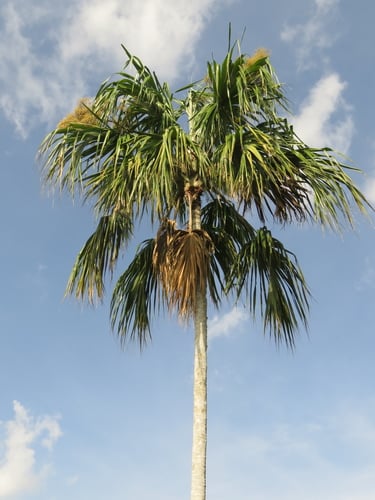
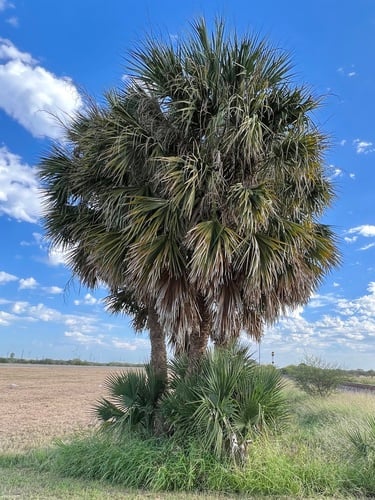
Oncosperma horridum
(Griff.) Scheff.
Mountain Nibong palm
iNaturalist· cc-by-nc-sa
(c) Ahmad Fuad Morad, some rights reserved (CC BY-NC-SA)
iNaturalist· cc-by-nc
(c) mercury9nine, some rights reserved (CC BY-NC)
Description
A clump forming palm. There are about 4-6 stems in a clump. Each stem has many black spines. They grow 20 m high. The trunks are 25 cm across. The leaves are 4-5 m long. Leaflets are closely and regularly spaced. The crown is sparse and has leathery fronds. The flowering stalk is 60 cm long. The flowers are yellow and densely cover the stalk. The fruit is 2-2.5 cm across and round. It is purple-black when ripe. The fruit have a fine grainy surface.
Edible Uses
The palm heart (cabbage) can be eaten raw or cooked. The fruit is also edible. The nut is used as a betel nut substitute.
Traditional Uses
The palm heart is eaten raw or cooked. The nut is used as a betel nut substitute.
This uses section is brief — help expand it
Distribution
It is a tropical plant. It likes warm humid conditions and is very sensitive to cold. It grows naturally on forested hillsides. It grows up to 1500 m altitude.
Where It Grows
Asia, Australia, India, Indonesia*, Malaysia, Pacific, Philippines*, Sarawak, SE Asia, Singapore, Thailand,
Cultivation
Plants can be grown from seeds.
Propagation
Seed - pre-soak for 24 hours in warm water and sow in containers. Fresh seed can germinate in under 2 months. Division of suckers.
Other Uses
The leaves are used to weave baskets. Wood - the outer section of the stem is used. Stronger and more durable than most other palms. The stem is especially durable in both salt and fresh water. It is used for house construction, especially for the foundation piles of elevated houses, and is also split into planks for flooring, walls, boat building etc.
Notes
There are 5 Oncospermum species. The cabbage of most Oncosperma species is edible.
Also Known As
Bayai, Bayas, Bayeh, Karien kao, Palei, Palem bayeh, Palem berduri, Pinang bajeh, Tadup, Tedo, Teduk
References (15)
- Ambasta, S.P. (Ed.), 2000, The Useful Plants of India. CSIR India. p 408
- Balick, M.J. and Beck, H.T., (Ed.), 1990, Useful palms of the World. A Synoptic Bibliography. Colombia p 216
- Burkill, I.H., 1966, A Dictionary of the Economic Products of the Malay Peninsula. Ministry of Agriculture and Cooperatives, Kuala Lumpur, Malaysia. Vol 2 (I-Z) p 1608
- Call, C. A., et al, 2004, Participatory Rural Appraisal in the Upland Ecosystem of Mt Malindang, Misamis Occidental, Philippines. Biodiversity Research Programme for Development in Mindanao. p 53
- Chai, P. P. K. (Ed), et al, 2000, A checklist of Flora, Fauna, Food and Medicinal Plants. Lanjak Entimau Wildlife Sanctuary, Sarawak. Forestry Malaysia & ITTO. p 164, 169
Show all 15 references Hide references
- Haynes, J., & McLaughlin, J., 2000, Edible palms and Their Uses. University of Florida Fact sheet MCDE-00-50-1 p 11
- Johnson, D.V., 1998, Tropical palms. Non-wood Forest products 10. FAO Rome. p 19, 47
- Jones, D.L., 1994, Palms throughout the World. Smithtonian Institution, Washington. p 57, 279
- Jones, D.L., 2000, Palms of Australia 3rd edition. Reed/New Holland. p 189
- Natuurk. Tijdschr. Ned.-Indies 32:189, 191. 1873
- Ong, H., et al, 2012, Traditional knowledge and usage of edible plants among the Semai community of Kampung Batu 16, Tapah, Perak, Malaysia. Scientific Research and Essays Vol. 7(4), pp. 441-445, 30 January, 2012
- Riffle, R.L. & Craft, P., 2003, An Encyclopedia of Cultivated Palms. Timber Press. p 395
- Soepadmo, E., 1998, Plants. The Encyclopedia of Malaysia. Archipelago press. p 54
- Sukarya, D. G., (Ed.) 2013, 3,500 Plant Species of the Botanic Gardens of Indonesia. LIPI p 798
- World Checklist of Useful Plant Species 2020. Royal Botanic Gardens, Kew