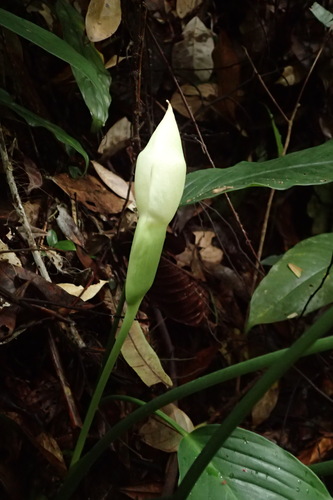
Xanthosoma caracu
K. Koch & C. D. Bouche
White fleshed malanga
gbif· cc0
President and Fellows of Harvard College
Summary
Source: WikipediaXanthosoma caracu (yautia horqueta) is a species of edible plant in the family Araceae. It was first formally described by Karl Koch and Carl David Bouché. It is native to South America and cultivated in Puerto Rico.
Description
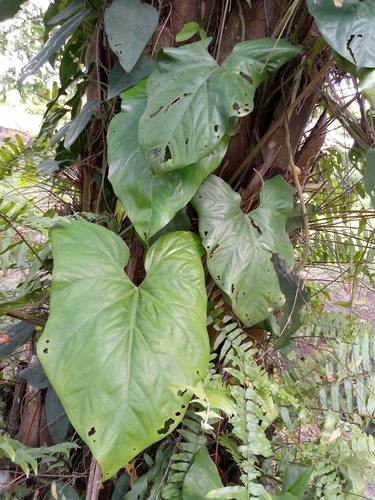
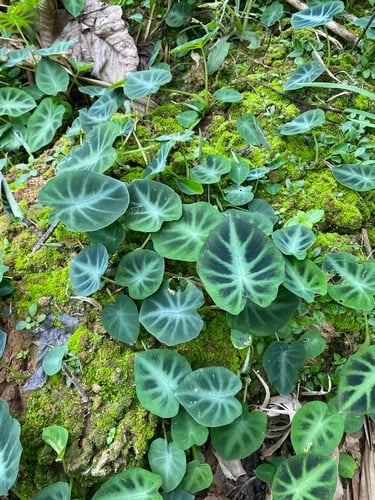
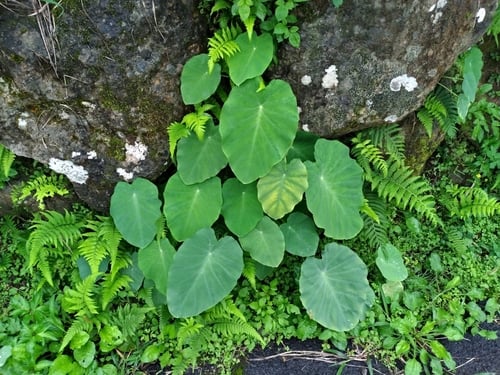
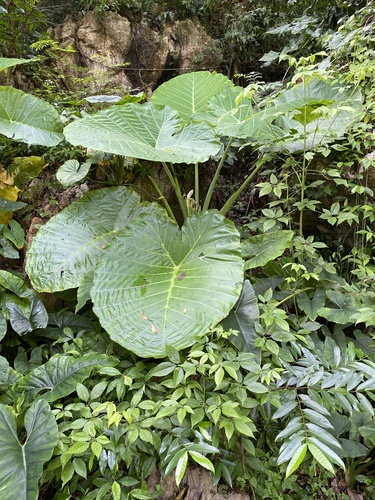
A large herb. It grows up to 2 m tall. The stem is not above ground. The leaf stalk is thick and fleshy. The wings are tinged violet. They is a waxy bloom on the back. The leaf blade is bluish-green and shiny above and pale underneath. It is spear shaped and pointed and 25-50 cm long. It is 45 cm wide. It has tubers underground.
Edible Uses
The corms and leaves are edible and are cultivated for food in Mexico, the Caribbean (including Puerto Rico) and northern South America. The corms are high in starch.
Known Hazards
All parts of the plant contain calcium oxalate crystals. This substance is toxic fresh and, if eaten, makes the mouth, tongue and throat feel as if hundreds of small needles are digging in to them. However, calcium oxalate is easily broken down either by thoroughly cooking the plant or by fully drying it and, in either of these states, it is safe to eat the plant. People with a tendency to rheumatism, arthritis, gout, kidney stones and hyperacidity should take especial caution if including this plant in their diet.
Distribution
A tropical plant.
Where It Grows
Africa, Asia, Cameroon, Central America, Colombia, Cuba, Dominican Republic, Guianas, Guyana, Honduras, India, Mexico, North America, Northeastern India, Puerto Rico, South America, Suriname, Trinidad, Venezuela, West Indies,
Cultivation
A plant of the moister tropics, preferring an annual rainfall in the region 1,000 - 1,500mm. Succeeds in full sun or light shade, requiring high levels of organic matter in the soil. Prefers a pH in the range 5.5 - 6.5. Like many species in the family Araceae, this plant has the ability to heat the flowering spadix as the pollen becomes ready for fertilization. This heat greatly increases the strength of the aroma released by the plant, thus attracting more pollinating insects. It can also have the effect of making the insects more active, thus increasing the level of fertilization.
Propagation
Seed - rarely produced in cultivation. Division of the smaller corms that are produced on the side of the main corm.
Production
The tubers can be stored.
Other Information
It is a cultivated food plant.
Notes
There are 57 Xanthosoma species.
Also Known As
Caracu, Tarabolii, Tegue, Yautia blanca, Yautia manola
References (10)
- Hermandez Bermejo, J.E., and Leon, J. (Eds.), 1994, Neglected Crops. 1492 from a different perspective. FAO Plant Production and Protection Series No 26. FAO, Rome. p 254
- Index sem. hort. berol. app. 3. 1855
- Kermath, B. M., et al, 2014, Food Plants in the Americas: A survey of the domesticated, cultivated and wild plants used for Human food in North, Central and South America and the Caribbean. On line draft. p 926
- Martin, F.W. & Ruberte, R.M., 1979, Edible Leaves of the Tropics. Antillian College Press, Mayaguez, Puerto Rico. p 176
- Purseglove, J.W., 1972, Tropical Crops. Monocotyledons. Longmans p 69
Show all 10 references Hide references
- Saikia, J. P., et al, 2010, Genome size determination and rapid analysis of four edible aroids of Northeast India. IIAOB Journal 1(3)
- Terra, G.J.A., 1973, Tropical Vegetables. Communication 54e Royal Tropical Institute, Amsterdam, p 82
- USDA, ARS, National Genetic Resources Program. Germplasm Resources Information Network - (GRIN). [Online Database] National Germplasm Resources Laboratory, Beltsville, Maryland. Available: www.ars-grin.gov/cgi-bin/npgs/html/econ.pl (10 April 2000)
- Wiersema, J. H. & Leon, B., 2013, World Economic Plants. A Standard Reference CRC Press. 2nd Ed. p 730
- World Checklist of Useful Plant Species 2020. Royal Botanic Gardens, Kew