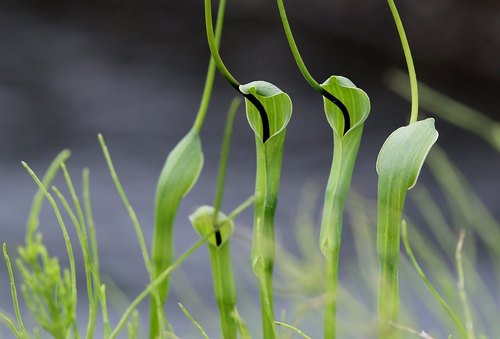
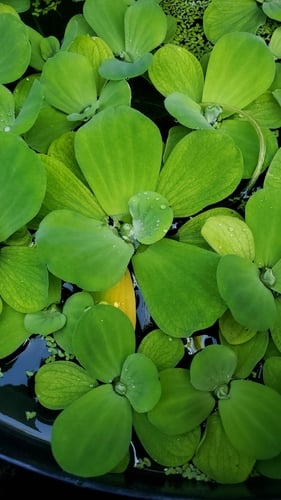
Cyrtosperma merkusii
(Hassk.) Schott.
Swamp taro
iNaturalist· cc-by-nc-sa
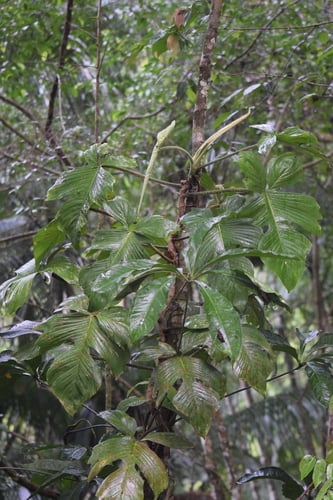
(c) Véronique, some rights reserved (CC BY-NC-SA)
iNaturalist· cc-by-nc
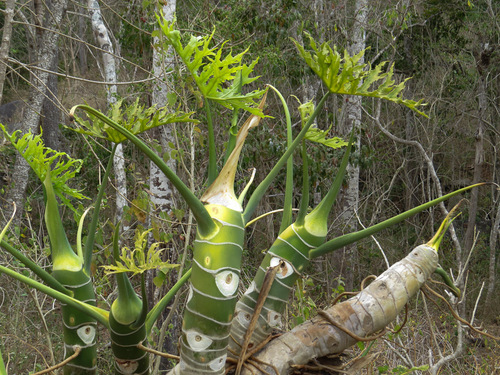
(c) Akmal Idham, some rights reserved (CC BY-NC)
iNaturalist· cc-by-nc
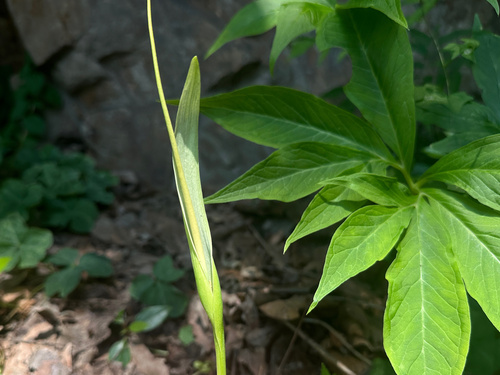
(c) Akmal Idham, some rights reserved (CC BY-NC)
Summary
Source: WikipediaCyrtosperma merkusii or giant swamp taro, is a crop grown throughout Oceania and into South and Southeast Asia. It is a riverine and "swamp crop" similar to taro, but "with bigger leaves and larger, coarser roots." There are no demonstrably wild populations today, but it is believed to be native to Indonesia. It is known as puraka in Cook Islands, lak in Yap (Federated States of Micronesia), babai in Kiribati, iaraj in the Marshall Islands, brak in Palau, babaʻ in the Marianas Islands, pula’a in Samoa, via kana, Pulaka in Lau, Lovo in Fiji, pulaka in Tokelau and Tuvalu, mwahng in Pohnpei, pasruk in Kosrae, simiden in Chuuk, swam taro in Papua New Guinea, navia in Vanuatu and palawan in the Philippines. The same species is also known by the names Cyrtosperma lasioides, Cyrtosperma chamissonis and Cyrtosperma edule. In the harsh atoll environments of the Central Pacific, especially Tuvalu and Kiribati, swamp taro is an important source of carbohydrates in a diet dominated by fish and coconut. Its cultivation is difficult and time-consuming, and the plant has deep cultural as well as practical significance. The roots need to be cooked for hours to reduce toxicity in the corms, but are rich in nutrients, especially calcium. The cultivation of Pulaka in Tuvalu, and babai in Kiribati, is an important cultural and culinary tradition, now under threat from rising sea level and displacement from the growing use of imported food products. In Nepal, Giant Swamp Taro is called mane and grows in the tropical and sub tropical forests along stream banks. It is gathered in January–February and all plant parts (leaf, stem, rhizomes) are savored after being boiled and roasted. The stem requires prolonged boiling and the water is replaced once to remove irritating chemicals. If cooked carefully, the rhizomes taste like taro and the leaves like spinach. But without careful washing, the food causes an unpleasant tingling or scratchy sensation.
Description
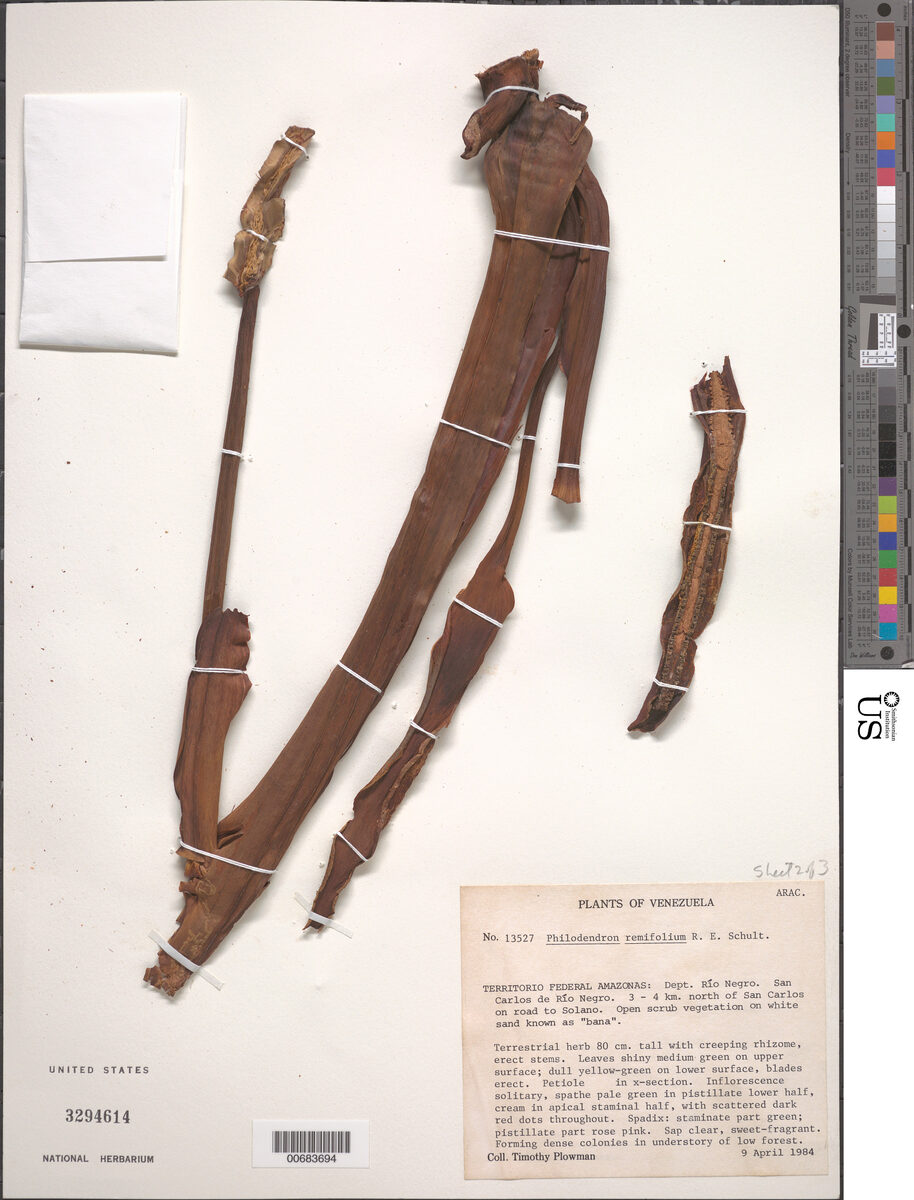
A large perennial taro family plant up to 2-3 m high, with the pointy ends to the leaf lobes. The leaves are very large, upright and with points on the bottom lobes. The leaf stalks are up to 2.5 m long and 10 cm across. The leaves are 1.5 m long. Other aspects of the plant can vary such as kinds which are more spiny on the leaf stalks than others. The plants can grow up to 4 metres tall. Under the ground there is a large fattened rhizome or corm. This is shaped liked a cylinder and can be up to 70 kg in size. The plant produces a large purple lily type flower which then produces a group of seeds which are orange in colour. The plant produces suckers. The number of suckers varies with varieties.
Edible Uses
The corms are peeled and boiled or roasted, and are also used to make flour. The tubers are often boiled, mashed, and fermented before cooking again. Young leaves and flowers are also eaten.
Traditional Uses
The corms are peeled and boiled or roasted. They are also used to make flour. Leaves and young flowers can be eaten. The tubers are ofte boiled then mashed and left to ferment before cooking again.
Medicinal Uses
The plant is noted as a commercially cultivated vegetable and is a major crop on Pacific atoll islands.
Known Hazards
The plant contains calcium oxalate crystals. These cause an extremely unpleasant sensation similar to needles being stuck into the mouth and tongue if they are eaten, but they are easily neutralized by thoroughly drying or cooking the plant or by steeping it in water.
Distribution
It is a tropical plant and grows from 18°N to 20°S. It grows in fresh or brackish swamps up to 150 m altitude. Water 0.6-0.9 m deep and rich in humus is the environment used. It can stand shade. It can withstand flooding. It occurs in Papua New Guinea, the Solomon Islands and the Philippines as well as in other countries. It is found in valleys in central and southern parts of the Philippines. It is grown in Visayas and Camarines. In Papua New Guinea it becomes important in Bougainville. It grows in fresh or brackish swamps up to 150 m altitude. It occurs on atoll islands. It has reasonable salt tolerance (2%).
Where It Grows
Asia, Bougainville, Brunei, Caroline Islands, China, Chuuk, Cook Islands, Fiji, French Polynesia, FSM, Guam, Indonesia, Kiribati, Malaysia, Mariana Islands, Marquesas, Marshall Islands, Micronesia, Mortlock Islands, Nauru, Nepal, Pacific, Palau, Papua New Guinea, PNG, Philippines, Pohnpei, Polynesia, Rotuma, Samoa, SE Asia, Singapore, Solomon Islands, Tahiti, Tokelau, Tonga, Truk, Tuvalu, Vanuatu, Vietnam, Wallis & Futuna, Yap,
Cultivation
Plants are normally put in swamps or ditches. Parts of the main corm, or suckers can be used for planting. It can be intercropped with Colocasia taro. A spacing of 1.2 x 1.2 m is suitable. It normally receives little management. It is known to respond to organic matter.
Propagation
Seed - Division of suckers. Cormels, which send up leaves and develop into suckers, are produced as side shoots on the parent corm after about three years.
Production
Yields of 10-15 tons/year/ha have been recorded. It takes 2-6 years to mature. Tubers become more fibrous with time so that 2 years is a suitable harvesting time. Individual corms can weigh 2-50 kg.
Other Information
It is a commercially cultivated vegetable. This taro is seen in some coastal areas of Papua New Guinea but only becomes important in some of the coral atoll islands. It is a major crop in Atoll Islands in the Pacific.
Notes
There are 11-12 Cyrtosperma species.
Nutrition
| Part | Moisture | kJ | kcal | Protein | Vit A | Vit C | Iron | Zinc |
|---|---|---|---|---|---|---|---|---|
| Root | 72.4 | 343 | 82 | 1.1 | 5 | 15.7 | 1.3 | 0.11 |
Synonyms
Also Known As
Ape de veo, Aro matawa, Baba, Babai, Brak, Bwanihaka, Dababai, Gabi, Galiang, Gallan, Iaraj, Kakake, Kakale, Kakama, Kape ta'a-ta'a, Karake, Lak, Lok, Mane, Maota, Muen, Muiang, Mwahng, Mweiang, Mwong, Niha, Palanau, Palauan, Paluku, Papai, Papoi, Pasruk, Pula'a, Pulaka, Puna, Pura, Puraka, Puraka, Pwolok, Ta'o, Tao Kape, Te babai, Teplaka, Tepulaka, Tepuraka, Ula, Via kana, Via kau, Voruku
References (74)
- Cyrtosperma merkusii (chamissonis) swamp taro references.
- Altschul, S.V.R., 1973, Drugs and Foods from Little-known Plants. Notes in Harvard University Herbaria. Harvard Univ. Press. Massachusetts. no. 113
- Ali,A & Asghar,M., The Agronomy of Cyrtosperma chamissionis in Kiribati. Alafua Agricultural Bulletin 12(3): Sep.-Dec. ‘87.
- Allen, R.N., 1929, Photomicrographs of Philippine starches. Philipp.J. Sci., 38(2):247-248.
- Arora, R. K., 2014, Diversity in Underutilized Plant Species - An Asia-Pacific Perspective. Bioversity International. p 102 (As Cyrtosperma chamissonis)
Show all 74 references Hide references
- Barrau, J.,1957, Les aracees a tubercules alimentaires das iles du Pacifique sud. J.Agric.trop.Bot appl. 4(1):36-40.
- Barrau, J., 1959, The sago palms and other food plants of marsh dwellers in the south Pacific islands. Econ.Bot..13(2):159-162.
- Barrau, J., 1976, Subsistence Agriculture in Melanesia. Bernice P. Bishop Museu, Bulletin 219 Honolulu Hawaii. Kraus reprint. p 17
- Barrau, J., 1976, Subsistence Agriculture in Polynesia and Micronesia. Bernice P. Bishop Museu, Bulletin 223 Honolulu Hawaii. Kraus reprint. p 39
- Boag, A.D. and Curtis, R.E., 1959., Agriculture and population in the Mortlock islands. Papua New Guinea Agric. J., 12(1):21-24.
- Brown, D., 2000, Aroids. Plants of the Arum family. Timber Press. (Second edition) p 262
- Bradbury, J.H., and Holloway, W.D., 1988, Chemistry of Tropical Root Crops. ACIAR, Canberra. pp 24, 66, 97, 181-184.
- Brown, W.H., 1920, Wild Food Plants of the Philippines. Bureau of Forestry Bulletin No. 21 Manila. p 31
- Burkill, I.H., 1935, A dictionary of the economic products of the Malay Peninsula. London. p 755 (Also as Cyrtosperma edule)
- Call, C. A., et al, 2004, Participatory Rural Appraisal in the Upland Ecosystem of Mt Malindang, Misamis Occidental, Philippines. Biodiversity Research Programme for Development in Mindanao.
- Catala, R. L. A., 1957, The babai. Atoll Res. Bull. 59:67-75
- Chandra, S. (Ed), 1984, Edible Aroids. Oxford.
- De la Cruz,E.,1973, Root and Tuber crops of the Trust Territory of the Pacific Islands. Proc. 2nd. Int. Symp. Trop. Root & Tuber Crops. Honolulu, Hawaii Vol 2.:77-86.
- Englberger, L., et al, 2005, Carotenoid content of pandanus fruit cultivars and other foods of the republic of Kiribati. Public health nutrition 9(5), 631-643 (As Cyrtosperma chamissonis)
- Englberger, L., et al, 2006, Documentation of the traditional food system of Pohnpei. Indigenous People's food systems. Chp 6 p 119
- Facciola, S., 1998, Cornucopia 2: a Source Book of Edible Plants. Kampong Publications, p 23 (As Cyrtosperma chamissonis)
- Franklin, J., Keppel, G., & Whistler, W., 2008, The vegetation and flora of Lakeba, Nayau and Aiwa Islands, Central Lau Group, Fiji. Micronesica 40(1/2): 169–225, 2008 (As Cyrtosperma chamissonis)
- French, B.R., 2010, Food Plants of Solomon Islands. A Compendium. Food Plants International Inc. p 12
- Gautam, R. S., et al, 2022, Ethnobotanical Review of Wild Edible Plants of Nepal. Journal of Natural History Museum Volume 32, 2021-22 p 104
- Gesmundo, A. E., 1932, The nutritive value of gallan. Cyrtosperma merkussii (Hasskarl) Schott. Philipp. Agric. 21:106-126.
- Gillaumin, R., 1954, Les Plantes utiles des Nouvelles-Hebrides (fin et complement) In: Journal d'agriculture tropicale et de botanique appliquee Vol. 1, No. 10-12 pp 453-460 (As Cyrtosperma chamissonis)
- Hay, A., 1988, Cyrtosperma (Araceae) and its Old World Allies. Blumea 33 (1988) 427-469.
- Henderson, C. P. and I. R. Hancock, 1988, A Guide to the Useful Plants of the Solomon Islands. Res. Dept. Min of Ag. & Lands. Honiara, Solomon Islands. p 29
- Heywood, V.H., Brummitt, R.K., Culham, A., and Seberg, O., 2007, Flowering Plant Families of the World. Royal Botanical Gardens, Kew. p 348
- Kay, D.E., 1973, Root Crops. TPI Crop and Product Digest. p139-143.
- Kays, S. J., and Dias, J. C. S., 1995, Common Names of Commercially Cultivated Vegetables of the World in 15 languages. Economic Botany, Vol. 49, No. 2, pp. 115-152
- Kuhnlein, H. V., et al, 2009, Indigenous Peoples' food systems. FAO Rome p 119
- Lambert, M., 1982, The cultivation of “taro” Cyrtosperma chamissonis Schott in Kiribati pp163-165 in Regional Technical Meeting on Atoll Cultivation 1982; Collected Papers; Tech Paper No.180 South Pacific Commission, Noumea, New Caledonia.
- Lim, T. K., 2015, Edible Medicinal and Non Medicinal Plants. Volume 9, Modified Stems, Roots, Bulbs. Springer p 32
- Loumala,
- MacKinnon, K., The Ecology of Kalimantan. p 710 (Also as Cyrtosperma lasioides)
- Massal, E.and Barrau J.,1956, Food plants of the south sea islands. S.P.C. Techn. Paper No 94 pp6-11.
- McClatchey, W. C., 2012, Wild food plants of Remote Oceania. Acta Societatis Botanicorum Poloniae 81(4) 371-380
- Migvar, L., 1968, How to grow taros, yams, cassava and sweet potatoes. Mariana Is Divn. Agric., dep. Res. Dev., Trust Terr. Pacific Is., Agr.Ext.Bull. No7 pp7-8.
- Monsalud, M.R., Tongacan, A.L., Lopez, F.R., & Lagrimas, M.Q., 1966, Edible Wild Plants in Philippine Forests. Philippine Journal of Science. p 444
- Murai, M., Pen.F., & Miller C.D., 1958, Some tropical South Pacific island foods. Univ.Hawaii Press. Honolulu p89-99
- Oesterr. Bot. Wochenbl. 7:61. 1857
- Pancho, J.V.,1959. Notes on cultivated aroids in the Philippines: the edible aroids. Baileya 7(1):63-70.
- Parham, B.E.V., 1942, Some useful plants of the Fiji Islands. Fiji Agric. J. 13(2):41.
- Parham, B. E. V., 1971, The Vegetation of the Tokelau Islands with special reference to the Plants of Nukunonu Atoll. New Zealand Journal of Botany. 9:4, 576-609
- Parham, B. E. V., 1972, Plants of Samoa. New Zealand Department of Scientific and Industrial Research. Information Series. No. 85 p 106
- Parham J.,
- Pena, R.S.de la, 1970. The edible aroids in the Asian-Pacific area. Proc. 2nd int. Sympos. Tropical Root and Tuber Crops.1 Pt5,136-140.
- Peters, F.E.,1957, The chemical composition of some south Pacific foods. Proc.9th Pacif. Sci Congr.,15,129-138.
- Plucknett, D.L.,1970, Colocasia, Xanthosoma, Alocasia, Cyrtosperma & Amorphophallus. Proc.2nd.int Sympos.Tropical Root and Tuber Crops. 1 Pt.5,127-135.
- Plucknett, D.L.,1976, Giant Swamp taro, a Little-known Asian-Pacific Food Crop. Proc.4th.Symp. Int. Soc. for Tropical Root Crops.
- Plucknett, D.L.,1976,Edible aroids, in Simmonds N.W.,(ed), Crop Plant Evolution. Longmans. London. p10-12.
- Purseglove, J.W., 1972, Tropical Crops: Monocotyledons. 2 Vols. London
- Romanowski, N., 2007, Edible Water Gardens. Hyland House. p 56
- Small, C. A., 1972, Atoll agriculture in the Gilbert and Ellice Islands. Dept.of Agric., Tarawa.
- Sproat, M. N., 1968, A guide to subsistence agriculture in Micronesia. Mariana Is. Divn. Agric., Dep. Dev. Trust Terr. Pac. Is., Extn. Bull. No 9 pp 21-26.
- St John, H., 1948, Report on the flora of Pingelap atoll, Caroline islands, Micronesia. Pacific Sci. 2(2):107-108.
- Stone, B. C., 1970, The Flora of Guam. A Manual for the Identification of the Vascular Plants of the Island. Micronesica. Journal of the University of Guam. p 120
- Terra, G. J. A., 1973, Tropical Vegetables. Communication 54e Royal Tropical Institute, Amsterdam, p 44
- Thaman, R. R., 1987, Plants of Kiribati: A listing and analysis of vernacular names. Atoll Research Bulletin No. 296
- Thaman, R. R., et al, 1994, The Flora of Nauru. Atoll Research Bulletin No. 392. Smithsonian Institute p 41
- Thaman, R. R, 2016, The flora of Tuvalu. Atoll Research Bulletin No. 611. Smithsonian Institute p 39
- Ulian, T., et al, 2020, Unlocking plant resources to support food security and promote sustainable agriculture. Plants, People, Planet. 2020;2:421–445.
- USDA, ARS, National Genetic Resources Program. Germplasm Resources Information Network - (GRIN). [Online Database] National Germplasm Resources Laboratory, Beltsville, Maryland. Available: www.ars-grin.gov/cgi-bin/npgs/html/econ.pl (10 April 2000)
- Valenzuela, A. & Webster, P. J., 1930, Composition of some Philippine fruits, vegetables, and forage plants. Philipp. J. Sci. 41(1):85-102.
- Vander Velde, N, 2003, The Vascular Plants of Majuro Atoll, Republic of the Marshall Islands. Atoll research Bulletin. No. 503. Smithsonian Institute. p 27
- Vickers, M.E.H., 1982, The agronomy of Cyrtosperma chamissonis (Schott) Merr, in Kiribati pp 90-97. In Lambert,M.,(ed.) 1982, Taro Cultivation in the South Pacific. SPC Handbook No22 South Pacific Commission, Noumea, New Caledonia.
- Walter, A. & Lebot, V., 2007, Gardens of Oceania. ACIAR Monograph No. 122 p. 69 (As Cyrtosperma chamissonis)
- Wiersema, J. H. & Leon, B., 2013, World Economic Plants. A Standard Reference CRC Press. 2nd Ed. p 229
- Whistler, A. S., Edible vascular plants of the Line Islands. Pacific Health Dialog. Vol. 3 No. 2 (As Cyrtosperma chamissonis)
- Whistler, W. A., 1988, Ethnobotany of Tokelau: The Plants, Their Tokelau Names, and Their Uses. Economic Botany 42(2): 155-176
- www.hawaii.edu Plants & Environments of the Marshall Islands (As Cyrtosperma chamissonis)
- World Checklist of Useful Plant Species 2020. Royal Botanic Gardens, Kew
- Zeven, A. C. & de West, J. M. J., 1982, Dictionary of cultivated plants and their regions of diversity. Wageningen. p 49