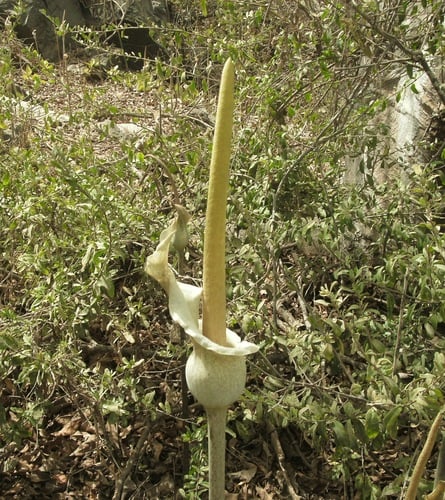
Dracunculus vulgaris
Schott
Stink Lily, Dragon Lily, Dragon arum
iNaturalist· cc-by-nc
(c) cwtw, some rights reserved (CC BY-NC), uploaded by cwtw
iNaturalist· cc-by-nc-sa
(c) Roberto Sindaco, some rights reserved (CC BY-NC-SA)
iNaturalist· cc-by-nc-sa
(c) Roberto Sindaco, some rights reserved (CC BY-NC-SA)
Summary
Source: WikipediaDracunculus vulgaris is a species of aroid flowering plant in the genus Dracunculus and the arum family Araceae. Common names include the common dracunculus, dragon lily, dragon arum, black arum and vampire lily. In Greece, part of its native range, the plant is called drakondia, the long spadix being viewed as a small dragon hiding in the spathe. This herbaceous perennial is endemic to the Balkans, extending as far as Greece, Crete, and the Aegean Islands, and also to the south-western parts of Anatolia.
Description
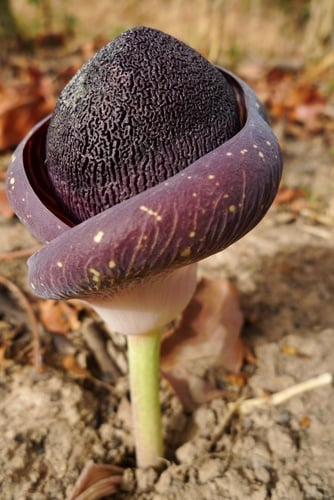
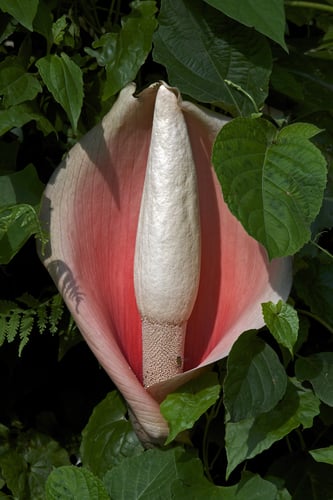
A tall tuber forming plant. It grows 1 m tall. The 'stem' is thick and strongly blotched. This 'stem' is formed from the leaf stalks and the flower stem. The leaves are deep green and often have white streaks. The leaves are deeply divided into 10-15 narrow segments. The edges of these segments are wavy. The spathe around the flower is a rich velvety red but green on the outside. The spathe is broadly sword shaped. It is 25-40 cm long. The spike of flowers is a deep reddish-black. It is stout and shiny and erect. It tapers to the tip. The flower has a strong bad smell. The fruit are berries in an oblong head.
Edible Uses
The roots and tubers are boiled with water changes before cooking as a meal, or the root starch can be extracted and added to bread flour after the acrid element has been removed. It is used as a famine food.
Traditional Uses
The starch of the root can be used to add to bread flour after the acrid element has been removed. The roots are boiled and the water changed before being cooked as a meal. CAUTION: Plants in this group are possibly poisonous without careful treatment.
Known Hazards
Plants in this group are possibly poisonous without careful treatment.
Distribution
It is a Mediterranean climate plant. It grows in rocky places and dry hillsides. It is usually at low altitudes in the Mediterranean.
Where It Grows
Algeria, Australia, Europe, France, Mediterranean, North Africa, Tasmania, Turkey, Türkiye,
Other Information
It is a famine food.
Notes
There are 26 Arum species.
Synonyms
References (8)
- Blamey, M and Grey-Wilson, C., 2005, Wild flowers of the Mediterranean. A & C Black London. p 502
- Brickell, C. (Ed.), 1999, The Royal Horticultural Society A-Z Encyclopedia of Garden Plants. Convent Garden Books. p 379
- Hibbert, M., 2002, The Aussie Plant Finder 2002, Florilegium. p 33,
- Lim, T. K., 2015, Edible Medicinal and Non Medicinal Plants. Volume 9, Modified Stems, Roots, Bulbs. Springer p 12
- Özdemir, E. and Kültür, S., 2017, Wild Edible Plants of Savaştepe District (Balıkesir, Turkey), Marmara Pharm J 21/3: 578-589
Show all 8 references Hide references
- PARMENTIER (As Arum dracunculus)
- H. Schott & S. L. Endlicher, Melet. bot. 17. 1832
- Wilson, S., 1997, Some Plants are Poisonous. Reed. p 25 (As Arum dracunculus)