Dracontium polyphyllum
L.
Motley-stalked dragon-plant
iNaturalist· cc-by-nc
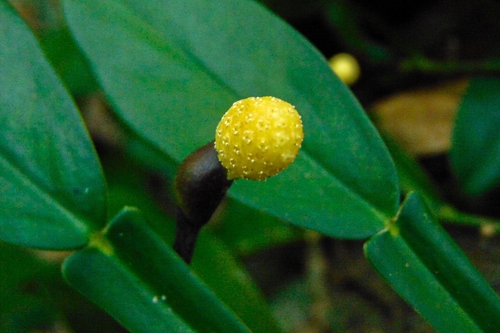
(c) Sébastien SANT, some rights reserved (CC BY-NC), uploaded by Sébastien SANT
iNaturalist· cc-by-nc
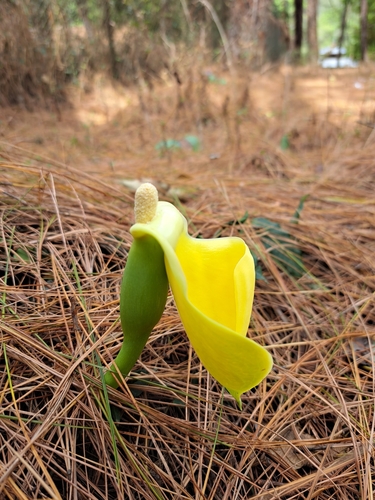
(c) Guillaume Léotard, some rights reserved (CC BY-NC)
iNaturalist· cc-by-nc
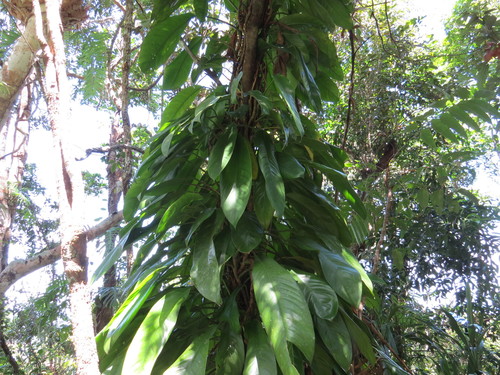
(c) Guillaume Léotard, some rights reserved (CC BY-NC)
Description
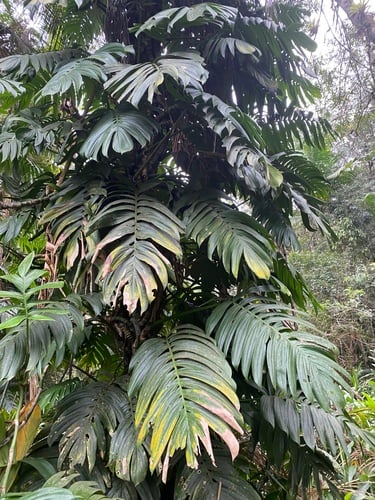
A taro family herb. It is like Amorphophallus. The tubers are round and 6-10 cm wide by 5-8 cm thick. They are flat on top and rounded underneath. There are a few small tubers. The tuber produces a single leaf. The leaf stalks are 1-2 m long and 2-4 cm across. They are dark green or mottled. The leaf blades spreads horizontally and can be 1 m across. The leaves are divided. There is usually one flowering shoot. There are 150-300 flowers arranged in a spiral on one stalk. There is a spathe 6-12 cm long by 3-5 cm wide. The collection of fruits are 5-16 cm long and 3-4 cm wide. The berries have 3 seeds.
Edible Uses
The tubers are cooked and eaten.
Traditional Uses
The tubers are cooked and eaten.
This uses section is brief — help expand it
Distribution
A tropical plant. It grows in moist forests. It grows up to 220 m above sea level.
Where It Grows
Amazon, Asia, Brazil, Central America, Colombia, Costa Rica, Guianas, Haiti, India, Indonesia, Myanmar, Pacific, Peru*, SE Asia, South America, Suriname, Trinidad, Venezuela, West Indies,
Cultivation
Plants can be grown from seeds or by division of the tuber.
Notes
There are 23 Dracontium species.
Synonyms
Also Known As
Adive kanda, Changuango, Drakontium latina, Guapa, Jararaca-mirim, Jiracaca, Kaat curna, Sevala
References (9)
- Ambasta, S.P. (Ed.), 2000, The Useful Plants of India. CSIR India. p 183
- Ekman Herbarium records Haiti
- Hedrick, U.P., 1919, (Ed.), Sturtevant's edible plants of the world. p 282
- Kermath, B. M., et al, 2014, Food Plants in the Americas: A survey of the domesticated, cultivated and wild plants used for Human food in North, Central and South America and the Caribbean. On line draft. p 320
- Lim, T. K., 2015, Edible Medicinal and Non Medicinal Plants. Volume 9, Modified Stems, Roots, Bulbs. Springer p 40
Show all 9 references Hide references
- SHORTT,
- Sp. pl. 2:967. 1753
- Sukarya, D. G., (Ed.) 2013, 3,500 Plant Species of the Botanic Gardens of Indonesia. LIPI p 1104
- WATT,