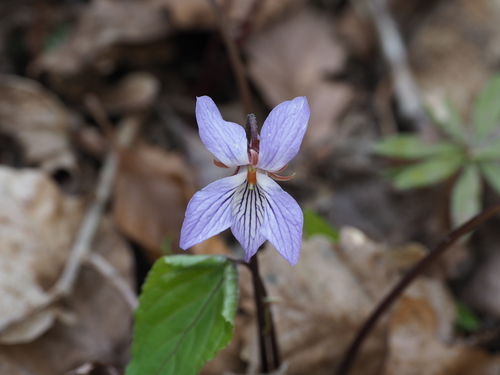
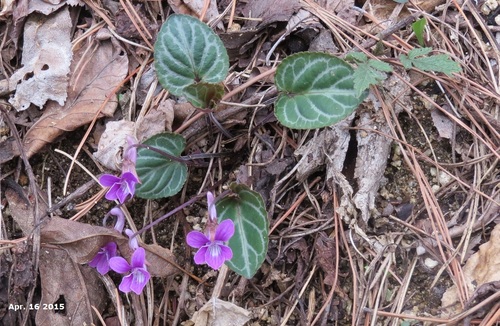
Viola adunca
Sm.
Western dog violet, Hooked-spur violet, Purple violet, Early blue violet
iNaturalist· cc-by-nc
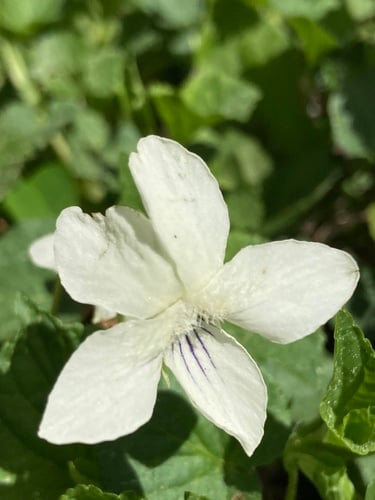
(c) cedarleaf, some rights reserved (CC BY-NC)
iNaturalist· cc-by-nc
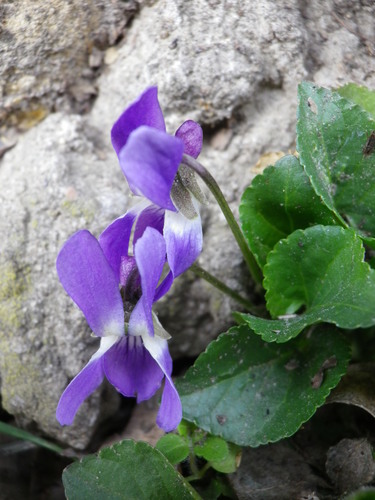
(c) Matthias Buck, some rights reserved (CC BY-NC)
iNaturalist· cc-by-nc
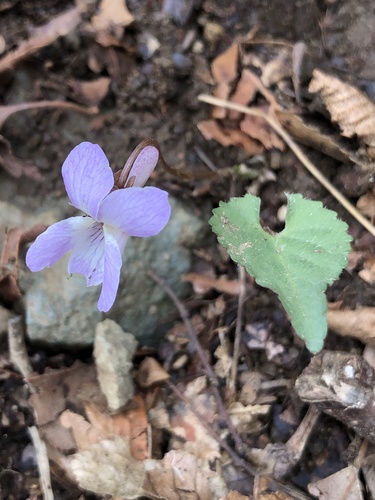
(c) Matthias Buck, some rights reserved (CC BY-NC)
Summary
Source: WikipediaViola adunca is a species of violet known by the common names hookedspur violet, early blue violet, sand violet, and western dog violet. It is native to meadows and forests of western North America, Canada, and the northern contiguous United States.
Description
A spreading herb. It grows 5-10 cm high and spreads 30-40 cm wide. It keeps growing from year to year. It forms tufts. The leaves are rounded to heart shaped. They are 40 mm long. The flowers are blue to violet. They are 12 mm wide. The fruit is a dry capsule with 3 valves. It has many seeds.
Edible Uses
Young leaves and flower buds can be eaten raw or cooked. When added to soup they thicken it in much the same way as okra. Dried leaves can be used to make a tea.
Traditional Uses
The leaves can be eaten raw or cooked as a potherb. The flowers can be eaten fresh or candied. The leaves and flowers can be used for tea, or wine.
This uses section is brief — help expand it
Medicinal Uses
An infusion of the leaves and roots has been used to treat stomach problems and asthma in children. A wash and poultice made from the roots and leaves has been applied to sore and swollen joints. Women have chewed the roots and leaves during childbirth. A poultice of chewed leaves has been applied to sore eyes, and a poultice of crushed flowers has been applied to the side or chest to treat pain.
Distribution
It is a temperate plant. It grows in subarctic zones. It grows in moist places on prairie and open woods. It suits hardiness zones 4-9.
Where It Grows
Australia, Canada, North America, USA,
Cultivation
Prefers a cool moist well-drained humus-rich soil in partial or dappled shade and protection from scorching winds. Tolerates sandstone and limestone soils but becomes chlorotic if the pH is too high. Prefers a pH between 6 and 6.5. All members of this genus have more or less edible leaves and flower buds, though those species with yellow flowers can cause diarrhoea if eaten in large quantities. There is at least one named form selected for its ornamental value. 'Alba' has white flowers. Flowers formed late in the season are cleistogamous (lacking petals, the flowers do not open but are self-pollinated).
Propagation
Seed is best sown in autumn in a cold frame. Stored seed can be sown in early spring in a cold frame. Prick seedlings into individual pots when large enough to handle and plant out during summer. Divide plants in autumn or just after flowering. Larger divisions can go directly into permanent positions, but smaller divisions do best potted up and grown on in light shade in a greenhouse or cold frame until established, then planted out in summer or the following spring.
Other Uses
A blue dye can be obtained from the flowers.
Notes
There are about 500 Viola species. It can contain salicylates.
Synonyms
References (8)
- Cormack, R. G. H., 1967, Wild Flowers of Alberta. Commercial Printers Edmonton, Canada. p 202
- Cundall, P., (ed.), 2004, Gardening Australia: flora: the gardener's bible. ABC Books. p 1472
- Hibbert, M., 2002, The Aussie Plant Finder 2002, Florilegium. p 307
- Kermath, B. M., et al, 2014, Food Plants in the Americas: A survey of the domesticated, cultivated and wild plants used for Human food in North, Central and South America and the Caribbean. On line draft. p 913
- MacKinnon, A., et al, 2009, Edible & Medicinal Plants of Canada. Lone Pine. p 228
Show all 8 references Hide references
- Plants for a Future database, The Field, Penpol, Lostwithiel, Cornwall, PL22 0NG, UK. http://www.scs.leeds.ac.uk/pfaf/
- Porsild, A.E., 1974, Rocky Mountain Wild Flowers. Natural History Series No. 2 National Museums of Canada. p 278
- A. Rees, Cycl. 37: Viola n. 63. 1817