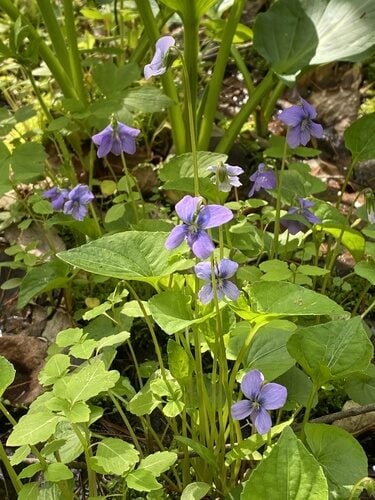
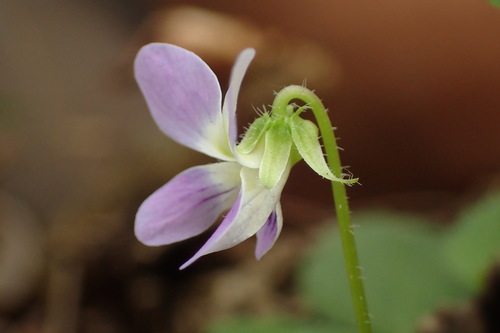
Viola canadensis
L.
Canada white violet
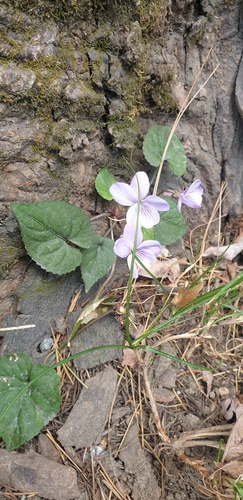
iNaturalist· cc-by-sa
(c) Douglas Goldman, some rights reserved (CC BY-SA)
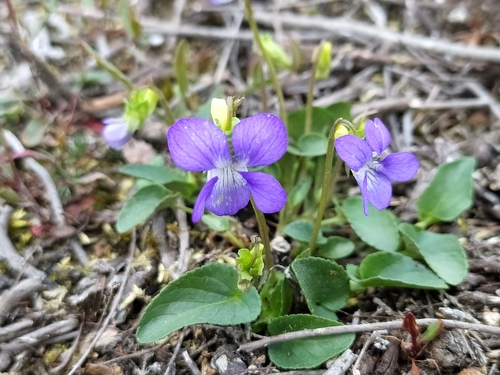
iNaturalist· cc-by
(c) Katja Schulz, some rights reserved (CC BY)
Summary
Source: WikipediaViola canadensis is a flowering plant in the Violaceae family. It is commonly known as Canadian white violet, Canada violet, tall white violet, or white violet. It is widespread across much of Canada and the United States, from Alaska to Newfoundland, south as far as Georgia and Arizona. It is a perennial herb and the Latin-specific epithet canadensis means of Canada. Viola canadensis bears white blooms with yellow bases and sometimes streaks of purple. The petals are purple-tinged on the backside. The leaves are heart-shaped, with coarse, rounded teeth. Subspecies and varieties Viola canadensis var. canadensis Viola canadensis subsp. canadensis Viola canadensis var. rugulosa (Greene) C.L. Hitchc. Viola canadensis subsp. scopulorum (A. Gray) House
Description
A small plant. It grows 10-40 cm tall. The stems are slender. These have several heart shaped leaves. The flowers are white to violet and yellow at the base. There are purple lines. The seed pods open suddenly with a twist.
Edible Uses
Young leaves and flower buds can be eaten raw or cooked. They have a very mild flavour and are best mixed with other stronger-tasting leaves when boiled as greens. When added to soup they thicken it in much the same way as okra. The flowers can be eaten raw. The leaves make a good tea substitute.
Traditional Uses
The young leaves and flowers are eaten raw in tossed salads. They can also be boiled as potherbs. The flowers can be candied like rose petals. They also give flavour to vinegar. The leaves can be used as a substitute tea drink.
Medicinal Uses
A tea made from the roots has been used to treat pain in the bladder region. The roots and leaves have traditionally been used to induce vomiting, and have also been made into a poultice and applied to skin abrasions and boils.
Distribution
It is a temperate plant. It grows in groups in rich, moist forests. It suits hardiness zone 4.
Where It Grows
Canada, North America, USA,
Cultivation
Easily grown in any fertile soil in full sun or partial shade. Prefers a cool position in a moist well-drained humus-rich soil in partial or dappled shade and protection from scorching winds. Tolerates sandstone and limestone soils but becomes chlorotic if the pH is too high. Prefers a pH between 6 and 6.5. Hardy to about -25°c. All members of this genus have more or less edible leaves and flower buds, though those species with yellow flowers can cause diarrhoea if eaten in large quantities. This species has mainly white flowers that are at first yellowish at the base then turn violet. There are some named varieties selected for their ornamental value.
Propagation
Seed is best sown in autumn in a cold frame. Stored seed can be sown in early spring in a cold frame. Prick seedlings into individual pots when large enough to handle and plant out during summer. Divide plants in autumn or just after flowering. Larger divisions can go directly into permanent positions, but smaller divisions do best potted up and grown on in light shade in a greenhouse or cold frame until established, then planted out in summer or the following spring.
Other Uses
This plant is a dynamic accumulator, gathering minerals and nutrients from the soil and storing them in a more bioavailable form suitable for use as fertilizer or to improve mulch.
Notes
There are about 500 Viola species.
Synonyms
Also Known As
Western violet
References (10)
- Elias, T.S. & Dykeman P.A., 1990, Edible Wild Plants. A North American Field guide. Sterling, New York p 95
- Esperanca, M. J., 1988. Surviving in the wild. A glance at the wild plants and their uses. Vol. 1. p 177
- Facciola, S., 1998, Cornucopia 2: a Source Book of Edible Plants. Kampong Publications, p 245
- https://www.fireflyforest.com/flowers/category/edible-plants/ Edible Plants – Southeastern Arizona Wildflowers and Plants
- Jackes, D. A., 2007, Edible Forest Gardens
Show all 10 references Hide references
- Kermath, B. M., et al, 2014, Food Plants in the Americas: A survey of the domesticated, cultivated and wild plants used for Human food in North, Central and South America and the Caribbean. On line draft. p 913
- MacKinnon, A., et al, 2009, Edible & Medicinal Plants of Canada. Lone Pine. p 228
- Plants for a Future database, The Field, Penpol, Lostwithiel, Cornwall, PL22 0NG, UK. http://www.scs.leeds.ac.uk/pfaf/
- Scotter, G. W., & Flygare, H., 1993, Wildflowers of the Canadian Rockies. Hurtig. p 28
- Sp. pl. 2:936. 1753