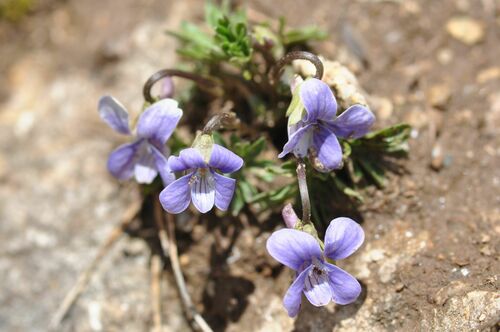
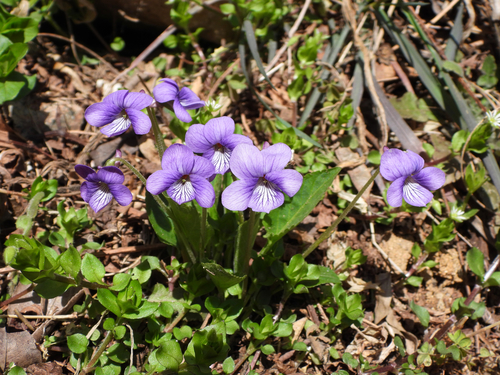
Viola biflora
L.
Twoflower violet, Arctic Yellow Violet
iNaturalist· cc0
no rights reserved, uploaded by 葉子
iNaturalist· cc-by-nc
(c) elin, some rights reserved (CC BY-NC)
Summary
Source: WikipediaViola biflora is a species of the genus Viola. It is also called alpine yellow-violet, arctic yellow violet, or twoflower violet. It is found in Europe, Siberia, Central Asia, India, Pakistan, western and northern China, North Korea, Japan, and Western North America. The species is listed as Vulnerable in the Canadian province of British Columbia, Yukon Territory, and the US state of Colorado.
Description
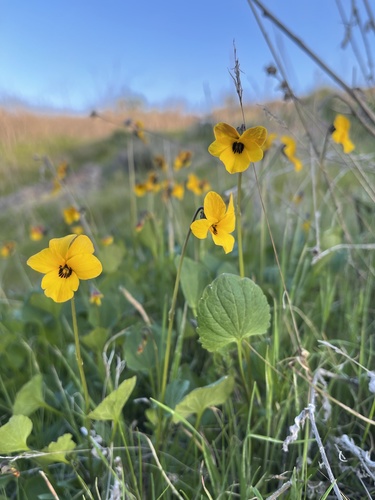
A herb. It grows 10-20 cm high and spreads 15-25 cm wide. It forms mounds. The leaves have shallow teeth and are faintly downy. The leaves are heart or kidney shaped. They are 30 mm long. The flowers are pale yellow with dark streaks. They are 18 mm wide.
Edible Uses
Young leaves and flower buds can be eaten raw or cooked. When added to soup they thicken it in much the same way as okra. The flowers are raw and usually yellow — caution is advised as plants with yellow flowers have been known to cause diarrhoea if eaten in large quantities. The leaves can be used to make a tea.
Traditional Uses
The leaves and flowers are used as a substitute for tea.
This uses section is brief — help expand it
Medicinal Uses
The root is emetic. The flowers are antispasmodic, diaphoretic, emollient, and pectoral. The leaves are emollient and laxative.
Known Hazards
Yellow flowers may cause diarrhea if consumed in large quantities.
Distribution
It is a temperate plant. It grows between 2000-4000 m altitude in Uttar Pradesh. In temperate China it grows on alpine meadows and grassy slopes between 2,500-4,300 m above sea level. It suits hardiness zones 3-9.
Where It Grows
Asia, Australia, Balkans, Bhutan, Bosnia, Central Asia, Europe, Himalayas, India, Indonesia, Japan, Korea, Malaysia, Mongolia, Myanmar, Nepal, North America, Norway, NW India, Russia, Scandinavia, SE Asia, Slovenia, Taiwan, Tajikistan, Tibet, USA,
Cultivation
Prefers a cool moist well-drained humus-rich soil in partial or dappled shade and protection from scorching winds. Tolerates sandstone and limestone soils but becomes chlorotic if the pH is too high. Prefers a pH between 6 and 6.5. All members of this genus have more or less edible leaves and flower buds, though those species with yellow flowers can cause diarrhoea if eaten in large quantities.
Propagation
Seed is best sown in autumn in a cold frame. Stored seed can be sown in early spring in a cold frame. Prick seedlings into individual pots when large enough to handle and plant out during summer. Divide plants in autumn or just after flowering. Larger divisions can go directly into permanent positions, but smaller divisions do best potted up and grown on in light shade in a greenhouse or cold frame until established, then planted out in summer or the following spring.
Other Uses
The stems and fragrant blossoms have been placed in clothes cupboards to impart a pleasant scent to clothing.
Notes
There are about 500 Viola species.
Synonyms
Also Known As
Dvocvjetna ljubicica, Dvocvetna vijolica, Fjellfiol, Pila banfsha, Vanfsa
References (10)
- Ambasta, S.P. (Ed.), 2000, The Useful Plants of India. CSIR India. p 679
- Cundall, P., (ed.), 2004, Gardening Australia: flora: the gardener's bible. ABC Books. p 1472
- Girard, N. J., 2020, Sustainable Foraging of Wild Edible Plants in Norway. A Biocultural Approach. M. Sc. thesis Norwegian University. p 136
- Hibbert, M., 2002, The Aussie Plant Finder 2002, Florilegium. p 307
- http://www.botanic-gardens-ljubljana.com/en/plants
Show all 10 references Hide references
- Negi, K.S., 1988, Some little known wild edible plants of U.P. Hills. J. Econ. Tax. Bot. Vol. 12 No. 2 pp 345-360
- Plants for a Future database, The Field, Penpol, Lostwithiel, Cornwall, PL22 0NG, UK. http://www.scs.leeds.ac.uk/pfaf/
- Rashid, A., Anand, V.K. & Serwar, J., 2008, Less Known Wild Plants Used by the Gujjar Tribe of District Rajouri, Jammu and Kashmir State. International Journal of Botany 4(2):219-244
- Redzic, S. J., 2006, Wild Edible Plants and their Traditional Use in the Human Nutrition in Bosnia-Herzegovina. Ecology of Food and Nutrition, 45:189-232
- Sp. pl. 2:936. 1753