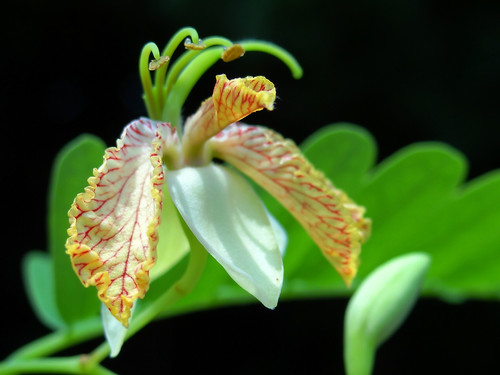
Hymenaea oblongifolia
Huber
Oblong leaf copal
iNaturalist· cc-by-nc
(c) Riley Fortier, some rights reserved (CC BY-NC), uploaded by Riley Fortier
iNaturalist· cc-by-nc
(c) Riley Fortier, some rights reserved (CC BY-NC), uploaded by Riley Fortier
Summary
Source: WikipediaHymenaea oblongifolia is a widespread species of flowering plant in the family Fabaceae, native to the várzea forest ecosystem of northern and western South America. A tree reaching 40 m (130 ft), it is harvested for its timber, and its edible fruit is also collected in the wild for sale. It is used as a street tree in Medellín, Colombia.
Description
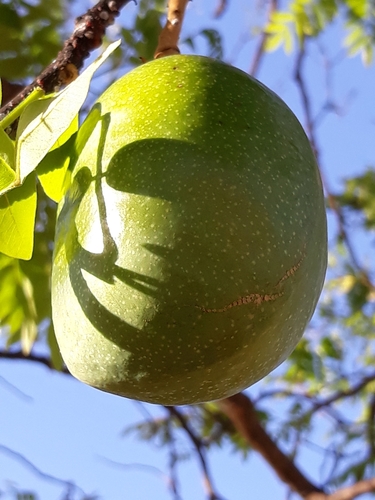
An evergreen tree. The crown is an umbrella shape. It grows 40 m tall. The trunk often has buttresses. The trunk can be 1 m across. The fruit have seeds surrounded by a white, powdery, sweet flesh.
Edible Uses
Fruit - raw. The seeds are surrounded by a white, powdery, sweet-tasting but odoriferous flesh. The fruit is an oblong pod (legume), 41 - 64mm long, 28 - 38mm wide and 13 - 26mm thick, containing several large seeds which are surrounded by a dry, white edible pulp.
Traditional Uses
The fruit pulp is eaten raw.
This uses section is brief — help expand it
Distribution
It is a tropical plant. It grows in non-flooded lowland forest. It is often in forests along riverbanks. It grows below 400 m above sea level.
Where It Grows
Amazon, Bolivia, Brazil, Colombia, Ecuador, Guyana, Peru, South America*, Suriname,
Propagation
Seed - it has a hard seedcoat and benefits from scarification before sowing to speed up and improve germination. This can usually be done by pouring a small amount of nearly boiling water on the seeds (being careful not to cook them!) and then soaking them for 12 - 24 hours in warm water. By this time they should have imbibed moisture and swollen - if they have not, then carefully make a nick in the seedcoat (being careful not to damage the embryo) and soak for a further 12 hours before sowing. Sow the treated seed in a partially shaded position in individual containers.
Other Uses
The bark contains an abundance of a pale yellow or reddish translucent gum, known as 'South American copal'. This gum often accumulates in the ground at the base of the tree and may be found in the soil (fossil gum) in large quantities long after the tree has disappeared. The resin is used in making certain cements and varnishes, and is also wrapped in corn husks and sold in cake form as incense for burning in churches. Traditionally, the bark was stripped from large trees and used for making native canoes that were capable of holding 25 - 30 people. Freshly cut heartwood is salmon red to orange brown, becoming russet to reddish brown when seasoned; it is sharply demarcated from the white, gray, or pinkish, usually wide layer of sapwood. The heartwood frequently is marked with dark streaks and may at times show a golden lustre. The grain is usually interlocked, but is occasionally straight; the texture is medium to coarse; there is no distinctive odour or taste in the seasoned wood. The wood is particularly attractive, resembling sugar maple on the radial surface and having a high lustrous sheen marked with scattered lines of vessels on the tangential surface. Quartersawn wood is particularly attractive due to the exposure of the radial surface on the top surface of the boards. The wood is very strong, hard to very hard, tough and heavy to very heavy. There are mixed reports on durability, possibly because the tree has a wide sapwood which is less durable that the heartwood. The heartwood is generally durable in the soil. The wood is moderately difficult to work, due largely to its high density. It nails badly but has good screw-holding power; takes glue well and turns satisfactorily; finishes smoothly but does not take a high polish. It is comparable to white oak in steam-bending properties and splits rather easily. It is used for heavy construction and parquet flooring. The wood's high shock resistance fits it admirably for use in sporting goods and for tool handles in place of ash. It is also suitable for steam-bent boat parts for which oak is generally used. As flooring and stair treads, it provides a very wear-resistant surface, which takes a fairly good polish. The timber has been recommended for veneer, because the characteristic wide sapwood layer in second-growth timber works well into natural and blond-finish furniture. Both the sapwood and heartwood are suitable for furniture, cabinetwork, interior trim, and turnery. European manufacturers have recently shown interest in the timber as a piano wood. Other purposes for which the wood is used include ship planking, tree-nails, gear cogs, wheel rims, general building construction, looms, naves and felloes of wheels, and as wooden parts in sugar mills and other mill machinery. It is also used to some extent for lock gates in areas free from marine borers.
Other Information
The fruit are enjoyed.
Notes
Also as Caesalpinaceae.
Synonyms
Also Known As
Algarrobo, Azucar huayo, Azucar muyo, Guiramonca, Guiramonacahue, Jatoba, Jutahy-miry, Jutai, Karapa, Minamocave, Parcunba, Pepa de axucar, Simiri, Sojo, Tocte, Widamonka, Widamonkawe, Yuru, Yutubanco
References (12)
- Altschul, S.V.R., 1973, Drugs and Foods from Little-known Plants. Notes in Harvard University Herbaria. Harvard Univ. Press. Massachusetts. no. 1652
- Asprilla-Perea, J., & Diaz-Puente, J.M., 2018, Traditional use of wild edible food in rural territories within tropical forest zones: A case study from the northwestern Colombia. New Trends and Issues Proceedings on Humanities and Social Sciences [Online]. 5(1), 162–181.
- Fern, K., 2012, Tropical Species Database http://theferns.info/tropical/
- Grandtner, M. M. & Chevrette, J., 2013, Dictionary of Trees, Volume 2: South America: Nomenclature, Taxonomy and Ecology. Academic Press p 312
- Kermath, B. M., et al, 2014, Food Plants in the Americas: A survey of the domesticated, cultivated and wild plants used for Human food in North, Central and South America and the Caribbean. On line draft. p 428
Show all 12 references Hide references
- Lopez-Diago, D. & Garcia, N., 2021, Wild edible fruits of Colombia. Biota ColomBiana 22 (2) p 37
- Pennington, T. D., et al, 2004, Illustrated Guide to the Trees of Peru.
- Philips, O., 1992, The potential for harvesting fruits in tropical rainforests: new data from Amazonian Peru. Biodiversity and Conservation 2, 18-38
- Reis, S. V. and Lipp, F. L., 1982, New Plant Sources for Drugs and Foods from the New York Botanical Garden herbarium. Harvard. p 126
- Roa, J. A. G. & Boada, D. S. G., 2018, Fundación para el Fortalecimiento de la Fruticultura y Plantas Alimenticias no Convencionales en Colombia.
- Torre, de la, L., et al, 2008, Enciclopedia de las Plantas Útiles del Ecuador. Herbario QCA. Pontificia Universidad Católica del Ecuador. p 341
- Vasquez, R. and Gentry, A. H., 1989, Use and Misuse of Forest-harvested Fruits in the Iquitos Area. Conservation Biology 3(4): 350f