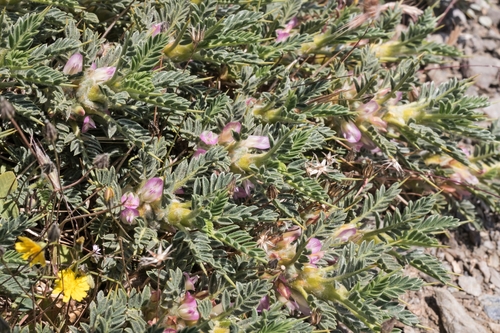
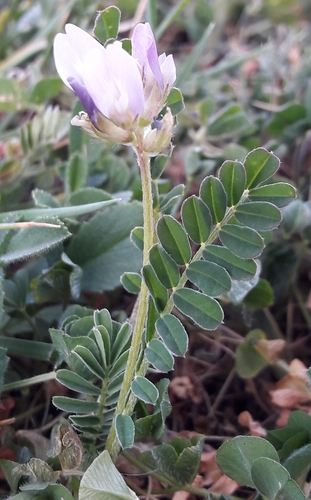
Hymenaea stigonocarpa
Mart. ex Hayne
Jutaicica, Spotted fruit copal
iNaturalist· cc-by-nc
(c) Estevão Fernandes de Souza, some rights reserved (CC BY-NC), uploaded by Estevão Fernandes de Souza
iNaturalist· cc-by-nc-sa
(c) Mauricio Mercadante, some rights reserved (CC BY-NC-SA)
Summary
Source: WikipediaHymenaea stiginocarpa is an irregularly shaped, mostly 6–9 m (20–30 ft) high tree that has been assigned to the pea family. It has a twisted spindle-shaped trunk, a very rough grey bark, and reddish-brown twigs. The deciduous leaves consist of two large asymmetrical leaflets with an entire margin. The flowers occur in clusters of up to thirty at the end of the branches. It produces edible, highly appreciated fruits, which are often collected from the wild and used by local people. The vernacular name of this species in Brazil is jatobá do cerrado.
Description
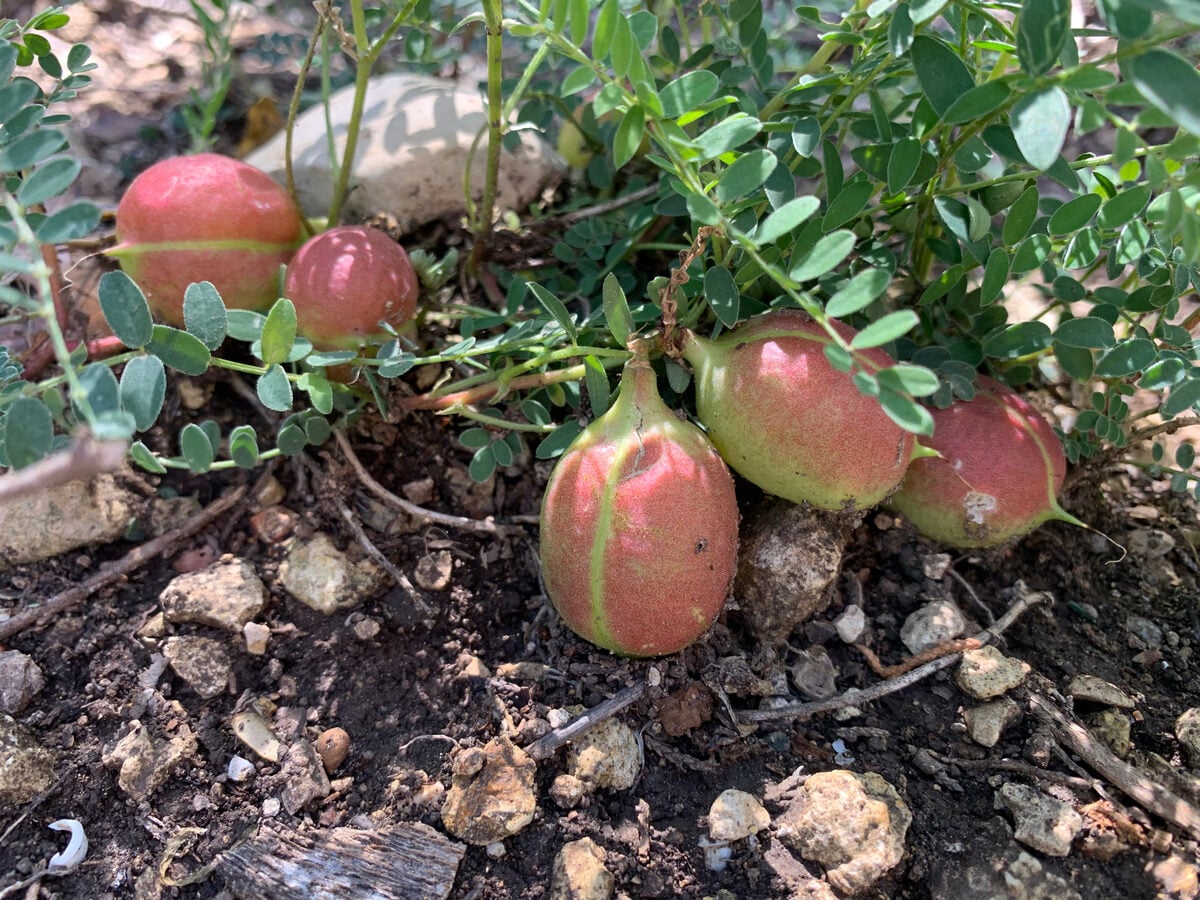
A tree. It grows 6-9 m high. The crown is an irregular shape. The trunk is 30-50 cm across. The leaves are compound and have short leaf stalks. The leaflets are 8-15 cm long. The flowers are in small groups at the ends of branches. The flowers are large and white. The fruit is a hard woody pod 12 cm long. There are 3-6 hard seeds. The pulp is white and has an aroma. It is sweet and edible.
Edible Uses
Jatobá do cerrado is an important tree for the people of the Brazilian Cerrado, and it represents a substantial economic value with its high quality wood, resin and edible fruits. These fruits can be used to produce flour and in the preparation of different types of food. With the increasing demand for the products of this plant, there is a need for commercial cultivation and for growing high quality seedlings. Jatobá fruit pulp contains about 5½% protein, and almost 50% high-fibre flour consisting of 40% non-soluble fibre and about 9% soluble fibre. Basic nutritional components, vitamins and minerals of Jatobá do cerrado fruit pulp The flour made from jatobá is appreciated by the local people in the Cerrado and used to prepare jelly, liqueur, cakes, breads and porridge. The resin from the stems of jatobá do cerrado is used to polish canoes, and to produce varnishes. Scholars showed a large variation in genetics between and within subpopulations that corresponds to variability in the weight of the fruit, and this provides perspective for breeding varieties with more favourable traits for human use. Seedlings can be grown in plastic bags with 50% shading, and do best in a mineral soil without organic compost and in a greenhouse. H. stigonocarpa grows best in a sunny spot and prefers well-drained soil. When established, the trees are somewhat resistant to drought. In general, it grows slowly. Jatobá do cerrado is sometimes planted as an ornamental. One study showed that extracts of H. stigonocarpa suppressed cell division in onions, and this may imply that it contains some cytotoxic substance.
Traditional Uses
The floury pulp of the fruit is eaten fresh or used for porridge, cakes and bread.
This uses section is brief — help expand it
Medicinal Uses
The resin obtained from the base of the tree is balsamic, bechic, stomachic, tonic and vulnerary. The sap that flows from bore holes the trunk is considered to be fortifying and wound healing. It is used for treating chronic cystitis, urine retention, anaemia, prostatitis, blennorrhagia and chronic bronchitis. The bark is astringent and pectoral. A decoction of the bark, in a bath, is used as a treatment for skin diseases.
Distribution
It is a tropical plant. It grows in the savannas and barren lands in Brazil.
Where It Grows
Amazon, Bolivia, Brazil*, Paraguay, South America, Venezuela,
Cultivation
Plants are grown from seed. The ripe pods are harvested and allowed to open in the sun. Seed will only store for 4 months. Fresh seed should be planted. They germinate in 15-25 days. Seedlings develop quickly and can be transplanted into the field in 4 months.
Propagation
Seed - it has a hard seedcoat and benefits from scarification before sowing to speed up and improve germination. This can usually be done by pouring a small amount of nearly boiling water on the seeds (being careful not to cook them!) and then soaking them for 12 - 24 hours in warm water. By this time they should have imbibed moisture and swollen - if they have not, then carefully make a nick in the seedcoat (being careful not to damage the embryo) and soak for a further 12 hours before sowing. Sow the treated seed in a partially shaded position in individual containers.
Other Uses
A resin is obtained from the base of the trunk. It is used medicinally. The roots and trunk yield a pale yellow or red resin-like gum known commercially as 'South American copal'. The gum obtained from tapping the trunk is soft and considered to be of lower quality - it is used mainly for medicinal purposes. The best quality gum is quite old - it is found in hard lumps that have become buried in the soil at the base of a tree or at the site of a dead tree. A minor source of the gum (it is obtained mainly from Hymenaea courbaril), it can be used in making varnishes but also for incense and local medicines. The copal is also used for patent leather, as an adhesive for crockery and in stains for tin ware. The heartwood and sapwood are distinctly demarcated. The wood is heavy, very hard and resistant, with moderate durability. It is suitable for house building and was at one time widely used for ship building.
Production
Plants grow slowly.
Other Information
It is a popular food.
Notes
Also as Caesalpinaceae. It is a good source of Vitamin C and folates.
Nutrition
| Part | Moisture | kJ | kcal | Protein | Vit A | Vit C | Iron | Zinc |
|---|---|---|---|---|---|---|---|---|
| Fruit | 8.6 | 1132 | 272 | 6.1 | — | 4.7 | 1.1 | 1 |
| Fruit | 8.8 | — | 193 | 5.6 | — | — | — | 1.4 |
Also Known As
Jatai, Jatiba-do-cerrado, Jatoba-capo, Jatoba-cascudo, Jatoba-de-casca-fina, Jatobero, Jitai, Jutai
References (11)
- Bortolotto, I. M., et al, 2015, Knowledge and use of wild edible plants in rural communities along Paraguay River, Pantanal, Brazil. Journal or Ethnobiology and Ethnomedicine. 11:46
- Bortolotto, I. M., et al, 2018, Lista preliminar das plantas alimenticias nativas de Mato Grosso do Sul, Brasil. Iheringia, Serie Botanica, Porto Alegre, 73 (supl.):101-116
- Brazil: Biodiversity for Food and Nutrition. http://www.b4fn.org/countries/brazil/
- Cardoso, L. et al, 2013, 'Jatoba do cerrado' (Hymenaea stigonocarpa): chemical composition, caretenoids and vitamins in an exotic fruit from the Brazilian Savannah. Fruits, vol 68, p. 95-107
- Grandtner, M. M. & Chevrette, J., 2013, Dictionary of Trees, Volume 2: South America: Nomenclature, Taxonomy and Ecology. Academic Press p 312
Show all 11 references Hide references
- Kermath, B. M., et al, 2014, Food Plants in the Americas: A survey of the domesticated, cultivated and wild plants used for Human food in North, Central and South America and the Caribbean. On line draft. p 429
- Leticia, Z., et al, 2015, Do Socioeconomic characteristics explain the knowledge and use of native food plants in semiarid environments in Northeastern Brazil? Journal of Arid Environments 115:53-61
- Lorenzi, H., 2002, Brazilian Trees. A Guide to the Identification and Cultivation of Brazilian Native Trees. Vol. 01 Nova Odessa, SP, Instituto Plantarum p 173
- Lorenzi, H., Bacher, L., Lacerda, M. & Sartori, S., 2006, Brazilian Fruits & Cultivated Exotics. Sao Paulo, Instituto Plantarum de Estuados da Flora Ltda. p 140
- Paz, F. S., et al, 2021, Edible Fruit Plant Species in the Amazon Forest Rely Mostly on Bees and Beetles as Pollinators. Journal of Economic Entomology, XX(XX), 2021, 1–13
- Peres, M. K., 2011, Diasporos do Cerrado Atrativos para Fauna: Chave Interativa Caracterizacao Visual e Relacoes Ecologicas. Masters thesis. Universidade de Brasilia.