Viburnum edule
(Michx.) Raf.
Mooseberry, Cranberry tree, Highbush cranberry
iNaturalist· cc-by-nc
(c) suzanne53, some rights reserved (CC BY-NC)
iNaturalist· cc-by-nc
(c) Reece Redeye-Desposito, some rights reserved (CC BY-NC)
iNaturalist· cc-by-nc
(c) Reece Redeye-Desposito, some rights reserved (CC BY-NC)
Summary
Source: WikipediaViburnum edule, the squashberry, mooseberry, moosomin, moosewood viburnum, pembina, pimina, highbush cranberry, or lowbush cranberry is a species of shrub. It grows up to 2.5 metres (8 ft) tall and has smooth branches. The species is native to Canada and the northern United States. The tart berries ripen early in spring and are eaten by various animals. With the seeds removed, they are edible to humans as well, and can be made into jam.
Description
A shrub. It grows 2 m tall. The leaves have 3 lobes. They are crinkled on the upper surface and hairy underneath. They have long stalks. They turn red in autumn. The flowers are white and in small clusters. These are 1-2.5 cm wide. The fruit are red and bitter. They occur in clusters of 2-5.
Edible Uses
The fully ripe fruit can be eaten raw or cooked. It has a mildly acid, pleasant taste and is highly valued for making jam. The ovoid fruit is about 8mm long and contains a single large seed. It is best enjoyed before a frost with the skin removed, though some Native American groups preferred to wait until after the first frost to harvest. The fruit can also be dried for winter use. Some caution is advised regarding toxicity. Flowers can be used in fritters.
Traditional Uses
The fruit can be dried. The fully ripe fruit can be eaten raw. They are usually cooked. They are used for juice or jelly. They can also be used for tarts.
Medicinal Uses
The bark is antispasmodic and astringent. An infusion of crushed inner bark has been used to treat dysentery and as a purgative. The bark has been chewed and the juice swallowed for whooping cough and colds on the lungs. A decoction of the stems treats coughs, and an infusion of the leaves and stems serves as a gargle for sore throats. Twig tips have also been chewed and the juice swallowed for sore throats. A poultice of chewed, unopened flower buds has been applied to lip sores. A decoction of the roots has been used to treat teething-related sickness.
Distribution
It is a cold temperate plant. It grows as an understorey species in forests. It grows in moist woodlands. In Canada it grows from sea level to moderate elevations in the mountains.
Where It Grows
Alaska, Asia, Britain, Canada, Europe, North America, USA,
Cultivation
Plants can be grown from seeds. It can also be grown from cuttings.
Propagation
Seed is best sown in a cold frame as soon as it is ripe. Germination can be slow, sometimes taking more than 18 months. Seed harvested green — fully developed but not yet fully ripe — and sown immediately in a cold frame should germinate the following spring. Stored seed needs 2 months of warm stratification followed by 3 months of cold stratification, and may still take 18 months to germinate. Prick seedlings into individual pots when large enough to handle and grow on in a cold frame or greenhouse, planting out in late spring or early summer the following year. Softwood cuttings taken in early summer in a frame should be potted individually once rooting begins and planted out the following late spring or early summer. Half-ripe cuttings, 5–8cm long with a heel if possible, taken in July or August in a frame, should be potted as soon as they root. These can be difficult to overwinter and are best kept under glass until spring before planting out. Mature wood cuttings taken in winter in a frame should root in early spring; pot when large enough and plant out in summer if sufficient new growth has formed, otherwise overwinter in a frame and plant out the following spring. Layering of the current season's growth in July or August takes 15 months.
Other Uses
The stems have been used to reinforce the rims of birch bark baskets.
Notes
There are about 150 Viburnum species. Also put in the family Adoxaceae. Also put in the family Caprifoliaceae.
Nutrition
| Part | Moisture | kJ | kcal | Protein | Vit A | Vit C | Iron | Zinc |
|---|---|---|---|---|---|---|---|---|
| Fruit | 89 | 176 | 42 | 0.1 | — | 13.4 | 0.3 | 0.1 |
Synonyms
Also Known As
Agautaat, Low bush cranberry, Moosewood, Squashberry
References (24)
- Beckstrom-Sternberg, Stephen M., and James A. Duke. "The Foodplant Database." http://probe.nalusda.gov:8300/cgi-bin/browse/foodplantdb.(ACEDB version 4.0 - data version July 1994) (As Viburnum pauciflorum)
- Cormack, R. G. H., 1967, Wild Flowers of Alberta. Commercial Printers Edmonton, Canada. p 330
- Elias, T.S. & Dykeman P.A., 1990, Edible Wild Plants. A North American Field guide. Sterling, New York p 227, 253, p 224 (Also as Viburnum pauciflorum)
- Esperanca, M. J., 1988. Surviving in the wild. A glance at the wild plants and their uses. Vol. 2. p 252
- Facciola, S., 1998, Cornucopia 2: a Source Book of Edible Plants. Kampong Publications, p 72
Show all 24 references Hide references
- Farrar, J.L., 1995, Trees of the Northern United States and Canada. Iowa State University press/Ames p 178
- Fisk, J. R. & Hoover, E., 2015, Wild Fruits of Minnesota. A Field Guide. University of Minnesota p 20
- Fl. N. Amer. 2:17. 1841 (As Viburnum pauciflorum)
- Heller, C. A., 1962, Wild Edible and Poisonous Plants of Alaska. Univ. of Alaska Extension Service. p 53
- Holloway, P. S. & Alexander, G., 1990, Ethnobotany of the Fort Yukon Region, Alaska. Economic Botany, Vol. 44, No. 2 pp. 214-225
- Janick, J. & Paul, R. E. (Eds.), 2008, The Encyclopedia of Fruit & Nuts. CABI p 7
- Jernigan, K. (Ed.), 2012, A Guide to the Ethnobotany of the Yukon-Kuskokwim Region. Draft.
- Jones, A., 2010, Plants that we eat. University of Alaska Press. p 131
- Kermath, B. M., et al, 2014, Food Plants in the Americas: A survey of the domesticated, cultivated and wild plants used for Human food in North, Central and South America and the Caribbean. On line draft. p 906
- Kuhnlein, H. V., et al, 2009, Indigenous Peoples' food systems. FAO Rome
- MacKinnon, A., et al, 2009, Edible & Medicinal Plants of Canada. Lone Pine. p 126
- Med. Repos. ser. 2. 5:354. 1808
- Moerman, D. F., 2010, Native American Ethnobotany. Timber Press. p 594
- Plants for a Future database, The Field, Penpol, Lostwithiel, Cornwall, PL22 0NG, UK. http://www.scs.leeds.ac.uk/pfaf/
- Porsild, A.E., 1974, Rocky Mountain Wild Flowers. Natural History Series No. 2 National Museums of Canada. p 370
- Scotter, G. W., & Flygare, H., 1993, Wildflowers of the Canadian Rockies. Hurtig. p 42
- Turner, N., 1995, Food Plants of Coastal First Peoples. Royal BC Museum Handbook p 69
- Turner, N., 1997, Food Plants of Interior First Peoples. Royal BC Museum Handbook p 105
- Turner, N., et al, 2011, "Up on the Mountain": Ethnobotanical Important of Montane Sites in Pacific Coastal North America. Journal of Ethnobiology 31(1): 4-43
More from Adoxaceae
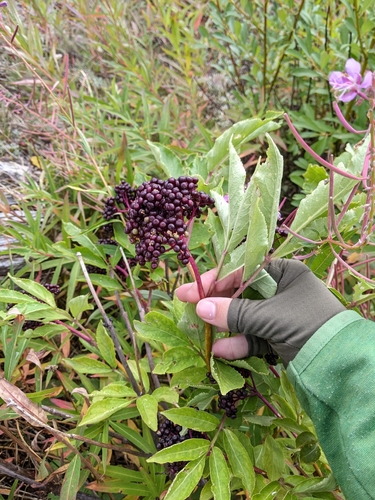
Sambucus melanocarpa
Black berried elder, Black elder, Blackbead elderberry
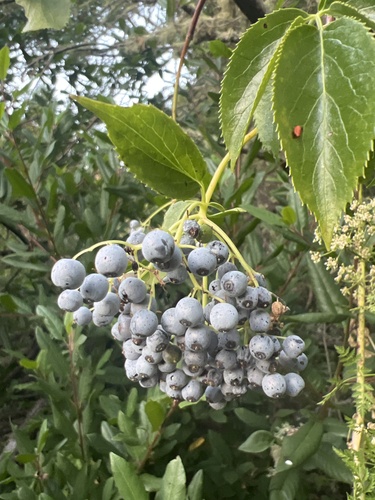
Sambucus mexicana
Mexican elderberry
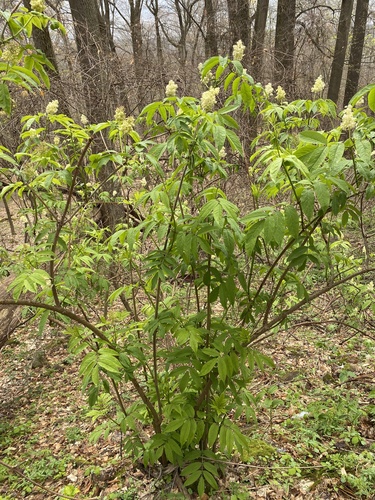
Sambucus microbotrys
Red elder, European Red Elderberry

Sambucus nigra
European Elderberry, Black Elder
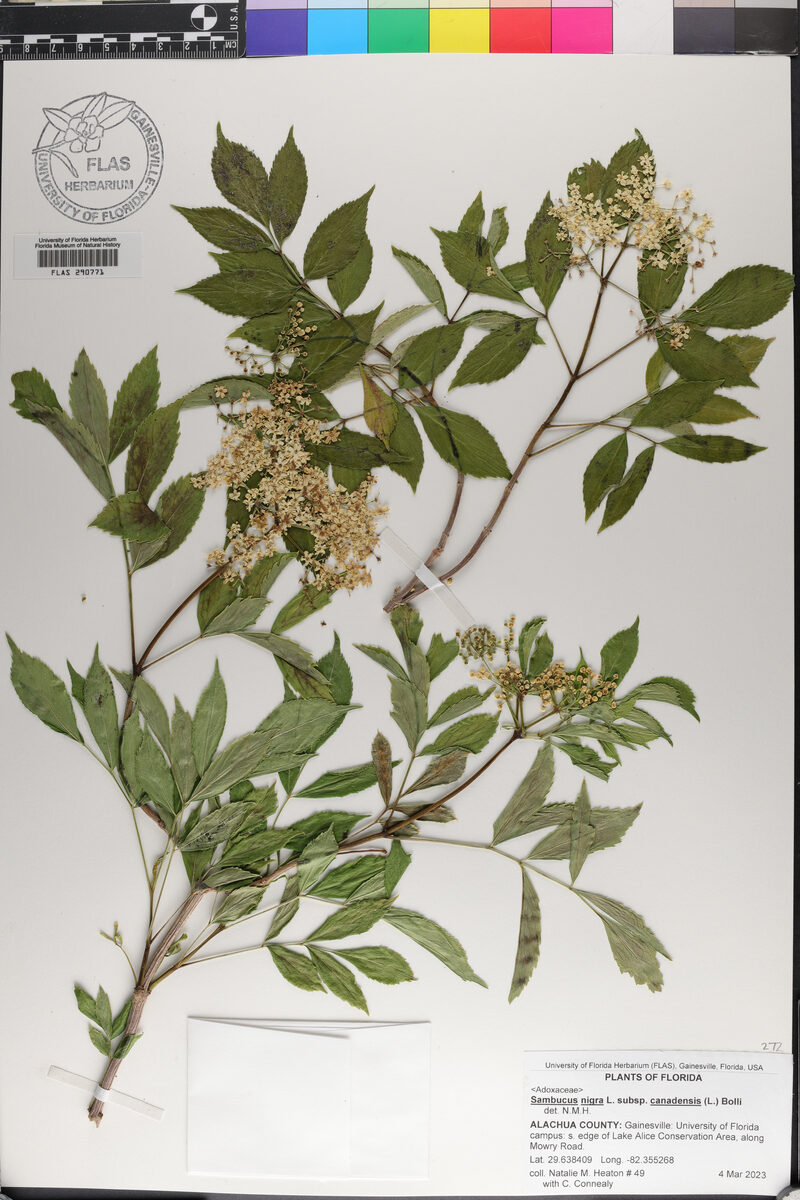
Sambucus nigra subsp. canadensis
Canadian elderberry
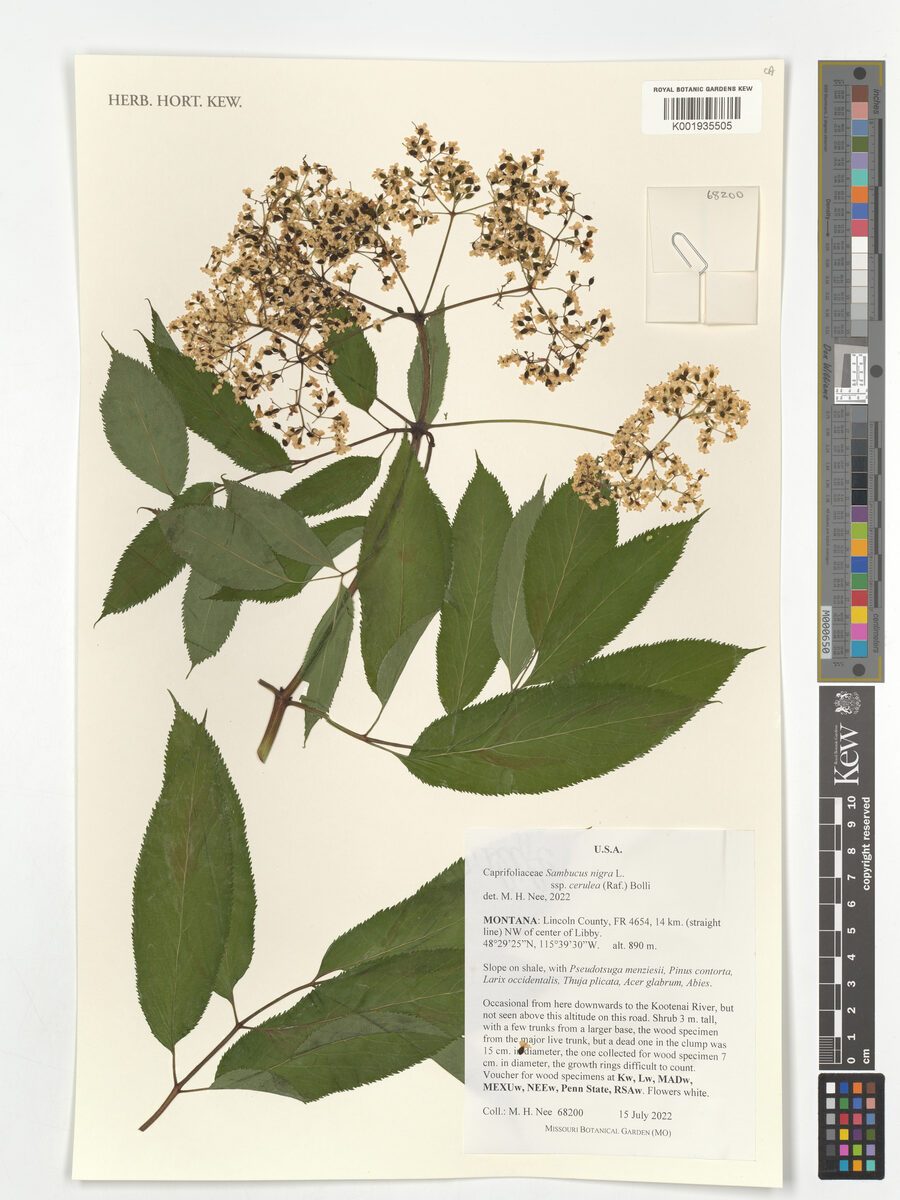
Sambucus nigra subsp. cerulea
Blue black elder