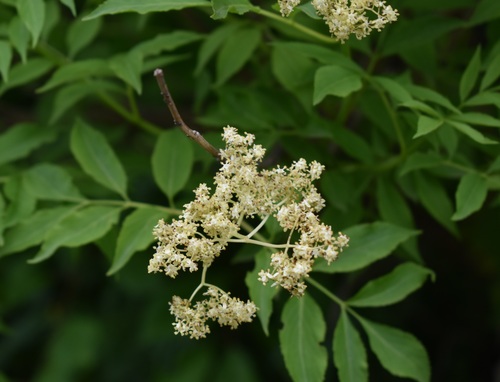
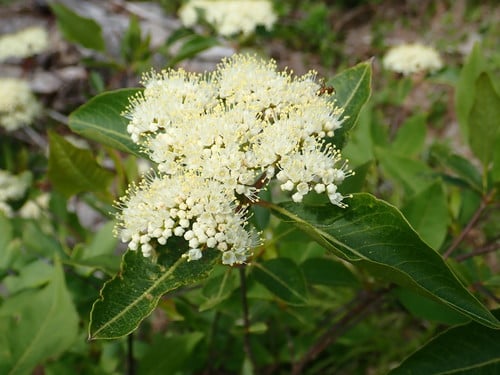
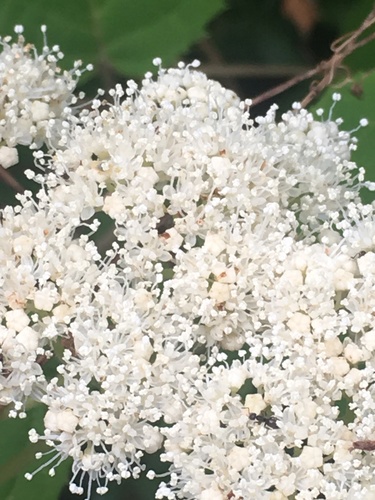
Sambucus nigra subsp. cerulea
(Raf.) Bolli
Blue black elder
gbif· cc-by
Royal Botanic Gardens, Kew
gbif· cc-by-nc
SDSU - Vascular Plants of the San Diego State University Herbarium (SDSU-SDSU)
gbif· cc-by-nc
SDSU - Vascular Plants of the San Diego State University Herbarium (SDSU-SDSU)
Summary
Source: WikipediaSambucus nigra is a species complex of flowering plants in the family Viburnaceae native to most of Europe. Common names include elder, elderberry, black elder, European elder, European elderberry, and European black elderberry. It grows in a variety of conditions including both wet and dry fertile soils, primarily in sunny locations. The plant is widely grown as an ornamental shrub or small tree. Both the flowers and the berries have a long tradition of culinary use, primarily for cordial and wine. Although the plant is commonly used in dietary supplements and traditional medicine, there is no scientific evidence that it provides any significant health benefit.
Description
A tree.
This description is brief — help expand it
Edible Uses
The dark blue or purple berries are mildly poisonous in their raw state, but are edible after cooking. They can be used to make jam, jelly, chutney, and Pontack sauce. In Scandinavia and Germany, soup made from the elderberry (e.g. the German Fliederbeersuppe) is a traditional meal. Commonly, the flowerheads are used in infusions, giving a drink in Northern Europe and the Balkans. These drinks are sold commercially as elderflower cordial or elderflower pressé. In Europe, the flowers are made into a syrup or cordial (in Romanian: socată, in Swedish: fläder(blom)saft, in Danish: hyldeblomstsaft / hyldedrik), which is diluted with water before drinking. The popularity of this traditional drink recently has encouraged some commercial soft drink producers to introduce elderflower-flavoured drinks (Fanta Shokata, Freaky Fläder). The flowers also may be dipped into a light batter and then fried to make elderflower fritters. The berries may be made into elderberry wine. In Hungary, an elderberry brandy is made that requires 50 kilograms of fruit to produce 1 litre of brandy. In south-western Sweden, it is traditional to make a snaps liqueur flavoured with elderflower. Elderflowers are used in liqueurs such as St-Germain, and in a mildly alcoholic sparkling elderflower 'champagne', although a more alcoholic home-made version can be made. In Beerse, Belgium, a variety of jenever called beers vlierke is made from the berries.
Traditional Uses
The fruit are eaten. The dried and fresh berries are used to make jelly. They are cooked and used in pies. The fruit are dried and stored for later use.
Medicinal Uses
This plant is used in traditional medicine by native peoples and herbalists. Extracts of the flowers and fruits are used for cold and flu symptoms, although there is no high-quality clinical evidence that it is effective for treating any disease.
Known Hazards
Components of the elderberry plant, including its fruit, contain diverse phytochemicals, such as alkaloids, lectins, and cyanogenic glycosides, which may be toxic if consumed raw. The seeds and all green parts of the plant contain cyanogenic glycosides. Consumption of berries, leaves, bark or stems, if not properly prepared, may cause nausea, vomiting, and severe diarrhea. Elderberry plant constituents or products should not be consumed during pregnancy or by people with allergies or gastrointestinal diseases. Elderberry products may cause adverse effects when used with prescription drugs.
Distribution
It is a temperate plant.
Where It Grows
Canada, Mexico, North America, USA,
Notes
Also put in the family Sambucaceae.
Dangerous Lookalikes
This plant can be confused with the following toxic species. Always verify identification carefully before consuming any wild plant.
Pokeweed
Phytolacca americana
Jakec
Blue black elder
Sambucus nigra subsp. cerulea
Royal Botanic Gardens, Kew
Pokeweed: Thick red/purple herbaceous stems (no bark), berries in a line (raceme), simple large leaves, large white taproot.
Blue black elder: Woody bark, berries in broad flat clusters (cymes), compound leaves with 5-7 leaflets.
Synonyms
Also Known As
Sabugueiro, Saco, Sauco
References (4)
- Grandtner, M. M., 2008, World Dictionary of Trees. Wood and Forest Science Department. Laval University, Quebec, Qc Canada. (Internet database http://www.wdt.qc.ca)
- Kermath, B. M., et al, 2014, Food Plants in the Americas: A survey of the domesticated, cultivated and wild plants used for Human food in North, Central and South America and the Caribbean. On line draft. p 782
- Moerman, D. F., 2010, Native American Ethnobotany. Timber Press. p 512
- Turner, N., et al, 2011, "Up on the Mountain": Ethnobotanical Important of Montane Sites in Pacific Coastal North America. Journal of Ethnobiology 31(1): 4-43