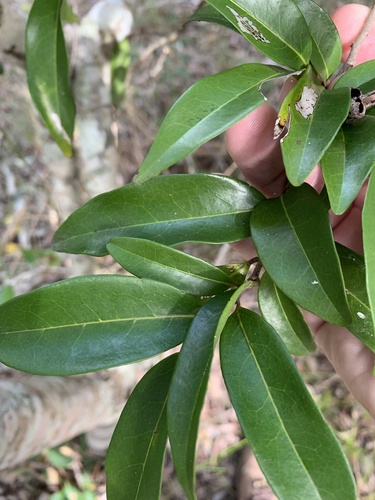
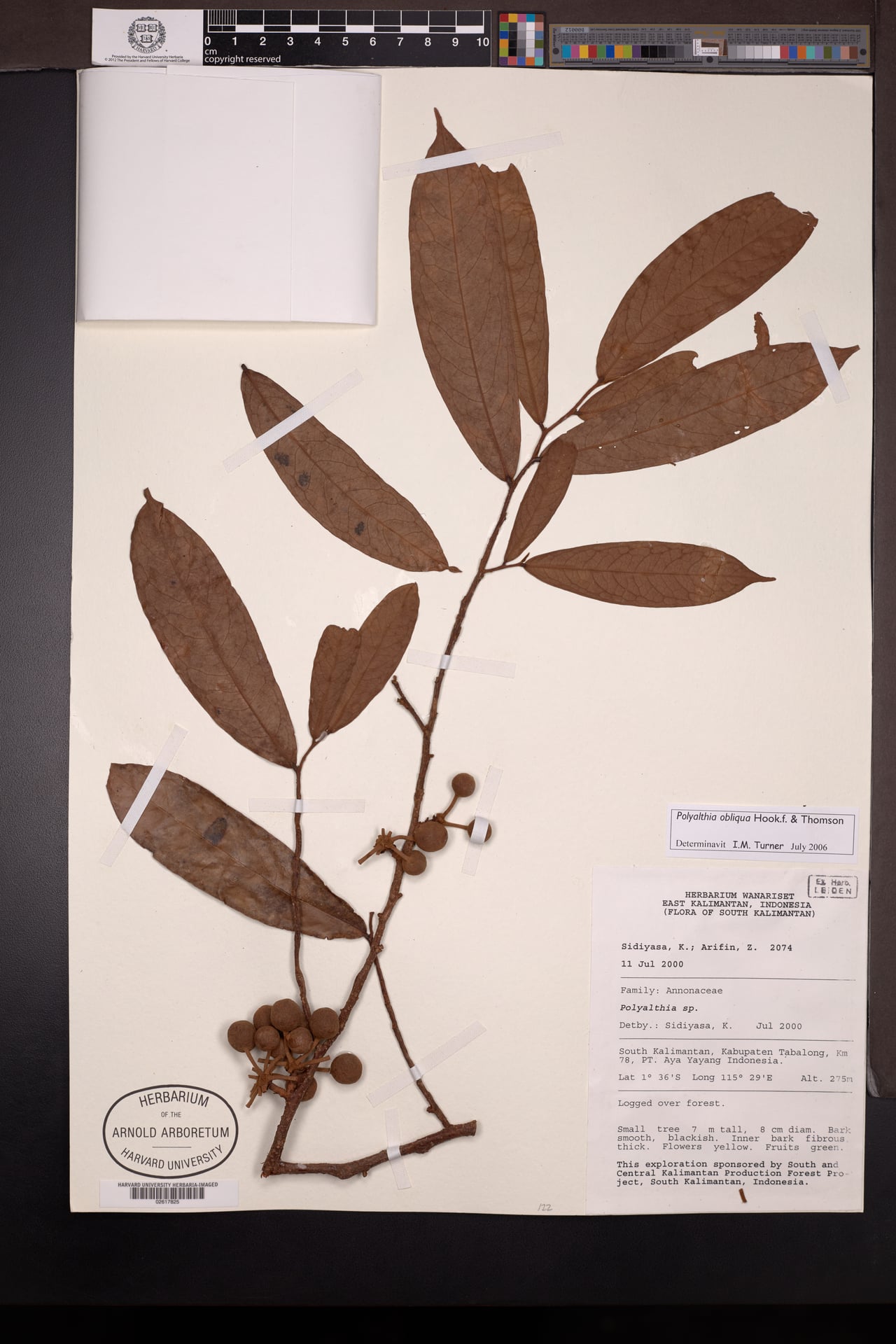
Uvaria rufa

Blume

Torres strait scrambler, Sweet gum tree

iNaturalist· cc-by-nc

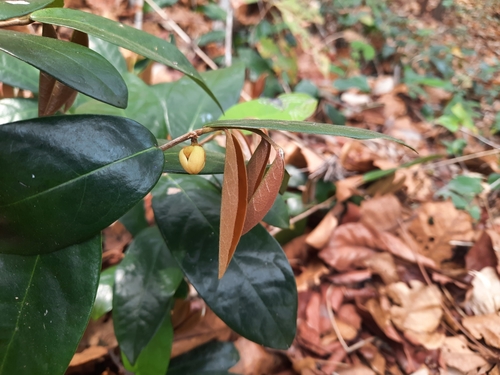
(c) Scott Zona, some rights reserved (CC BY-NC)

iNaturalist· cc-by-nc

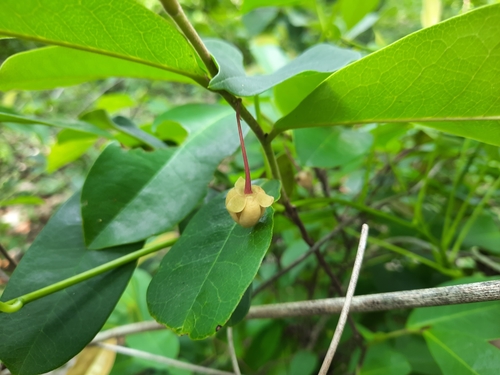
(c) Rui Da Silva Pinto, some rights reserved (CC BY-NC), uploaded by Rui Da Silva Pinto

iNaturalist· cc-by-nc

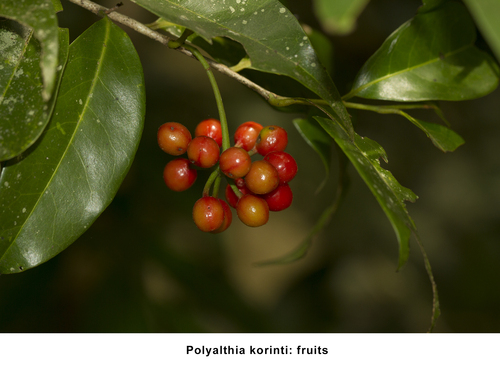
(c) Naufal Urfi Dhiya'ulhaq, some rights reserved (CC BY-NC), uploaded by Naufal Urfi Dhiya'ulhaq

Uvaria rufa is a species of vines or shrubs commonly known as susung-kalabaw ('Carabao teats') or Torres Strait scrambler, of the plant family Annonaceae. It grows naturally in Cambodia (where it is called /triəl svaː/ ទ្រៀលស្វា), Laos, Thailand, New Guinea, more widely in Malesia and in Cape York Peninsula Australia.

Description

A climbing shrub or creeper. It grows up to 20 m long. The younger parts are covered with hairs. The leaves are alternate and hairy. They are pointed at the tip and heart shaped at the base. They are 8 to 16 cm long. The flowers have a sweet smell. The fruit are borne in rounded clusters. They are oval, hairy and red. They contain two rows of flat semicircular seeds.

Edible Uses

The fruits of Uvaria rufa are edible, having a sharp sweet-sour taste. They are known colloquially as Suso ng kalabaw or susung-kalabaw ('Carabao teats') because of its physical appearance. The wood is also used as a Rattan substitute in making furniture and handicrafts.

Traditional Uses

The ripe fruit are eaten raw or cooked as a vegetable. The dried fruit are used as a masticatory.

This uses section is brief — help expand it

Medicinal Uses

An alcoholic tincture of the roots is used as an oxytocic. The bark has been shown to contain alkaloids.

Distribution

A tropical plant. They occur from central Luzon to southern Mindanao in the Philippines in small areas of shrub and in forests at low altitudes. It grows in southern China in mountainous sparse forests between 400-1700 m. altitude. In Yunnan.

Where It Grows

Asia, Australia, China, Cambodia, Cuba, East Timor, India, Indochina, Indonesia, Laos, Malaysia, Pacific, Papua New Guinea, PNG, Philippines, SE Asia, Singapore, Thailand, Timor-Leste, Torres Strait, Vietnam, West Indies,

Cultivation

They are sometimes cultivated. Plants can be grown by seeds.

Production

In NE Thailand fruit are ripe March to May.

Nutrition

PartMoisturekJkcalProteinVit AVit CIronZinc
Fruit90.2146350.70.6

Synonyms

Arinathan, V., et al, 2007, Wild edibles used by Palliyars of the western Ghats, Tamil Nadu. Indian Journal of Traditional Knowledge. 6(1) pp 163-168 Brown, W.H., 1920, Wild Food Plants of the Philippines. Bureau of Forestry Bulletin No. 21 Manila. p 58 Burkill, I.H., 1966, A Dictionary of the Economic Products of the Malay Peninsula. Ministry of Agriculture and Cooperatives, Kuala Lumpur, Malaysia. Vol 2 (I-Z) p 2256 (As Uvaria ridleyi) Cengel, D. J. & Dany, C., (Eds), 2016, Integrating Forest Biodiversity Resource Management and Sustainable Community Livelihood Development in the Preah Vihear Protected Forest. International Tropical Timber Organization p 123 Cooper, W. and Cooper, W., 2004, Fruits of the Australian Tropical Rainforest. Nokomis Editions, Victoria, Australia. p 28 Coronel, R.E., 1982, Fruit Collections in the Philippines. IBPGR Newsletter p 8 Cowie, I, 2006, A Survey of Flora and vegetation of the proposed Jaco-Tutuala-Lore National Park. Timor-Lests (East Timor) www.territorystories.nt/gov.au p 42 Fl. Jav. Anon. 19, T. 4 + 13. 1828 Also Food Composition Tables for use in East Asia FAO http://www.fao.org/infoods/directory No. 832 (As Uvaria ruva) Hu, Shiu-ying, 2005, Food Plants of China. The Chinese University Press. p 399 Maghirang, R. G., et al, 2018. Ethnobotanical Studies of Some Plants Commonly Used as Vegetables in Selected Provinces of the Philippines. Journal of Nature Studies. 17(2), 30-43. Menisa, A. A., et al, 2012, Survey and characterization of Indigenous Food Plants in Ilocos Norte, Philippines. SEARCA Discussion Paper series No. 2011-2 Miguel, E., et al, 1989, A checklist of the cultivated plants of Cuba. Kulturpflanze 37. 1989, 211-357 Milow, P., et al, 2013, Malaysian species of plants with edible fruits or seeds and their evaluation. International Journal of Fruit Science. 14:1, 1-2 Monsalud, M.R., Tongacan, A.L., Lopez, F.R., & Lagrimas, M.Q., 1966, Edible Wild Plants in Philippine Forests. Philippine Journal of Science. p 441 Mua Bioversity Profile, 2013, Profile for Management of the Habitats and Related Ecological and Cultural Resources of Mua Island. Torres Strait Regional Authority Land & Sea Management Unit. p 32 Natuhara, Y., et al, 2011, Uses of trees in paddy fields in Champasak Province, Southern Lao PDR. Landscape and Ecological Engineering. p 6 Pham-Hoang Ho, 1999, An Illustrated Flora of Vietnam. Nha Xuat Ban Tre. p 251 Phon, P., 2000, Plants used in Cambodia. © Pauline Dy Phon, Phnom Penh, Cambodia. p 619 Polinag, M. A., 2003, Food from the Wilderness. Department of Environment and Natural Resources. Laguna. Sukarya, D. G., (Ed.) 2013, 3,500 Plant Species of the Botanic Gardens of Indonesia. LIPI p 986 Suksri, S., et al, 2005, Ethnobotany in Bung Khong Long Non-Hunting Area, Northeast Thailand. Kasetsart J., (Nat. Sci) 39: 519-533 Turreira Garcia, N., et al, 2017, Ethnobotanical knowledgeof the Kuy and Khmer people in Prey Lang, Cambodia. Cambodian Journal of Natural History 2017 (1): 76-101 World Checklist of Useful Plant Species 2020. Royal Botanic Gardens, Kew

More from Annonaceae