Ulmus wallichiana
Planch.
West Himalayan Elm, Large-leaved elm
iNaturalist· cc-by-nc
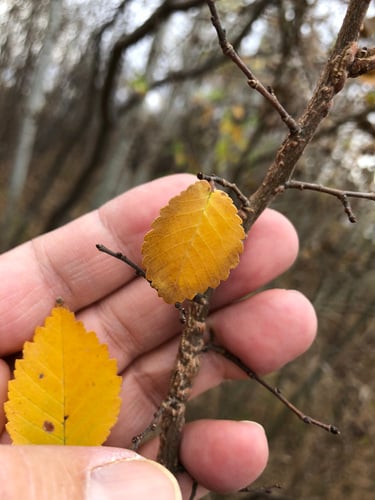
(c) Rajendra Koranga, some rights reserved (CC BY-NC), uploaded by Rajendra Koranga
Summary
Source: WikipediaUlmus wallichiana Planch., the Himalayan elm, also known as the Kashmir elm and Bhutan elm, is a mountain tree ranging from central Nuristan in Afghanistan, through northern Pakistan and northern India to western Nepal at elevations of 800–3000 m. Its common name is occasionally used in error for the cherry bark elm Ulmus villosa, which is also endemic to the Kashmir, but inhabits the valleys, not the mountain slopes, and is dissimilar in appearance. The species is closely related to the wych elm U. glabra.
Description
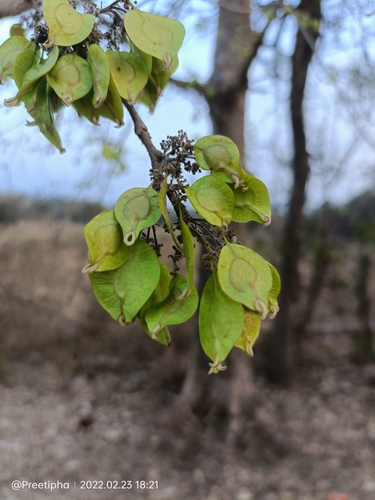
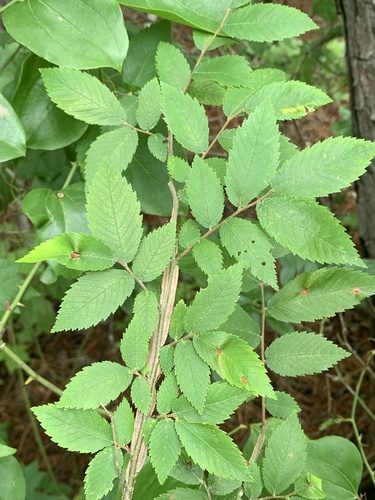
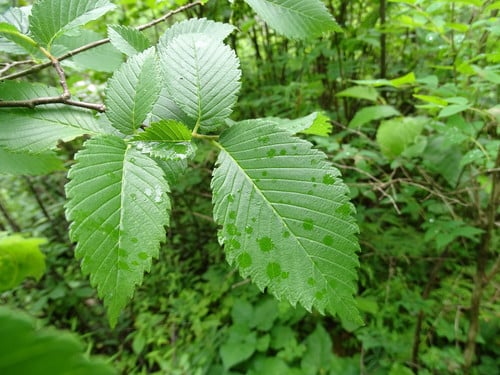
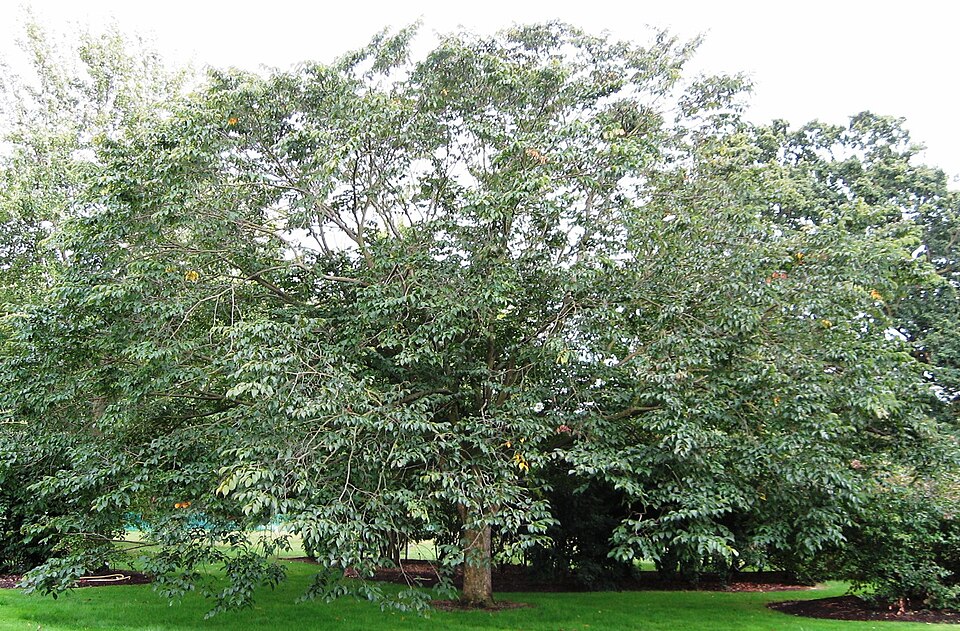
A large tree. It loses its leaves during the year. It grows 30 m tall. The crown is spreading. The leaves are alternate and rough. They have double teeth. The leaves are 8-10 cm long and have 15-20 pairs of parallel veins. There are many flowers and they are 3 mm long. They are in round heads. The fruit are winged and narrowly oval. They are in the axils of fallen leaves. The fruit is a nutlet. It has a papery wing around it. It is 1.5 cm across.
Edible Uses
The leaves can be eaten raw or cooked.
Medicinal Uses
Used in treatments relating to the skin.
Distribution
It grows in temperate oak forests in the Himalayas. It grows between 1,500-3,000 m altitude.
Where It Grows
Afghanistan, Asia, Himalayas, India, Nepal, NW India, Pakistan,
Cultivation
Prefers a fertile soil in full sun, but is easily grown in any soil of at least moderate quality so long as it is well drained. Susceptible to 'Dutch elm disease' according to one report, whilst another says that it might be resistant.This disease that has destroyed the greater part of all the elm trees growing in Britain. The disease is spread by means of beetles. There is no effective cure (1992) for the problem, but most E. Asian, though not Himalayan, species are resistant (though not immune) to the disease so the potential exists to use these resistant species to develop new resistant hybrids with the native species. The various species of this genus hybridize freely with each other and pollen is easily saved, so even those species with different flowering times can be hybridized.
Propagation
Seed sown in a cold frame as soon as it is ripe usually germinates within a few days. Stored seed germinates less reliably and is best sown in early spring. Seed can also be harvested green — fully developed but before drying on the tree — and sown immediately in a cold frame, where it germinates quickly and produces a larger plant by the end of the growing season. Once large enough to handle, prick seedlings into individual pots and grow on in a greenhouse through their first winter, then plant out in late spring or early summer after the last expected frosts. Do not leave plants in a nursery bed for more than two years, as they develop a tap root and transplant poorly after that point. Can also be propagated by layering suckers or coppiced shoots.
Other Uses
A strong fibre obtained from the inner bark is used for cordage, slow matches, and sandals. The young shoots can be made into strong ropes. Burning the twigs produces ash from which a dye can be extracted, though the resulting colour is not recorded. The wood is fairly hard, somewhat scented, and fine grained with a good polish, making it suitable for furniture.
Other Information
It is cultivated.
Synonyms
Also Known As
Amroi, Brari, Brera, Breri, Chambar maya, Emroi, Imroi, Kain, Mai, Mairu, Maral, Mareen, Mored, Pabuna
References (8)
- Ambasta, S.P. (Ed.), 2000, The Useful Plants of India. CSIR India. p 660
- Ann. Sci. Nat. Bot. ser. 3, 10:277. 1848
- Flora of Pakistan. www.eFloras.org
- Khan, M. A., 2010, An Ethnobotanical Inventory of HImalayan Region Poonch Valley Azad Kashmir (Pakistan). Ethnobotany Research & Applications 8: 107-123
- Marinelli, J. (Ed), 2004, Plant. DK. p 126
Show all 8 references Hide references
- Plants for a Future database, The Field, Penpol, Lostwithiel, Cornwall, PL22 0NG, UK. http://www.scs.leeds.ac.uk/pfaf/
- Sahni, K.C., 2000, The Book of Indian Trees. Bombay Natural History Society. Oxford. p 151
- Zeven, A. C. & de West, J. M. J., 1982, Dictionary of cultivated plants and their regions of diversity. Wageningen. p 86