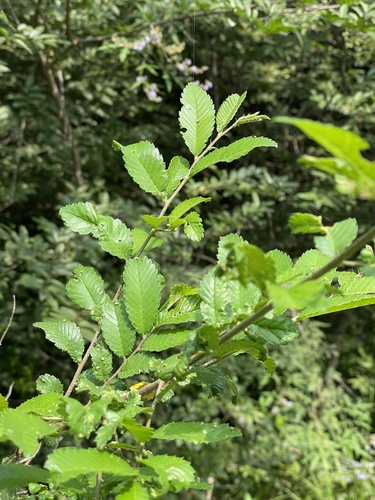
Ulmus alata
Michx.
Winged elm, Cork elm, Wahoo
iNaturalist· cc-by-nc
(c) Teri, some rights reserved (CC BY-NC), uploaded by Teri
iNaturalist· cc-by-nc
(c) Laurie Sheppard, some rights reserved (CC BY-NC)
Summary
Source: WikipediaUlmus alata, the winged elm or wahoo, is a small- to medium-sized deciduous tree endemic to the woodlands of the southeastern and south-central United States. The species is tolerant of a wide range of soils, and of ponding, but is the least shade-tolerant of the North American elms. Its growth rate is often very slow, the trunk increasing in diameter by less than 5 mm (3⁄16 in) per year. The tree is occasionally considered a nuisance as it readily invades old fields, forest clearings, and rangelands, proving particularly difficult to eradicate with herbicides.
Description
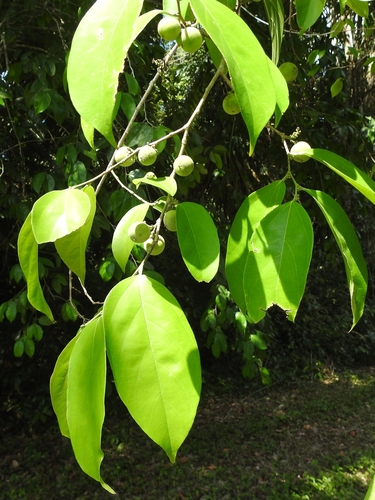
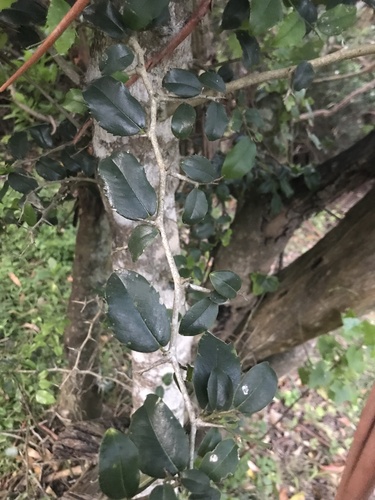
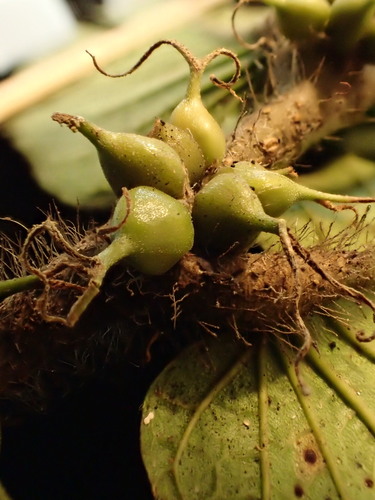
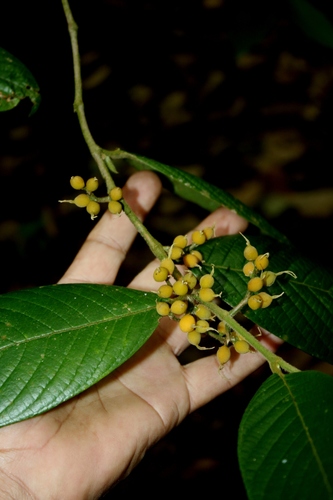
A tree. It has a short trunk. The crown is open and rounded. It grows 12-24 m high. The trunk can be 50 cm across. The bark is light brown and thin with irregular cracks. The leaves are in 2 rows. They are 3-6 cm long. They are narrowly oval and often slightly curved. The sides are unequal and there are double teeth along the edge. The mid vein is yellow. There are many straight side veins. The leaves are thick and firm. They are dark green above and have soft hairs underneath. They turn yellow in autumn. The flowers are 3 mm wide and green. They are clustered along the twigs. The fruit are 10 mm long and flat and reddish. They have 1 seed. They have narrow wings with 2 curved points at the tip.
Edible Uses
The leaves can be eaten raw or cooked.
Medicinal Uses
No medicinal uses are currently known for this species.
Distribution
It grows in dry uplands and moist valleys. In the southern USA it grows up to 600 m altitude.
Where It Grows
North America, USA,
Cultivation
Prefers a fertile soil in full sun, but can be grown in any soil of at least moderate quality so long as it is well drained. A fast-growing tree in its native range, but this species does not thrive in Britain. Closely related to U. thomasii. Susceptible to 'Dutch elm disease', a disease that has destroyed the greater part of all the elm trees growing in Britain. The disease is spread by means of beetles. Mature trees killed back by the disease will often regrow from suckers, but these too will succumb when they get larger. There is no effective cure (1992) for the problem, but most E. Asian, though not Himalayan, species are resistant (though not immune) to the disease so the potential exists to use these resistant species to develop new resistant hybrids with the native species. The various species of this genus hybridize freely with each other and pollen is easily saved, so even those species with different flowering times can be hybridized.
Propagation
Seed sown in a cold frame as soon as it is ripe usually germinates within a few days. Stored seed germinates less reliably and is better sown in early spring. Seed can also be harvested green — when fully developed but before it dries on the tree — and sown immediately in a cold frame for rapid germination and a larger plant by the end of the season. Once large enough to handle, prick seedlings into individual pots and grow on in the greenhouse through the first winter before planting out in late spring or early summer after the last expected frosts. Plants should not be left in a nursery bed for more than two years as they develop a tap root and transplant poorly. Layering of suckers or coppiced shoots is also possible.
Other Uses
The inner bark is highly fibrous and can be used as string. The wood is close-grained, heavy, hard, not particularly strong, brittle, and difficult to split, weighing approximately 46lb per cubic foot. It is not considered as strong as other elms but is used for tool handles, wheel hubs, and similar applications.
Notes
There are 30-45 Ulmus species.
References (3)
- Fl. bor.-amer. 1:173. 1803
- Little, E.L., 1980, National Audubon Society Field Guide to North American Trees. Alfred A. Knopf. p 418
- Plants for a Future database, The Field, Penpol, Lostwithiel, Cornwall, PL22 0NG, UK. http://www.scs.leeds.ac.uk/pfaf/