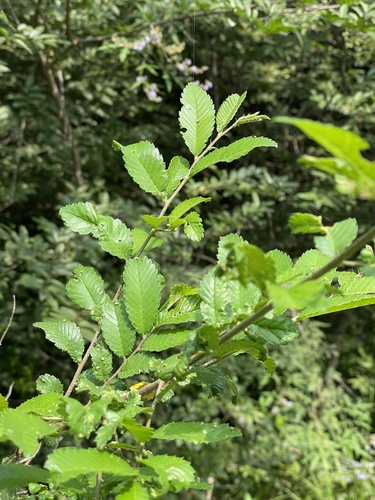
Ulmus rubra
Muhl.
Slippery elm, Red elm, Soft elm
iNaturalist· cc-by
(c) Zihao Wang, some rights reserved (CC BY), uploaded by Zihao Wang
iNaturalist· cc-by-sa
(c) Douglas Goldman, some rights reserved (CC BY-SA), uploaded by Douglas Goldman
iNaturalist· cc-by
(c) Evan M. Raskin, some rights reserved (CC BY), uploaded by Evan M. Raskin
Summary
Source: WikipediaUlmus rubra, the slippery elm, is a species of elm native to eastern North America. Other common names include red elm, gray elm, soft elm, moose elm, and Indian elm. It is closely related to the European wych elm (U. glabra), which has a very similar flower structure but lacks the pubescence over the seed.
Description
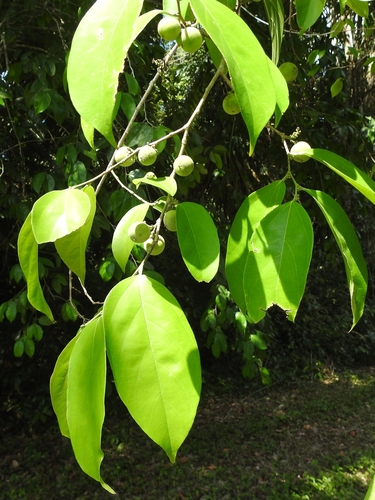
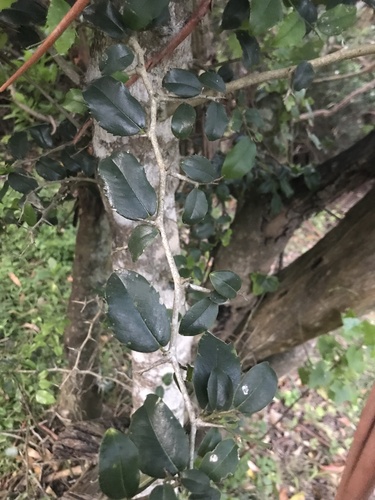
A medium sized tree. It grows to 25 m tall. The trunk is 60 cm across. The bark is dark brown and deeply furrowed. The inner bark is slimy. The crown is open and flat topped. The branches are spreading. The leaves are large and rough. They are in 2 rows and 10-18 cm long and 5-7.5 cm wide. They are narrowly oval with an abrupt long point. The base is rounded and the sides are very unequal. There are double teeth along the edge. There are straight parallel veins along each side. The leaves are thick. They are dark green and rough above and have soft hairs underneath. They turn dull yellow in autumn. The flowers are 3 mm wide and green. There are many flowers on short stalks along the twigs. The fruit are 12-19 mm long. They are 1 seeded keys. They have light green broad and hairless wings.
Edible Uses
Leaves can be eaten raw or cooked. The inner bark can be eaten raw or cooked; it can be dried, ground into a powder and used as a thickener in soups or added to cereal flours when making bread. It can also be chewed as a thirst quencher, or cooked with fats to prevent them turning rancid. Immature fruit, about 20mm in diameter, can be eaten raw or cooked. A tea-like beverage can also be brewed from the inner bark.
Traditional Uses
The inner bark is dried and ground and mixed with milk and eaten. It is also chewed when fresh. The bark is brewed into tea.
This uses section is brief — help expand it
Medicinal Uses
Slippery elm bark is a widely used herbal remedy, considered particularly valuable for soothing irritated mucous membranes of the chest, urinary tubules, stomach and intestines. The inner bark contains large quantities of a sticky mucilage that can be dried to a powder or prepared as a liquid. It is harvested in spring from the main trunk and larger branches, then dried and powdered for use. Ten-year-old bark is considered best. Fine grades of powder are preferred for internal use; coarser grades are better suited to poultices. The inner bark is demulcent, diuretic, emollient, expectorant and nutritive. It soothes and heals tissues it contacts and is used to treat sore throats, indigestion, digestive irritation and stomach ulcers. It was historically used as a nutritive tonic food for the elderly, young and convalescents, and applied externally to fresh wounds, burns and scalds. The bark has also been used as an antioxidant to prevent fats going rancid. The plant is included in the North American formula known as essiac, used as a popular cancer treatment alongside Arctium lappa, Rumex acetosella and Rheum palmatum; its effectiveness has not been reliably proven or disproven as controlled studies have not been carried out. The whole bark, including the outer bark, has been used as a mechanical irritant to abort foetuses; this use has become so widespread that it is now banned in several countries.
Known Hazards
Outer bark constituents known to cause abortions - avoid during pregnancy.
Distribution
It is a temperate plant. It grows best on rich soils along streams. In the USA it grows up to 600 m altitude. It suits hardiness zones 3-9.
Where It Grows
Australia, Canada, North America, Turkey, Türkiye, USA,
Cultivation
Prefers a fertile soil in full sun, but can be grown in any soil of at least moderate quality so long as it is well drained. Plants are hardy to about -10°c. A moderately fast-growing tree, living about 200 years in the wild, but although perfectly hardy, this species does not usually thrive in Britain. Trees are often harvested in the wild for their edible inner bark, the 'slippery elm' that can be obtained from chemists and health food shops. Trees have been over-exploited in the wild, plus they have also suffered from Dutch elm disease. As a result they are becoming much less common. The slippery elm is very susceptible to 'Dutch elm disease', a disease that has destroyed the greater part of all the elm trees growing in Britain. The disease is spread by means of beetles. There is no effective cure (1992) for the problem, but most E. Asian, though not Himalayan, species are resistant (though not immune) to the disease so the potential exists to use these resistant species to develop new resistant hybrids with the native species. The various species of this genus hybridize freely with each other and pollen is easily saved, so even those species with different flowering times can be hybridized.
Propagation
Sow seed in a cold frame as soon as it is ripe — it usually germinates within a few days. Stored seed germinates less reliably and should be sown in early spring; one report notes it requires 2–3 months of stratification. Seed can also be harvested green (fully developed but not yet dried on the tree) and sown immediately in a cold frame, where it will germinate quickly and produce a larger plant by the end of the season. Once large enough to handle, prick seedlings into individual pots and grow on in a greenhouse through their first winter. Plant out in late spring or early summer after the last expected frosts. Do not leave plants in a nursery bed for more than two years, as they develop a tap root and transplant poorly after that point. Propagation is also possible by layering suckers or coppiced shoots.
Other Uses
A fibre from the inner bark is used to make twine. Boiled bark has been used for matting and nets, and the inner bark has been used in basket making. The bark has also served as a roofing material, and weathered bark has been used as kindling. The wood is very close-grained, tough, heavy, hard, strong, durable and easy to split. It weighs 43lb per cubic foot and is used for fence posts, window sills and agricultural implements.
Production
Trees live for 125 years.
Synonyms
References (14)
- Beckstrom-Sternberg, Stephen M., and James A. Duke. "The Foodplant Database." http://probe.nalusda.gov:8300/cgi-bin/browse/foodplantdb.(ACEDB version 4.0 - data version July 1994) (As Ulmus fulva)
- Bremness, L., 1994, Herbs. Collins Eyewitness Handbooks. Harper Collins. p 89
- Facciola, S., 1998, Cornucopia 2: a Source Book of Edible Plants. Kampong Publications, p 243
- Farrar, J.L., 1995, Trees of the Northern United States and Canada. Iowa State University press/Ames p 358
- Gard. dict. ed. 8: Ulmus no. 2. 1768
Show all 14 references Hide references
- Hedrick, U.P., 1919, (Ed.), Sturtevant's edible plants of the world. p 663
- Jackes, D. A., 2007, Edible Forest Gardens
- Jordan, J., et al, 2006, Vascular Plants Utilized by the Plains Apache in Southwestern Oklahoma, Publications of the Oklahoma Biological Survey. 2nd Series. Volume 7: 24-33, 2006
- Kermath, B. M., et al, 2014, Food Plants in the Americas: A survey of the domesticated, cultivated and wild plants used for Human food in North, Central and South America and the Caribbean. On line draft. p 887
- Little, E.L., 1980, National Audubon Society Field Guide to North American Trees. Alfred A. Knopf. p 423
- Lord, E.E., & Willis, J.H., 1999, Shrubs and Trees for Australian gardens. Lothian. p 75
- MacKinnon, A., et al, 2009, Edible & Medicinal Plants of Canada. Lone Pine. p 64
- Moerman, D. F., 2010, Native American Ethnobotany. Timber Press. p 577
- Plants for a Future database, The Field, Penpol, Lostwithiel, Cornwall, PL22 0NG, UK. http://www.scs.leeds.ac.uk/pfaf/