Torreya taxifolia
Arn.
Florida torreya, Stinking cedar
iNaturalist· cc-by
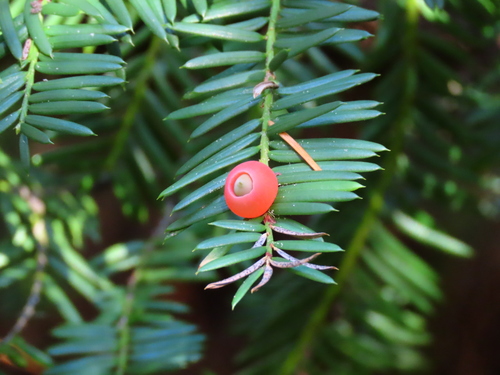
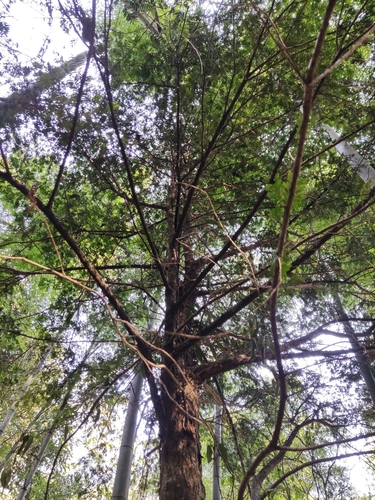
(c) Malcolm Manners, some rights reserved (CC BY)
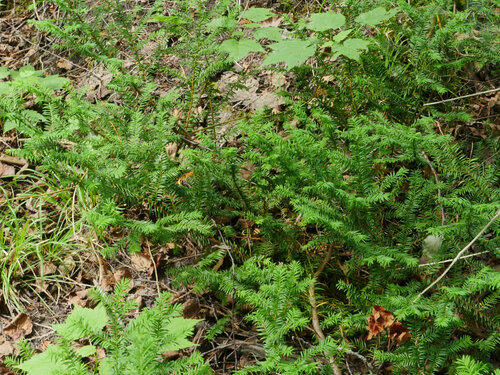
iNaturalist· cc-by-nc
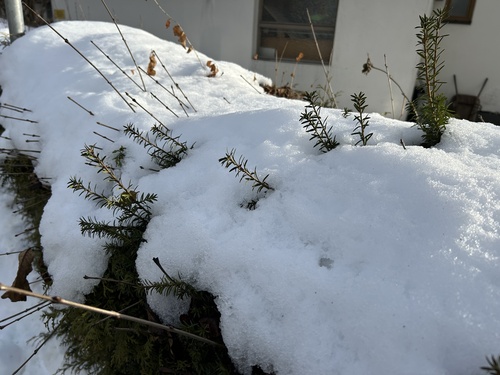
(c) Briarwood Nature Preserve, some rights reserved (CC BY-NC)
iNaturalist· cc-by-nc
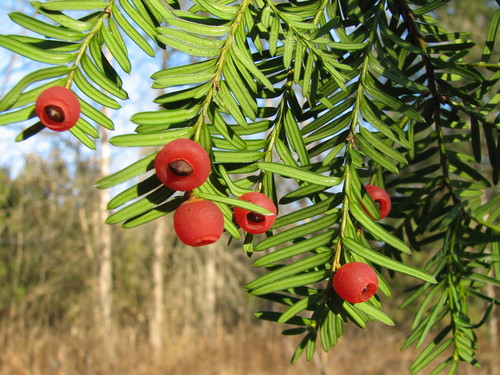
(c) amaya_, some rights reserved (CC BY-NC)
Summary
Source: WikipediaTorreya taxifolia, commonly known as Florida torreya or stinking-cedar, but also sometimes as Florida nutmeg or gopher wood, is an endangered subcanopy tree of the yew family, Taxaceae. It is native to only a small glacial refugium in the southeastern United States, at the state border region of northern Florida and southwestern Georgia.
Description
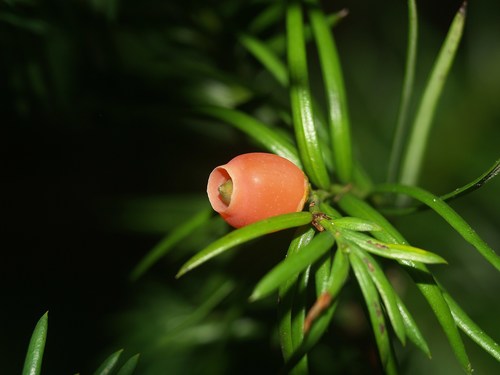
A small evergreen tree. It has an unpleasant smell. The crown is open and cone shaped. The bark is brown and thin. It has irregular cracks. The branches spread horizontal. It grows 9 m high and the trunk can be 30 cm across. The needles are 2.5-4 cm long by 3 mm wide. They spread in 2 rows. They have a long sharp tip. They are slightly curved and flattened but rounded on the back. They are dark green above and paler with 2 light bands underneath. The seeds and male cones are on separate trees. The seeds are 2.5-3 cm long. They occur singly and are narrowly oval but more broad above the middle. They have a fleshy dark green outer layer. The inner layer is light red brown. The male or pollen cones are 6 mm long. They are pale yellow and occur singly at the base of the leaves.
Edible Uses
The nuts are edible.
Known Hazards
Globally, Torreya taxifolia has been listed as a "critically endangered" species on the IUCN Red List of Threatened Species since 1998. Determinations made by the International Union for the Conservation of Nature primarily affect international trade prohibitions. Within-habitat restrictions and commercial trade are promulgated and administered in the United States by the federal government and relevant states. In 1984, the U.S. Fish and Wildlife Service listed Torreya taxifolia as endangered, in accordance with the Endangered Species Act of 1973, as amended prior to that time. This action was preceded by several federally sponsored overviews of plants for early consideration, and finally by a proposal to list the species, published in the Federal Register in 1983. The federal proposal included information on existing state regulations in Florida and in Georgia that offered protection for the species, and the additional protection that federal listing would provide: "Torreya taxifolia is offered protection under Florida Law, Chapter 65—426, Section 865.06 which includes prohibitions concerning taking, transport, and the selling of plants listed under that law. Torreya taxifolia is also included under Georgia's Wild Flower Preservation Act of 1973 which prohibits taking from public lands and intrastate transport and sale of certain rare plant species. The Endangered Species Act would offer additional protection for the species through the recovery process and interstate/international trade prohibitions." While listing offers legal protection, preventing extinction and working toward full recovery require plans and actions. Two years after declaring the species as endangered, in 1986 the U.S. Fish and Wildlife Service published a recovery plan. The chief tactic was to produce a genetically diverse collection of trees for reproduction and reintroduction into the wild. Other priorities were to protect the habitat of remaining populations, and to study the disease and methods of propagation. Only two updates of the federal recovery plan have been published since the 1986 original recovery plan. There was an update in 2010 and another in 2020. Because the federal publications are mandated to contain complete, factual, and up-to-date information on endangered species, the 2020 update will be the primary reference for sections on this page dealing with conservation actions. Policy was also expressed in a legal document in 2021, in the agency's 2021 "Finding on a Petition to Downlist the Florida Torreya." This document is primarily relevant in the "Conservation controversies" section of this page.
Distribution
It is a subtropical plant. It grows on banks near rivers and in moist valleys. They are mostly below 30 m altitude in Florida.
Where It Grows
North America, USA,
Notes
It is an endangered plant. Also put in the family Cephalotaxaceae.
References (3)
- Ann. Nat. Hist. 1:130. 1838
- Little, E.L., 1980, National Audubon Society Field Guide to North American Trees. Alfred A. Knopf. p 274
- Menninger, E.A., 1977, Edible Nuts of the World. Horticultural Books. Florida p 160