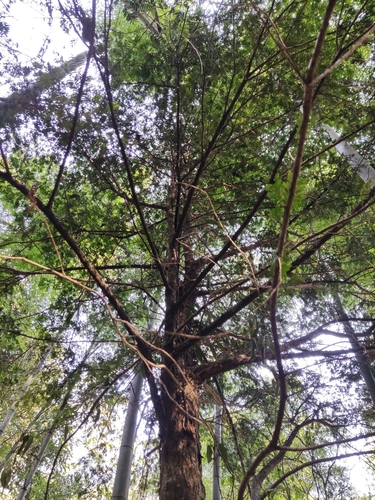
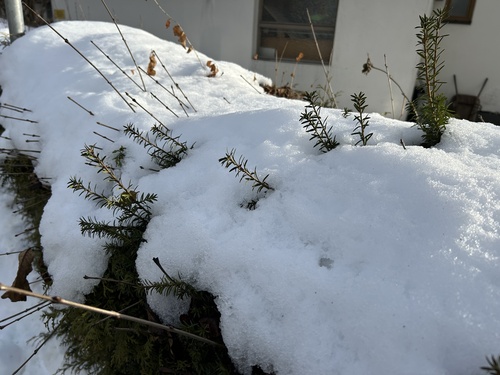
Taxus canadensis
Marshall
Canadian yew, Ground hemlock
iNaturalist· cc-by-nc
(c) Michael Werner, some rights reserved (CC BY-NC), uploaded by Michael Werner
iNaturalist· cc0
no rights reserved
Summary
Source: WikipediaTaxus canadensis, the Canada yew or Canadian yew, is a conifer native to central and eastern North America, thriving in swampy woods, ravines, riverbanks and on lake shores. Locally called simply as "yew", this species is also referred to as American yew or ground-hemlock. Most of its range is well north of the Ohio River. It is, however, found as a rare ice age relict in some coves of the Appalachian Mountains. The southernmost colonies are known from Ashe and Watauga Counties in North Carolina.
Description
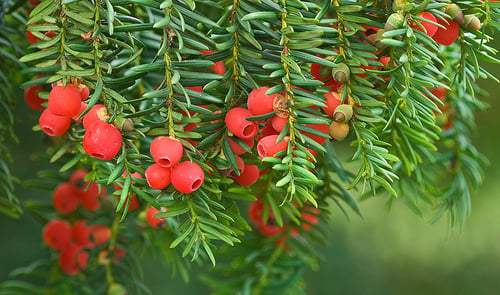
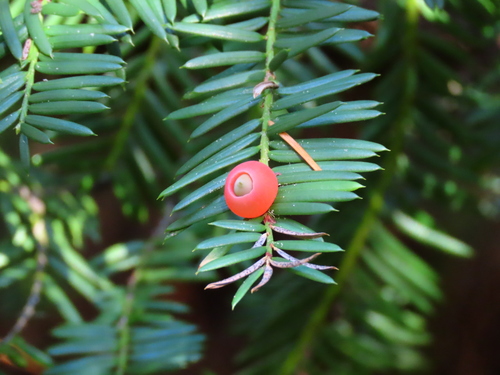
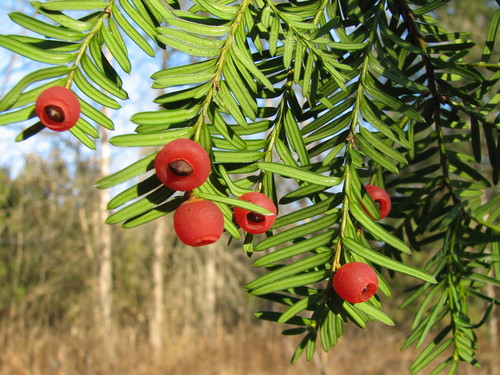
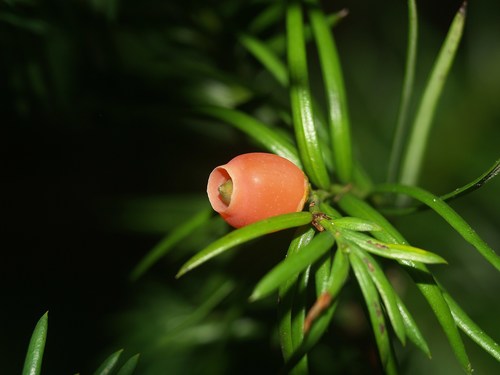
A shrub with many stems. It is straggling. It grows to 2 m high. It does not have a trunk. The stems trail in the layers of humus. They have tips which turn upwards. The needles are single and pale green. The fruit are small and grow amongst the leaves. They are red and fleshy and 8 mm long.
Edible Uses
The fleshy fruit can be eaten raw. It is very sweet and gelatinous — most people find it delicious, though some find it sickly. Each berry is about 8mm in diameter and contains a single seed. All other parts of this plant, including the seed, are highly poisonous. When eating the fruit, the seed should be spat out. Swallowing the seed whole may allow it to pass through without harm, but if it has been bitten into, it could cause problems.
Traditional Uses
CAUTION: The seeds are poisonous and tea from the leaves is poisonous. The fruit are fermented with water and maple water to make a beer. The ripe fruit can be eaten fresh, but not the seed.
Medicinal Uses
The Canadian yew is a very poisonous plant, though several native North American tribes used minute amounts of the leaves both internally and externally to treat rheumatism, fevers, influenza, to expel afterbirth, and to dispel clots. Modern research has identified taxol in its shoots and bark, which has shown exciting potential as an anti-cancer drug, particularly for ovarian cancers. This remedy is very toxic and should only be used under the supervision of a qualified practitioner, even when applied externally. The plant is abortifacient, analgesic, antirheumatic, antitumor, diaphoretic, diuretic, emmenagogue, febrifuge, and pectoral.
Known Hazards
All parts of the plant except the fleshy fruit are highly poisonous.
Distribution
It is a temperate plant.
Where It Grows
Canada, North America, USA,
Cultivation
Thrives in almost any soil, acid or alkaline, as long as it is well-drained. Plants are very shade tolerant82]. This species is the most cold-hardy member of the genus - dormant plants will tolerate very heavy frosts though the young growth in spring can be damaged by a few degrees of frost. The plants produce very little fibrous root and should be planted in their final positions when still small. Plants in this genus are notably resistant to honey fungus. Dioecious. Male and female plants must be grown if seed is required. Other reports say that this species usually has monoecious flowers (separate male and female flowers, but both borne on the same plant).
Propagation
Seed can be very slow to germinate, often taking 2 or more years. Sowing as soon as the seed is ripe in autumn gives the best chance of germination around 18 months later. Stored seed may take 2 or more years. Four months of warm stratification followed by 4 months of cold stratification may help shorten germination time. Harvesting seed green — fully developed but not yet dried on the plant — and sowing immediately has not been found to reduce germination time, as inhibiting factors develop too early. Prick seedlings into individual pots once large enough to handle, and grow on in a cold frame. Seedlings are very slow-growing and will likely need at least 2 years in pots before planting out, ideally in late spring or early summer after the last frosts. Half-ripe terminal shoot cuttings, 5–8cm long, taken in July/August in a shaded frame should root by late September; leave in the frame over winter and plant out the following late spring — success rate is high. Ripe terminal shoot cuttings can also be taken in winter after a hard frost, in a shaded frame.
Other Uses
A green dye can be obtained from the leaves.
Notes
There are about 6 Taxus species.
References (8)
- Arbust. amer. 151. 1785
- Farrar, J.L., 1995, Trees of the Northern United States and Canada. Iowa State University press/Ames p 125
- Kermath, B. M., et al, 2014, Food Plants in the Americas: A survey of the domesticated, cultivated and wild plants used for Human food in North, Central and South America and the Caribbean. On line draft. p 857
- Little, E.L., 1980, National Audubon Society Field Guide to North American Trees. Alfred A. Knopf. p 274
- MacKinnon, A., et al, 2009, Edible & Medicinal Plants of Canada. Lone Pine. p 78
Show all 8 references Hide references
- Medsger, O. P., 1939, Edible Wild Plants. Macmillan Company. p 1
- Moerman, D. F., 2010, Native American Ethnobotany. Timber Press. p 552
- Plants for a Future database, The Field, Penpol, Lostwithiel, Cornwall, PL22 0NG, UK. http://www.scs.leeds.ac.uk/pfaf/