Taxus brevifolia
Nutt.
Pacific yew
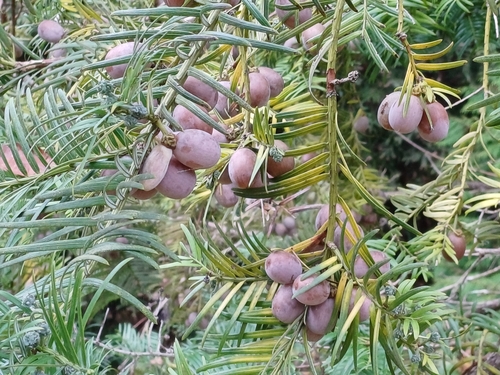
iNaturalist· cc-by-nc
(c) Kelly Dix, some rights reserved (CC BY-NC), uploaded by Kelly Dix
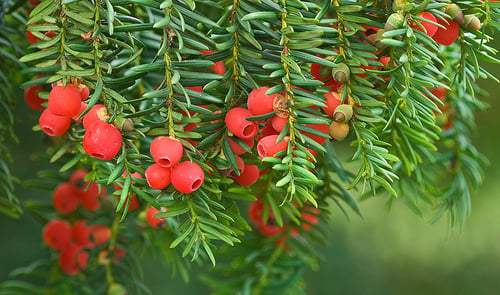
iNaturalist· cc-by-nc
(c) tay_berube, some rights reserved (CC BY-NC)
Summary
Source: WikipediaTaxus brevifolia, the Pacific yew or western yew, is a species of tree in the yew family Taxaceae native to the Pacific Northwest of North America. It is a small evergreen conifer, thriving in moisture and otherwise tending to take the form of a shrub.
Description
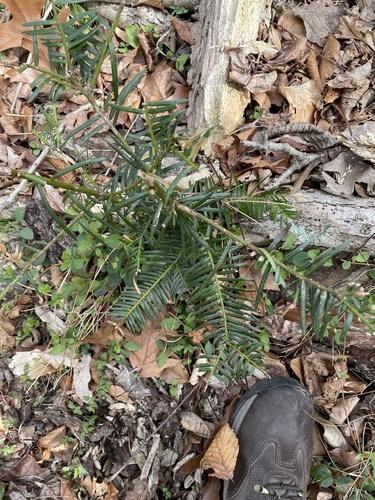
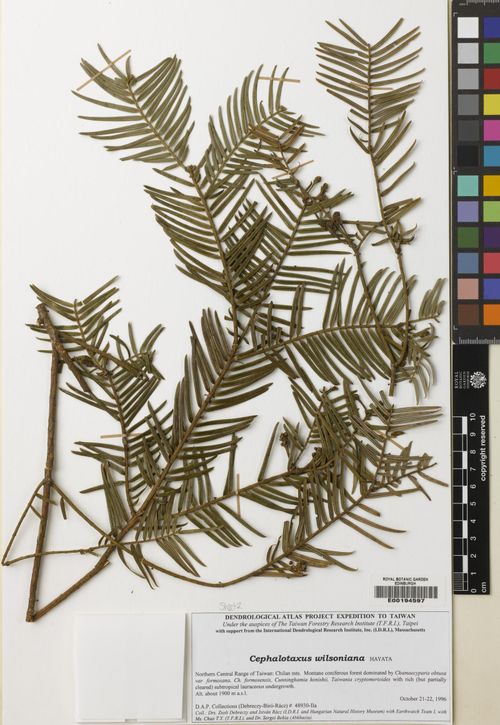
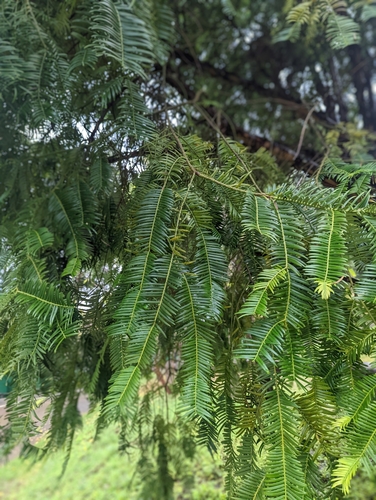
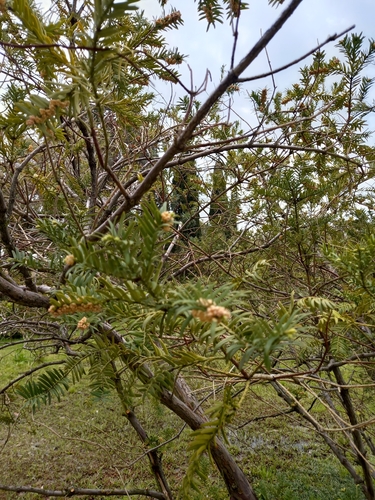
A small tree or shrub. It can grow to 20 m high. The crown is cone shaped. The young bark is smooth. The mature bark is fluted. The branches are irregular and spread. They are flat or slightly drooping. The needles are single and 13-25 mm long. They are dark yellowish-green above and pale below. The buds scales are keeled and loose. The seed has a fleshy aril or seed layer around it. This is red.
Edible Uses
The fleshy fruit can be eaten raw. It is very sweet and gelatinous — most people find it delicious, though some find it sickly. Each berry is about 8mm in diameter and contains a single seed, and trees usually produce good crops every year. All other parts of this plant, including the seed, are highly poisonous. When eating the fruit, the seed should be spat out. Swallowing the seed whole may allow it to pass through without harm, but if it has been bitten into, it could cause problems.
Traditional Uses
CAUTION: The seeds are poisonous and tea from the leaves is poisonous. The fruit are only eaten singly.
This uses section is brief — help expand it
Medicinal Uses
The Pacific yew is a highly toxic plant that was nonetheless used medicinally by several native North American tribes to treat a variety of complaints. Modern research has identified the compound taxol in its shoots and bark, which has shown exciting potential as an anti-cancer drug, particularly for ovarian cancers. However, taxol concentrations are low — bark from 6 trees is required to treat a single patient. This remedy is very toxic and should only be used under the supervision of a qualified practitioner, even when applied externally. All parts except the fleshy fruit are diaphoretic and pectoral. A decoction of branches and leaves has been used for lung problems. An infusion of crushed leaves applied externally has been used to promote perspiration and general health improvement. A poultice of crushed leaves has been applied to wounds. A decoction of small woody pieces has been used for internal complaints including stomach pain and blood in the urine. Leaves are harvested in early autumn or spring; bark from autumn to spring, for commercial taxol extraction. Ingestion of 50–100g of needles can cause death.
Known Hazards
All parts of the plant, except the flesh of the fruit, are highly poisonous. Another report says that the toxic alkaloid found in other yews, known as taxine, is not found in this species and that the toxicity of this species has not been conclusively proven. Poisoning symptoms are dry mouth, vomiting, vertigo, abdominal pain, dyspnoea, arrhythmias, hypotension & unconsciousness.
Distribution
It grows from sea level to 2,200 m altitude in forests in north America.
Where It Grows
Alaska, Canada, North America, USA,
Cultivation
Thrives in almost any soil, acid or alkaline, as long as it is well-drained. Succeeds in dry soils. Plants are very shade tolerant. Dormant plants are very cold-hardy, though the young growth in spring can be damaged by late frosts. A slow-growing but apparently long-lived tree. Plants produce very little fibrous root and should be planted in their final positions when still small. Because of its useful wood, large trees are unscrupulously poached from the wild and, in some areas, the species has been nearly extirpated. Exploitation of the species for medicinal purposes is further threatening it in the wild.. Plants in this genus are notably resistant to honey fungus. Dioecious. Male and female plants must be grown if seed is required.
Propagation
Seed can be very slow to germinate, often taking 2 or more years. Sowing as soon as the seed is ripe in autumn gives the best chance of germination around 18 months later. Stored seed may take 2 or more years. Four months of warm stratification followed by 4 months of cold stratification may help shorten germination time. Harvesting seed green — fully developed but not yet dried on the plant — and sowing immediately has not been found to reduce germination time, as inhibiting factors develop too early. Prick seedlings into individual pots once large enough to handle, and grow on in a cold frame. Seedlings are very slow-growing and will likely need at least 2 years in pots before planting out, ideally in late spring or early summer after the last frosts. Half-ripe terminal shoot cuttings, 5–8cm long, taken in July/August in a shaded frame should root by late September; leave in the frame over winter and plant out the following late spring — success rate is high. Ripe terminal shoot cuttings can also be taken in winter after a hard frost, in a shaded frame.
Other Uses
A red paint was made by mixing wood chips with oil. The roots have been used as weft material in twined basketry and are particularly valued for hopper mortar baskets due to their strength. The wood is fine-grained, strong, hard, heavy, durable, and resilient, taking a very fine polish. Though hard, it is easy to carve and is also used for paddles, fence posts, and various other small articles.
Notes
There are about 6 Taxus species.
Synonyms
References (7)
- Beckstrom-Sternberg, Stephen M., and James A. Duke. "The Foodplant Database." http://probe.nalusda.gov:8300/cgi-bin/browse/foodplantdb.(ACEDB version 4.0 - data version July 1994)
- Farrar, J.L., 1995, Trees of the Northern United States and Canada. Iowa State University press/Ames p 124
- MacKinnon, A., et al, 2009, Edible & Medicinal Plants of Canada. Lone Pine. p 78
- Marinelli, J. (Ed), 2004, Plant. DK. p 156
- Moerman, D. F., 2010, Native American Ethnobotany. Timber Press. p 551
Show all 7 references Hide references
- N. Amer. Sylv. 3:86, t. 108. 1849
- Plants for a Future database, The Field, Penpol, Lostwithiel, Cornwall, PL22 0NG, UK. http://www.scs.leeds.ac.uk/pfaf/