Thuja plicata
Donn ex D. Don
Western Red Cedar, Western Arborvitae, Giant Thuya
iNaturalist· cc-by-nc
(c) Nicholas Sly, some rights reserved (CC BY-NC), uploaded by Nicholas Sly
iNaturalist· cc0
no rights reserved
Summary
Source: WikipediaThuja plicata is a large evergreen coniferous tree in the family Cupressaceae, native to the Pacific Northwest of North America. Its common name is western redcedar. It is also less commonly called western red cedar, pacific red cedar, giant arborvitae, western arborvitae, just cedar, giant cedar, or shinglewood. It is not a true cedar of the genus Cedrus. T. plicata is the largest species in the genus Thuja, growing up to 70 metres (230 ft) tall and 7 m (23 ft) in diameter. It mostly grows in areas that experience a mild climate with plentiful rainfall, although it is sometimes present in drier areas on sites where water is available year-round, such as wet valley bottoms and mountain streamsides. The species is shade-tolerant and able to establish in forest understories and is thus considered a climax species. It is a very long-lived tree, with some specimens reaching ages of well over 1,000 years. Indigenous peoples of the Pacific Northwest use the wood of this species for many purposes, such as building canoes, totem poles, and tools. The bark is harvested by indigenous peoples and processed into a fiber, which they use to make items such as rope, baskets, clothing, and rain hats. Because of its wide range of uses, the species is of great cultural importance to these people. Western redcedar wood is aromatic and rot-resistant and is used for applications such as the construction of shingles and siding. It has been introduced to cool temperate areas in other parts of the world, such as Northern Europe and New Zealand.
Description
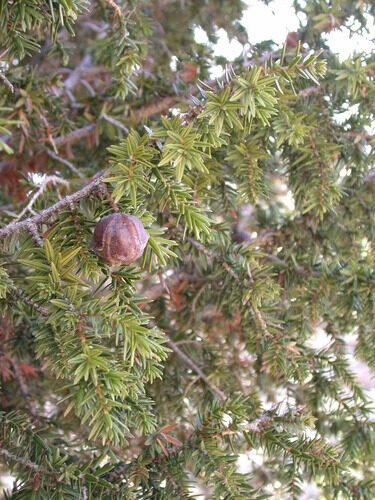
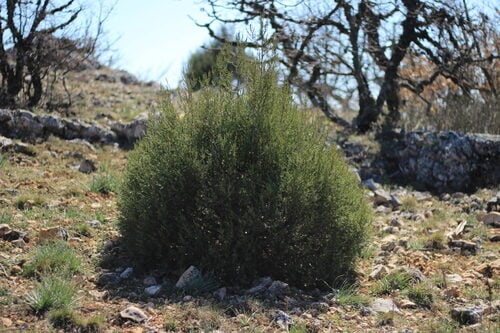
A very large evergreen tree. It grows 22-60 m tall and spreads 6-9 m wide. It has a conical shape. The trunk tapers rapidly and is buttressed at the base. At higher altitudes it becomes a small tree. The bark is light reddish brown and peels and flakes off. The main branches spread and droop but turn upwards at the ends. The branches can extend to the ground and cover the trunk. The leaves are bright green with a white cross on the underside. The leaves are flat and make up many small scale like sections. They have a pineapple smell when crushed. The twigs are leaf covered and are feather like. The seed cone is oval and 12-18 mm long. There are 8-10 scales with a small sharp point at the tip.
Edible Uses
The inner bark is edible fresh or dried. When dried, it can be ground into a powder and used as a soup thickener or mixed with cereals for bread-making. A pitch obtained from the trunk has also been used as a chewing gum.
Traditional Uses
The inner bark is edible. In spring it is eaten fresh or can be dried and ground into a powder. The wood is used during cooking to impart a flavour to fish. Caution: It should only be eaten in small amounts.
Medicinal Uses
Western red cedar was used medicinally by numerous native North American Indian tribes across a wide range of complaints, though it is seldom used in modern herbalism. A leaf infusion treats stomach pains and diarrhoea, and a leaf decoction is used for colds. A decoction of powdered leaves is applied externally for internal pains including rheumatism. Leaf buds have been chewed for toothache and sore lungs, and a bud decoction is used as a gargle. A decoction of small branches treats coughs, colds, and tuberculosis. A weak infusion is drunk for painful joints due to rheumatism or arthritis. A poultice of crushed bough tips and oil is applied to the back and chest for bronchitis, rheumatism, stomach pains, and swollen neck. A twig infusion serves as a wash for venereal disease sores. A decoction of the boughs is used as an antidandruff shampoo. A decoction of stem tips and roots treats colds. An infusion of bark and twigs is used for kidney complaints. An infusion of seeds and twigs treats fevers. Chewed bark or a bark decoction is drunk to induce menstruation. A moxa of the inner bark is used as a counter-irritant for the skin, and a poultice of the inner bark is applied to carbuncles. The bark is pounded until soft and used to rub the face; the softest bark is used to bind wounds and cover dressings; and shredded bark is used to cauterize sores and swellings.
Distribution
It is a temperate plant. In Canada it grows from sea level to 2000 m altitude. It grows in wetter places. It does best on moist alluvial sites. It is frost hardy. It suits hardiness zones 5-10. In Hobart Botanical gardens. Arboretum Tasmania.
Where It Grows
Asia, Australia, Britain, Canada, Europe, Indonesia, North America, SE Asia, Slovenia, Tasmania, USA,
Cultivation
Prefers a moist loamy soil. Dislikes dry soils. Not suitable for light sandy soils because it is shallow rooting, but it succeeds on most other soil types, even on waterlogged soils and heavy clays. Succeeds in chalky soils. Prefers some shelter from the wind according to some reports whilst others say that it is fairly wind resistant. Trees tolerate salt winds but not severe maritime exposure. The wood and foliage are highly aromatic. The foliage has a strong fruity smell, like pear-drops or crushed apples. A fast growing tree, it often puts out new growth of 1 metre a year and can average 60cm a year for the first 40 years. Increase in girth can also be rapid, 5cm a year for the first 60 years has been recorded. Sometimes planted for forestry in Britain, it is at its best in the moister western half of the country. There are many named varieties selected for their ornamental value. Tolerant of light trimming, so long as this is not back into old wood, plants also retain their lower branches unless these are shaded out by neighbouring plants. The foliage turns bronze in cold weather. Trees are notably susceptible to honey fungus.
Propagation
Seed is best sown when ripe in autumn in a cold frame. Stored seed benefits from brief cold stratification and can be sown in a cold frame in late winter. Prick seedlings into individual pots when large enough to handle and grow on under glass for their first winter, then plant out in late spring or early summer after the last expected frosts. For large quantities, sow in an outdoor seedbed in mid-spring, grow on for two years, then plant out in late autumn or early spring. Take half-ripe cuttings 5–8cm with a heel in July/August in a shaded frame — roots form by late September but plants should overwinter under glass. Alternatively, take near-ripe cuttings 5–10cm with a heel in September in a cold frame; these root the following summer and can be planted out in autumn or spring.
Other Uses
This species tolerates light trimming and reasonable exposure, making it suitable for hedges or shelterbelts. A bough infusion can be used as a hair wash to treat dandruff and scalp conditions. The fibrous inner bark, once pounded soft, serves as a scouring sponge, or can be used to make rough clothing, blankets, mats, ropes, sanitary towels, cradle padding, and nappies; it is also used in thatching, as mattress stuffing, and as roofing material. Waterproof hats, capes, trousers, and skirts can be made from it, and strips of inner bark have been used to make paint brushes and oil lamp wicks, as well as baskets. Roots are used in basket-making and net-making — peeled, split, and woven into coiled, watertight baskets capable of holding boiling water. Roots are best harvested in spring or early autumn when bark is easiest to remove; outer root strips form the basket base, the core forms the coils, and the bark, being tough, is used for the edges. The fibrous outer bark is also used for roofing, shelter walls, and insulation. Bark fibre, with heartwood fibre measuring approximately 3.8mm, is used in paper-making; branches harvested at any time are soaked, cooked for six hours or more with lye, then pounded or milled to produce a rich deep brown-red paper. Slender, pliable branches make high-quality rope — gathered in spring, peeled, split if thick, worked until supple, then twisted and woven together. A green dye is obtained from the leaves and twigs. The inner bark serves as tinder. The wood is aromatic, light, soft, and straight-grained — not particularly strong but highly resistant to decay, even that of fallen trees remaining sound for at least 100 years, likely due to powerful fungicidal compounds within it. Pale to dark red in colour, it was widely used by native North American peoples for canoes, houses, totem poles, bowls, spoons, ladles, and tools, and is currently used in greenhouse construction. Wood quality is lower when the tree is grown in mild, humid conditions. It makes good fuel, burning with very little smoke though quickly.
Production
Trees can live to 800 years old.
Notes
The leaves are used in medicine. There are 6 species of Thuja.
Synonyms
Also Known As
Cemara kipas besar, Orjaški klek
References (17)
- Beckstrom-Sternberg, Stephen M., and James A. Duke. "The Foodplant Database." http://probe.nalusda.gov:8300/cgi-bin/browse/foodplantdb.(ACEDB version 4.0 - data version July 1994)
- Bremness, L., 1994, Herbs. Collins Eyewitness Handbooks. Harper Collins. p 87
- Brickell, C. (Ed.), 1999, The Royal Horticultural Society A-Z Encyclopedia of Garden Plants. Convent Garden Books. p 1009
- Coombes, A.J., 2000, Trees. Dorling Kindersley Handbooks. p 50
- Cundall, P., (ed.), 2004, Gardening Australia: flora: the gardener's bible. ABC Books. p 1413
Show all 17 references Hide references
- Facciola, S., 1998, Cornucopia 2: a Source Book of Edible Plants. Kampong Publications, p 90
- Farrar, J.L., 1995, Trees of the Northern United States and Canada. Iowa State University press/Ames p 24
- Harris, E & J., 1983, Field Guide to the Trees and Shrubs of Britain. Reader's Digest. p 277
- Hedrick, U.P., 1919, (Ed.), Sturtevant's edible plants of the world. p 649 (As Thuja gigantea)
- Hibbert, M., 2002, The Aussie Plant Finder 2002, Florilegium. p 299
- http://www.botanic-gardens-ljubljana.com/en/plants
- Joyce, D., 1998, The Garden Plant Selector. Ryland, Peters and Small. p 174
- Kiple, K.F. & Ornelas, K.C., (eds), 2000, The Cambridge World History of Food. CUP p 1748
- A. B. Lambert, Desc. Pinus 2:19. 1824
- Lord, E.E., & Willis, J.H., 1999, Shrubs and Trees for Australian gardens. Lothian. p 90
- MacKinnon, A., et al, 2009, Edible & Medicinal Plants of Canada. Lone Pine. p 44
- Moerman, D. F., 2010, Native American Ethnobotany. Timber Press. p 558