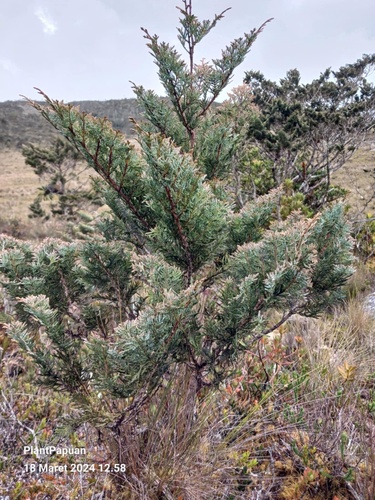
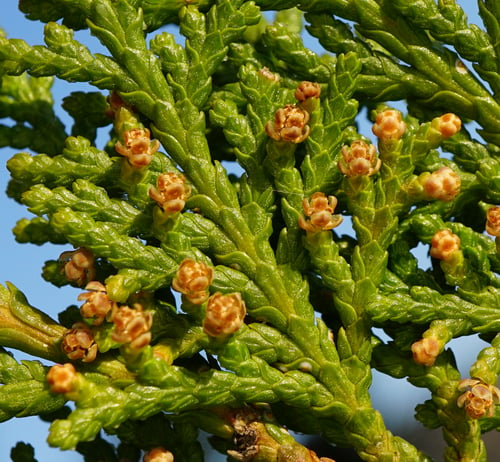
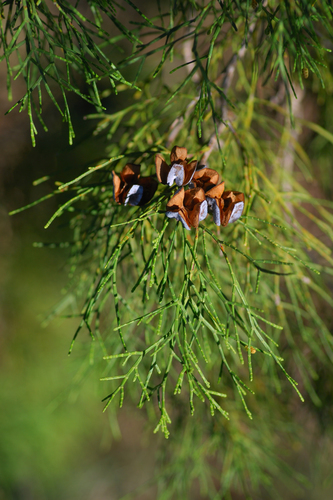
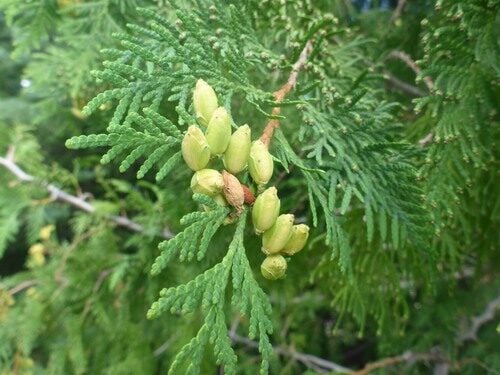
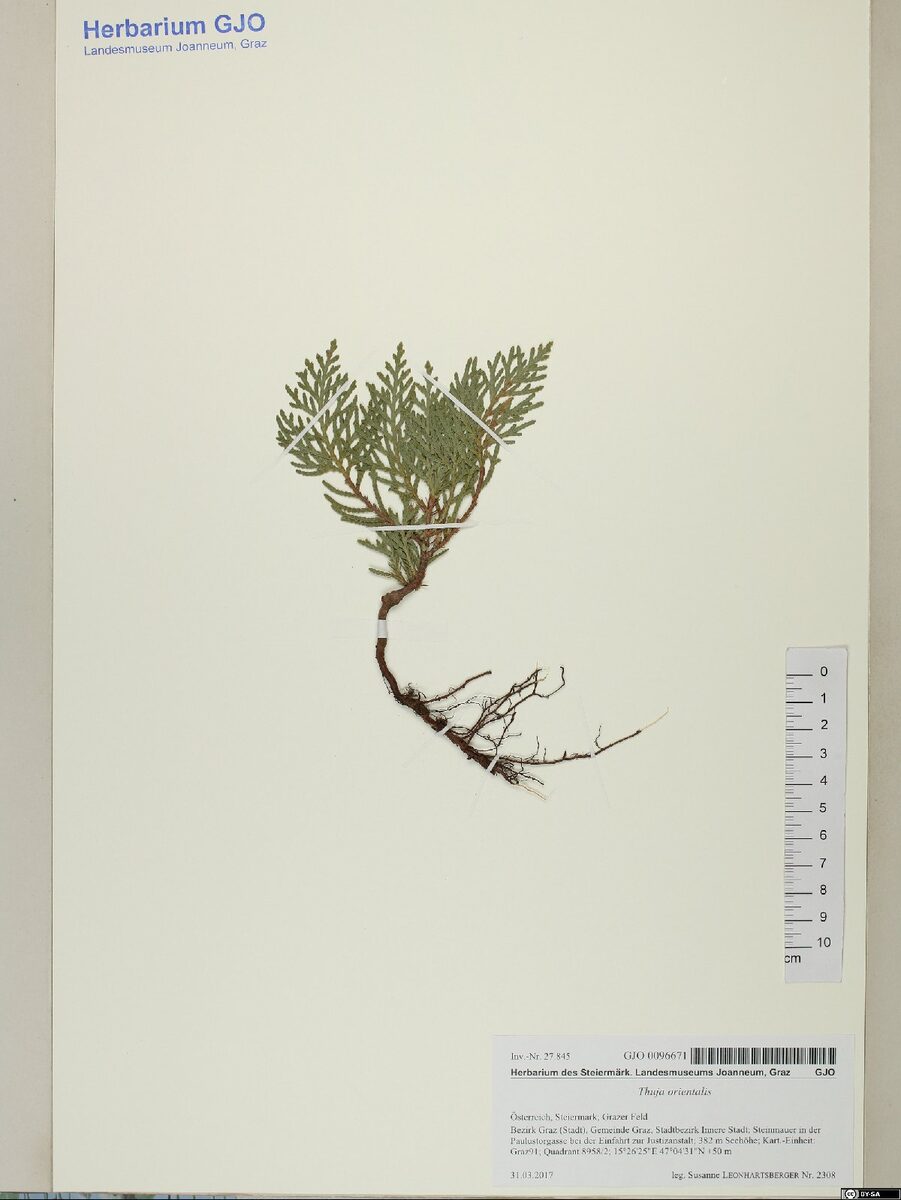
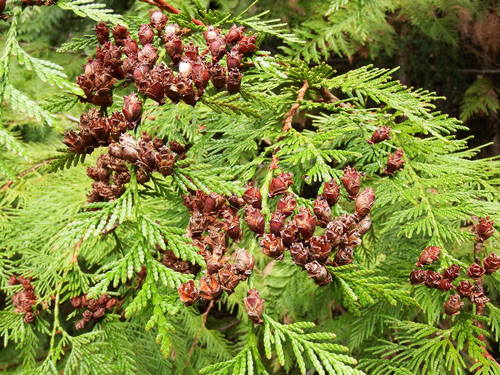
Juniperus phoenicea
L.
Phoenician Juniper
iNaturalist· cc-by-nc
(c) gentoo, some rights reserved (CC BY-NC)
iNaturalist· cc-by-nc
(c) Norbert Helm, some rights reserved (CC BY-NC), uploaded by Norbert Helm
iNaturalist· cc-by-nc
(c) Errol Véla, some rights reserved (CC BY-NC), uploaded by Errol Véla
Description
Juniperus phoenicea is an evergreen Tree growing to 7 m (23ft) by 7 m (23ft) at a slow rate. See above for USDA hardiness. It is hardy to UK zone 8 and is not frost tender. The flowers are pollinated by Wind. The plant is not self-fertile. It is noted for attracting wildlife. Suitable for: light (sandy), medium (loamy) and heavy (clay) soils, prefers well-drained soil and can grow in nutritionally poor soil. Suitable pH: mildly acid, neutral and basic (mildly alkaline) soils and can grow in saline soils. It can grow in semi-shade (light woodland) or no shade. It prefers dry or moist soil and can tolerate drought. The plant can tolerate maritime exposure.
Edible Uses
The reddish and more or less succulent seed cones can be used as a flavouring in cooking and alcoholic beverages. The dark reddish or yellowish brown, globose fruits take two years to mature. They are 8 - 15mm in diameter and contain three to nine seeds.
Medicinal Uses
The plant's aerial parts are used to treat skin diseases, pharyngitis, rheumatism, diabetes and diarrhoea. (The above uses were attributed to Juniperus phoenicea growing in Tunisia (which would have been the subspecies turbinata). The plants growing in that region are now considered a distinct species, Juniperus turbinata. Since the two species are very closely related, it would be reasonable to assume that these uses are interchangeable. An essential oil obtained from the plant is antifungal and antimicrobial.
Known Hazards
The plant's essential oil contains sabinol, a strong irritant that can cause digestive, neurological, cardiorespiratory, and hepato-renal disorders.
Distribution
Southwestern Europe - Portugal, Spain, southern France, northwest Italy.
Where It Grows
Native to: Baleares, France, Italy, Sardegna, Spain.
Cultivation
Soil Texture: It grows well in light (sandy), medium, and even heavy (clay) soils. It is highly adaptable and thrives in rocky or poor soils. Soil Moisture: It prefers dry to moderately moist soils. It is highly drought-tolerant and does not tolerate waterlogged conditions. Drainage: Requires well-drained soil. Waterlogging can lead to root rot. Soil pH: Tolerates a wide range of pH levels, from acidic to alkaline soils. Saline Tolerance: Highly tolerant of saline conditions, making it suitable for coastal areas. Tolerance of Poor Soil: It thrives in poor and nutrient-deficient soils, often growing in marginal and degraded areas. Light Requirements: Requires full sun for optimal growth. It tolerates light shade but thrives best in open, sunny areas. Height: Can grow up to 5–8 meters (16–26 feet) tall, though it often remains smaller in harsh environments, forming a shrub-like shape. Pollination: Pollinated by wind, as it produces small, inconspicuous cones instead of flowers. Temperature: Hardy and suited to USDA zones 7–11. It thrives in Mediterranean climates and tolerates high heat and drought. Coastal Tolerance: Well-adapted to saline air and sandy soils, making it an excellent choice for coastal landscapes. Drought Tolerance: Extremely drought-resistant, ideal for arid and semi-arid regions. Pests and Diseases: Generally pest-resistant. However, it may occasionally suffer from fungal diseases in overly wet conditions. Pruning: Minimal pruning is required, but it can be shaped as needed for landscaping. It is ideal for Mediterranean climates. It grows in dry, rocky soils and tolerates prolonged drought. It is commonly found along coastal areas of the Mediterranean Basin. It is used in landscaping for its attractive foliage and as a natural windbreak. In the wild, it is found in garrigue, maquis, or evergreen microphyllous woodland on dry, stony ground, limestone outcrops, or dunes at altitudes between 1m and 2,400m asl. Phoenician Juniper is commonly associated with Pinus halepensis, P. brutia, Quercus ilex, Pistacea lentiscus, Cistus spp., Olea europaea, Lavandula spp., Artemisia herba-alba, and numerous other genera. There is a predominance of limestone, but granitic rock, sandstone, serpentine, volcanic rock, and dunes are also mentioned as substrates. Soils are usually rocky or skeletal and can grow well from crevices in bedrock. The climate is Mediterranean, with dry and hot summers. The native range of this species is SE. & E. Spain and NW. Italy, Corse (SW. Mallorca), E. Sardegna. It is a tree and grows primarily in the subtropical biome. Juniperus phoenicea is not a very cold-hardy plant, able to tolerate short-lived temperatures down to around -5°c when fully dormant. It is native mainly to coastal regions of the western Mediterranean, though it can also be found further inland, experiencing hot, dry summers and cool, moist winters. It can succeed in regions where the annual precipitation is only 200mm. Requires an open, sunny position and well-drained soil, favouring but not restricted to calcareous substrates. The plant can experience sea spray and severe winter storms in its native habitat. The plant is said to be able to live for more than 1,000 years. Plants are usually monoecious, though dioecious forms occur and can be locally predominant. In this case, both male and female forms would need to be grown if seeds were to be produced.
Propagation
The seed requires a period of cold stratification. The seed has a hard seedcoat and can be very slow to germinate, requiring a cold period followed by a warm period and then another cold spell, each of 2 - 3 months duration. Soaking the seed for 3 - 6 seconds in boiling water may speed up the germination process. The seed is best sown as soon as it is ripe in a cold frame. Some might germinate in the following spring, though most will take another year. Another possibility is to harvest the seed 'green' (when the embryo has fully formed but before the seedcoat has hardened). The seedlings can be potted up into individual pots when they are large enough to handle. Grow on in pots until large enough, then plant out in early summer. When stored dry, the seed can remain viable for several years. In early autumn, cuttings of mature wood, 5 - 10cm with a heel. Plant out in the following autumn. Layering in early autumn. Takes 12 months.
Other Uses
Phoenician Juniper is used in landscaping for its attractive foliage and as a natural windbreak. The plant is sometimes grown as an ornamental. Agroforestry Uses: The Phoenician Juniper is a natural pioneer species that has moved into open areas, grassland, abandoned fields, etc., creating an environment suitable for other woodland plants to become established. It can be used to restore native woodland and establish woodland gardens. Other Uses: An extract of the gum of the plant is used as an ingredient in commercial cosmetic preparations as a skin tonic. An extract obtained from the wood of the plant is used as an ingredient in commercial cosmetic preparations for perfumery. The rose-coloured wood is fine-grained, hard, solid and resinous with an aromatic fragrance. Like other juniper woods, it is appreciated for small manufactured objects and inlay works. In Algeria and Tunisia, when the trunk grows straight, it is used for joinery and carpentry. In Africa, the wood is used mainly for fuel and charcoal production. The wood is of little commercial value. Nectary - Flowers rich in nectar and pollen: Juniper species produce small, inconspicuous flowers that do not produce significant nectar. However, they release pollen, which can be a food source for some insects, though not in large quantities. Wildlife - Food (Fruit, Seeds, Leaf litter, Shelter, Nesting, Roosting): Juniper berries (technically cones) are a food source for many birds and mammals. The dense foliage provides good shelter; some birds may nest or roost in the branches. Juniper is also used for cover by small wildlife. Invertebrate Shelter (Overwintering sites, Leaf litter, Groundcover): Juniper’s rough bark and dense foliage can provide overwintering sites for various invertebrates. The leaf litter from junipers can also serve as a habitat for insects and other small creatures. Pest Confuser (Smell): The pungent aroma of juniper, especially from its berries and leaves, can help deter certain pests. The volatile oils in juniper have natural insect-repellent properties.
Synonyms
Also Known As
Phoenicean juniper or Arâr