Artabotrys brachypetalus
Benth.
Purple hook-berry, Large hook-berry
iNaturalist· cc-by-nc
(c) Graeme White, some rights reserved (CC BY-NC), uploaded by Graeme White
iNaturalist· cc-by-nc
(c) Mark Hyde, Bart Wursten and Petra Ballings, some rights reserved (CC BY-NC)
iNaturalist· cc-by-nc
(c) Mark Hyde, Bart Wursten and Petra Ballings, some rights reserved (CC BY-NC)
Description
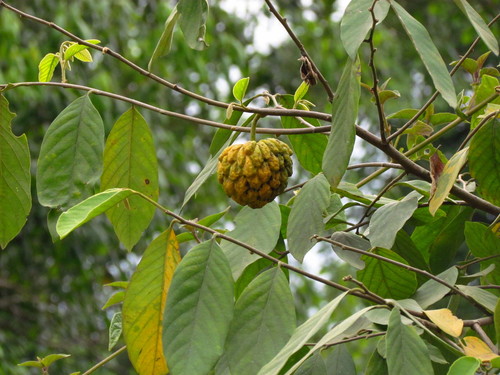
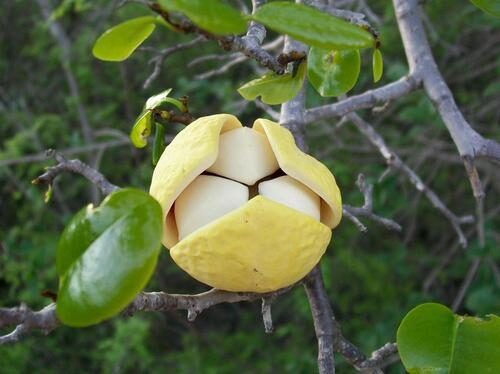
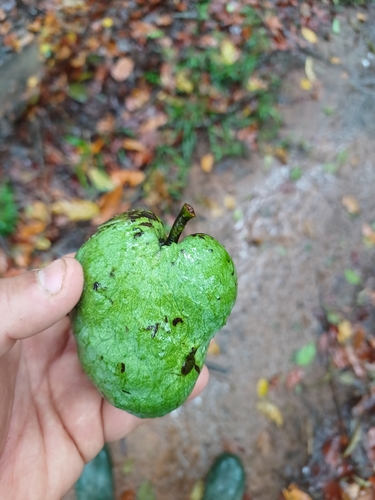
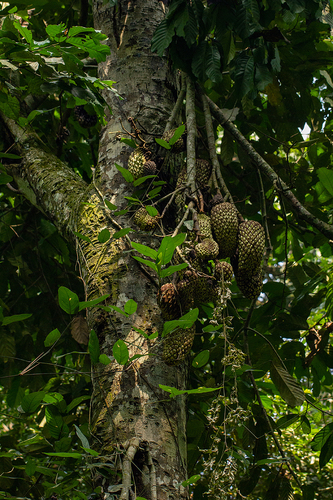
A woody climber. It can be a rambling bush or a small wide spreading tree. The young branches are covered with brown hairs. The leaves are oval and 2.5-11 cm long by 2.2-6.6 cm wide. The tips can be blunt, rounded or slightly pointed. It climbs by hooked flower stalks. The flowers are yellow. They occur singly on crooked woody stalks. The fruit has 1-14 segments clustered together. They are about 2.5 cm long and smooth. They look like black figs. They are purple-black and edible.
Edible Uses
The fruit can be eaten raw or fermented into an alcoholic drink.
Traditional Uses
The fruit can be eaten raw. They are also used for making an alcoholic drink. Caution: Alcohol is a cause of cancer.
This uses section is brief — help expand it
Known Hazards
Alcohol is a cause of cancer.
Distribution
A tropical plant. It grows in hot, dry low altitude areas. It occurs along streams. In grows between sea level and 1,140 m altitude. It can grow in arid places.
Where It Grows
Africa, Angola, Botswana, Central Africa, Congo, East Africa, Malawi, Mozambique, Namibia, South Africa, Southern Africa, Tanzania, Zambia, Zimbabwe,
Notes
There are about 100 Artabotrys species. They are shrubby climbers in SE Asia.
Nutrition
| Part | Moisture | kJ | kcal | Protein | Vit A | Vit C | Iron | Zinc |
|---|---|---|---|---|---|---|---|---|
| Fruit | 82.3 | 213 | — | 0.5 | — | 12.6 | 0.3 | 0.3 |
Also Known As
Groot-haakbessie, Macosso, uMazwenda omnyama, Mudzidzi, Munnamutswu, Umzitsi
References (21)
- Bruschi, P., et al, 2014, Traditional use of plants in a rural community of Mozambique and possible links with Miombo degradation and harvesting sustainability. Journal of Ethnobiology and Ethnomedicine. 2014, 10:59
- Flora Zambesiaca. http://apps.kew.org/efloras
- Fowler, D. G., 2007, Zambian Plants: Their Vernacular Names and Uses. Kew. p 8
- Fox, F. W. & Young, M. E. N., 1982, Food from the Veld. Delta Books. p 83
- Heywood, V.H., Brummitt, R.K., Culham, A., and Seberg, O. 2007, Flowering Plant Families of the World. Royal Botanical Gardens, Kew. p 33 (Genus)
Show all 21 references Hide references
- INFOODS:FAO/INFOODS Databases
- Magwede, K., van Wyk, B.-E., & van Wyk, A. E., 2019, An inventory of Vhavenḓa useful plants. South African Journal of Botany 122 (2019) 57–89
- Mokganya, M. G. et al, 2018, An evaluation of additional uses of some wild edible fruit plants of the Vhembe District Municipality in the Limpopo Province, South Africa. Indian Journal of Traditional Knowledge. Vol 17(2) April 2018, pp 276-281
- Palgrave, K.C., 1996, Trees of Southern Africa. Struik Publishers. p 171
- Palmer, E and Pitman, N., 1972, Trees of Southern Africa. Vol. 1. A.A. Balkema, Cape Town p 583
- Peters, C. R., O'Brien, E. M., and Drummond, R.B., 1992, Edible Wild plants of Sub-saharan Africa. Kew. p 54
- Plowes, N. J. & Taylor, F. W., 1997, The Processing of Indigenous Fruits and other Wildfoods of Southern Africa. in Smartt, L. & Haq. (Eds) Domestication, Production and Utilization of New Crops. ICUC p 185
- Royal Botanic Gardens, Kew (1999). Survey of Economic Plants for Arid and Semi-Arid Lands (SEPASAL) database. Published on the Internet; http://www.rbgkew.org.uk/ceb/sepasal/internet [Accessed 28th March 2011]
- Ruiters-Welcome, A. K., 2019, Food plants of southern Africa. Ph.D. thesis. Univ. of Johannesburg p 18
- Schmidt, E., Lotter, M., & McCleland, W., 2007, Trees and shrubs of Mpumalanga and Kruger National Park. Jacana Media p 108
- Scudder, 1962, 1971,
- Tredgold, M.H., 1986, Food Plants of Zimbabwe. Mambo Press. p 63
- Wehmeyer, A. S, 1986, Edible Wild Plants of Southern Africa. Data on the Nutrient Contents of over 300 species.
- Welcome, A. K. & Van Wyk, B.-E., 2019, An inventory and analysis of the food plants of southern Africa. South African Journal of Botany 122 (2019) 136–179
- Wild, 1975,
- World Checklist of Useful Plant Species 2020. Royal Botanic Gardens, Kew