Taxus baccata
L.
Yew, English yew, Common yew
iNaturalist· cc-by-nc-sa
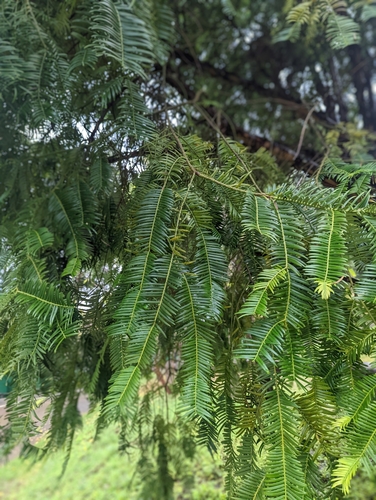
(c) Jonathan Tyler, some rights reserved (CC BY-NC-SA)
iNaturalist· cc-by-nc
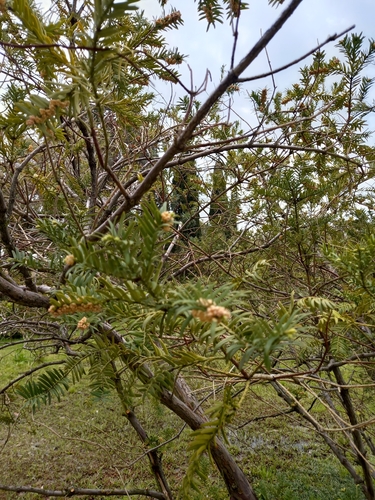
(c) ramazan_murtazaliev, some rights reserved (CC BY-NC)
iNaturalist· cc-by-nc
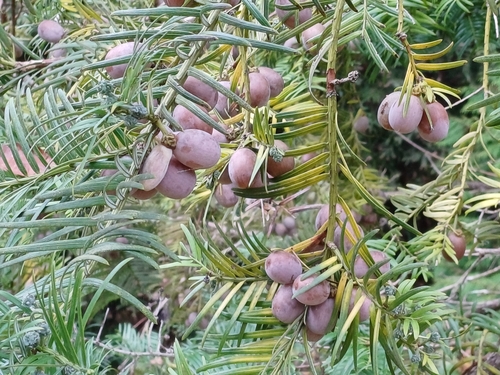
(c) Динасафина, some rights reserved (CC BY-NC)
Summary
Source: WikipediaTaxus baccata is an Old World species of evergreen tree in the family Taxaceae. It is the tree originally known as yew, though with other related trees becoming known, it is sometimes called common yew, European yew, or, in North America, English yew. It is a woodland tree in its native range, including much of Eurasia and Northwest Africa. All parts of the plant except the fleshy aril are poisonous, with toxins that can be absorbed through inhalation, ingestion, and transpiration through the skin. The wood has been prized for making longbows and for musical instruments such as lutes. Yews are often grown as ornamental trees, hedges or topiaries, including in churchyards, where they sometimes reach great age; many explanations have been given for this planting, especially that the yew is associated with death, immortality, and rebirth. Multiple place names derive from the Proto-Celtic *eburos, but scholars disagree as to whether this meant the yew tree.
Description
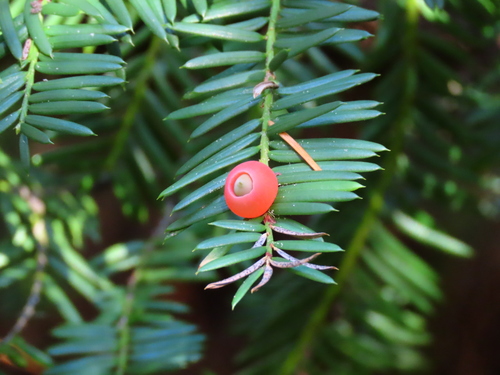
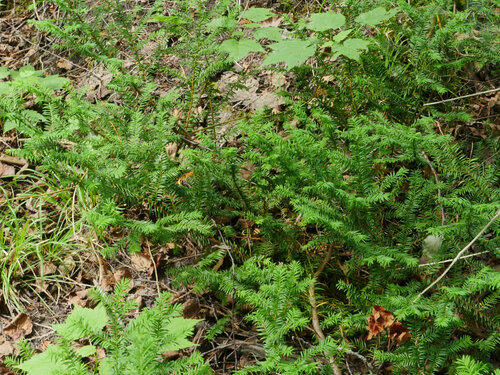
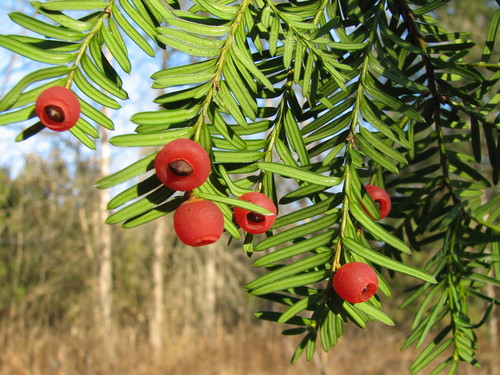
An evergreen tree. It can grow up to 20 m tall and spread 7.5-9 m wide. The trunk can be 100 cm across. The trunk is short. The bark is reddish-brown. It is rough and peels off in irregular papery scales. The leaves have short stalks and are 2.5-4 cm long. The leaves are in two ranks. They are linear and flattened. They are 10-30 mm long. There are 2 greyish bands beneath them. Male and female flowers are on separate trees. The male flower is yellow and the female flower is very small and green. The seed is enclosed in a scarlet cup-like aril or seed layer. Many cultivated varieties have been developed.
Edible Uses
The fleshy fruit can be eaten raw. It is very sweet and gelatinous — most people find it delicious, though some find it sickly. Its texture is frequently described as 'snotty', which puts off some who otherwise enjoy the flavour. Each berry is about 10mm in diameter and contains a single large seed. All other parts of this plant, including the seed, are highly poisonous. When eating the fruit, the seed should be spat out. Swallowing the seed whole may allow it to pass through without harm, but if it is bitten into, a very bitter taste will be noticeable and the seed should be spat out immediately to avoid potential harm. Note: it is likely that the digestive systems of most mammals, including humans, are capable of breaking down swallowed seeds, which would release toxic taxanes; birds can eat the whole berry because they are unable to digest the seeds. Some reports mention using the bark as a tea substitute, which would probably be very unwise.
Traditional Uses
CAUTION: All parts except the seed coat are very poisonous. The red and fleshy cup-shaped seed coat is eaten. It is used for desserts. The bark is used for tea. It is dried and powdered then boiled with salt and refined butter (ghee).
Medicinal Uses
The yew is a highly toxic plant occasionally used medicinally, primarily for chest complaints. Modern research has identified the compound taxol in the shoots, which has shown exciting potential as an anti-cancer drug, particularly for ovarian cancers. Concentrations of taxol in this species are too low for commercial use, though the plant is used for research. This remedy should only be used under supervision of a qualified practitioner. All parts except the fleshy fruit are antispasmodic, cardiotonic, diaphoretic, emmenagogue, expectorant, narcotic, and purgative. The leaves have been used internally for asthma, bronchitis, hiccup, indigestion, rheumatism, and epilepsy, and externally in a steam bath for rheumatism. A homeopathic remedy made from the young shoots and berries is used for cystitis, eruptions, headaches, heart and kidney problems, and rheumatism. Ingestion of 50–100g of needles can cause death.
Known Hazards
All parts of the plant except the fleshy fruit are highly poisonous. Ingestion of 50–100g of needles can cause death.
Distribution
It is a temperate plant. It will tolerate a wide range of conditions. They can grow on chalk soils. They can grow in shade. In Vietnam it grows above 1,500 m altitude. In Nepal it grows between 2200-3400 m altitude. It grows on exposed slopes. It suits hardiness zones 5-10. Arboretum Tasmania. Hobart Botanical gardens, Launceston Princess square.
Where It Grows
Afghanistan, Africa, Algeria, Asia, Asia Minor, Australia, Balkans, Belgium, Bhutan, Bosnia, Britain, Bulgaria, Canada, Caucasus, Central America, China, Croatia, Czech Republic, Denmark, Egypt, El Salvador, Estonia, Europe, Finland, France, Georgia, Germany, Greece, Guatemala, Himalayas, Hungary, India, Indochina, Iran, Ireland, Italy, Japan, Korea, Laos, Lithuana, Luxembourg, Macedonia, Mediterranean, Mexico, Middle East, Morocco, Myanmar, Nepal, New Zealand, North Africa, North America, Northeastern India, Norway, NW India, Pakistan, Philippines, Poland, Portugal, Romania, Russia, Scandinavia, SE Asia, Sikkim, Slovenia, Spain, Sweden, Switzerland, Taiwan, Tasmania, Turkey, Türkiye, Ukraine, USA, Vietnam,
Cultivation
A very easy plant to grow, it is extremely tolerant of cold and heat, sunny and shady positions, wet and dry soils, exposure and any pH. Thrives in almost any soil, acid or alkaline, as long as it is well-drained. Grows well in heavy clay soils. Sensitive to soil compaction by roads etc. Very shade tolerant. Tolerates urban pollution. In general they are very tolerant of exposure, though plants are damaged by severe maritime exposure. A very cold hardy plant when dormant, tolerating temperatures down to about -25°c. The fresh young shoots in spring, however, can be damaged by frosts. Plants are dioecious, though they sometimes change sex and monoecious trees are sometimes found. Male and female trees must be grown if fruit and seed is required. The fruit is produced mainly on the undersides of one-year old branches. A very long lived tree, one report suggests that a tree in Perthshire is 1500 years old, making it the oldest plant in Britain. Another report says that trees can be up to 4000 years old. It is, however, slow growing and usually takes about 20 years to reach a height of 4.5 metres. Young plants occasionally grow 30cm in a year but this soon tails off and virtually no height increase is made after 100 years. A very ornamental tree, there are many named varieties. Very resistant to honey fungus, but susceptible to phytopthera root rot. The bark is very soft and branches or even the whole tree can be killed if the bark is removed by constant friction such as by children climbing the tree. Plants produce very little fibrous root and should be planted in their final positions when still small. The fruit is greatly relished by thrushes.
Propagation
Seed can be very slow to germinate, often taking 2 or more years. Sowing as soon as the seed is ripe in autumn gives the best chance of germination around 18 months later. Stored seed may take 2 or more years. Four months of warm stratification followed by 4 months of cold stratification may help shorten germination time. Harvesting seed green — fully developed but not yet dried on the plant — and sowing immediately has not been found to reduce germination time, as inhibiting factors develop too early. Prick seedlings into individual pots once large enough to handle, and grow on in a cold frame. Seedlings are very slow-growing and will likely need at least 2 years in pots before planting out, ideally in late spring or early summer after the last frosts. Half-ripe terminal shoot cuttings, 5–8cm long, taken in July/August in a shaded frame should root by late September; leave in the frame over winter and plant out the following late spring — success rate is high. Ripe terminal shoot cuttings can also be taken in winter after a hard frost, in a shaded frame.
Other Uses
This plant is very tolerant of trimming and makes an excellent hedge, suitable for topiary. Even old trees can be cut back into old wood and will resprout — one report notes trees up to 1,000 years old respond well to trimming. A decoction of the leaves can be used as an insecticide. Some cultivars, such as 'Repandens' planted about 1 metre or more apart, can serve as ground cover. The wood is heavy, hard, durable, and elastic, takes a fine polish, and requires long seasoning. It is prized by cabinet makers and used for bows, tool handles, and firewood. The wood is also burned as incense.
Production
In Sikkim fruit are available September to November.
Notes
There are about 6-10 Taxus species. It is used for the anti-cancer drug Taxol.
Synonyms
Also Known As
Barmi, Bhirmie, Birmi, Birni chogan, Brahmi, Burmie, Cheongbu, Dhunu, Dingsableh, Gallu, Iichujhau, Kyauk-tinyu, Manduparni, Postil, Tasso, Tcheiraygulab, Teix, Tejo, Texum Thuna, Thaner, Thuner, Thuno, Tisa, Tiszafa, Tunsi, Utkhovari, Zirnupbirmi
References (44)
- Ambasta, S.P. (Ed.), 2000, The Useful Plants of India. CSIR India. p 622
- Bodkin, F., 1991, Encyclopedia Botanica. Cornstalk publishing, p 968
- Bonet, M. A. & Valles, J., 2002, Use of non-crop food vascular plants in Montseny biosphere reserve (Catalonia, Iberian Peninsula). International Journal of Food Sciences and Nutrition (2002) 53, 225–248
- Bremness, L., 1994, Herbs. Collins Eyewitness Handbooks. Harper Collins. p 86
- Brickell, C. (Ed.), 1999, The Royal Horticultural Society A-Z Encyclopedia of Garden Plants. Convent Garden Books. p 1001
Show all 44 references Hide references
- Bussman, R. W., et al, 2016, A comparative ethnobotany of Khevsureti, Samtskhe-Javakheti, Tusheti, Svaneti, and Racha-Lechkhumi, Republic of Georgia (Sakartvelo), Caucasus. Journal of Ethnobiology and Ethnomedicine.
- Bussman, R. W., et al, 2021, Unity in diversity—food plants and fungi of Sakartvelo (Republic of Georgia), Caucasus. Journal of Ethnobiology and Ethnomedicine (2021) 17:72 p 15
- Coombes, A.J., 2000, Trees. Dorling Kindersley Handbooks. p 79
- Cundall, P., (ed.), 2004, Gardening Australia: flora: the gardener's bible. ABC Books. p 1401
- Denes, A., et al, 2012, Wild plants used for food by Hungarian ethnic groups living in the Carpathian Basin. Acta Societatis Botanicorum Poloniae 81 (4): 381-396
- Facciola, S., 1998, Cornucopia 2: a Source Book of Edible Plants. Kampong Publications, p 240
- Farrar, J.L., 1995, Trees of the Northern United States and Canada. Iowa State University press/Ames p 124
- Flowerdew, B., 2000, Complete Fruit Book. Kyle Cathie Ltd., London. p 188
- Harris, E & J., 1983, Field Guide to the Trees and Shrubs of Britain. Reader's Digest. p 230
- Hedrick, U.P., 1919, (Ed.), Sturtevant's edible plants of the world. p 644
- Hibbert, M., 2002, The Aussie Plant Finder 2002, Florilegium. p 297
- http://www.botanic-gardens-ljubljana.com/en/plants
- Irving, M., 2009, The Forager Handbook, A Guide to the Edible Plants of Britain. Ebury Press p 356
- Joyce, D., 1998, The Garden Plant Selector. Ryland, Peters and Small. p 173
- Kermath, B. M., et al, 2014, Food Plants in the Americas: A survey of the domesticated, cultivated and wild plants used for Human food in North, Central and South America and the Caribbean. On line draft. p 857
- Khan, M. & Hussain, S., 2014, Diversity of wild edible plants and flowering phenology of district Poonch (J & K) in the northwest Himalaya. Indian Journal of Sci, Res. 9(1): 032-038
- Kremer, B.P., 1995, Shrubs in the Wild and in Gardens. Barrons. p 203
- Kunkel,
- Lord, E.E., & Willis, J.H., 1999, Shrubs and Trees for Australian gardens. Lothian. p 89
- Manandhar, N.P., 2002, Plants and People of Nepal. Timber Press. Portland, Oregon. p 451 (As Taxus baccata subsp wallichiana)
- Menendez-Baceta, G., et al, 2012, Wild edible plants traditionally gathered in Gorbeialdea (Biscay, Basque Country) Genetic Resources and Crop Evolution 59:1329-1347
- Pardo-de-Santayana, M., et al, 2007, Traditional knowledge of wild edible plants used in the northwest of the Iberian Peninsula (Spain and Portugal): a comparative study. Journal of Ethnobiology and Ethnomedicine 2007, 3:27
- Pham-Hoang Ho, 1999, An Illustrated Flora of Vietnam. Nha Xuat Ban Tre. p 227
- Pieroni, A., 1999, Gathered wild food plants in the Upper Valley of the Serchio River (Garfagnana), Central Italy. Economic Botany 53(3) pp 327-341
- Plants for a Future database, The Field, Penpol, Lostwithiel, Cornwall, PL22 0NG, UK. http://www.scs.leeds.ac.uk/pfaf/
- Radha, B., et al, 2013, Wild Edible Plant Resources of the Lohba Range of Kedarnath Forest Division (KFD), Garhwal Himalaya, India. Int. Res J. Biological Sci. Vol. 2 (11), 65-73
- Rawat, G.S., & Pangtey, Y.P.S., 1987, A Contribution to the Ethnobotany of Alpine Regions of Kumaon. J. Econ. Tax. Bot. Vol. 11 No. 1 pp 139-147
- Redzic, S. J., 2006, Wild Edible Plants and their Traditional Use in the Human Nutrition in Bosnia-Herzegovina. Ecology of Food and Nutrition, 45:189-232
- Sahni, K.C., 2000, The Book of Indian Trees. Bombay Natural History Society. Oxford. p 194
- Schuler, S., (Ed.), 1977, Simon & Schuster's Guide to Trees. Simon & Schuster. No. 41
- Sfikas, G., 1984, Trees and shrubs of Greece. Efstathiadis Group. Athens. p 56 (Seeds highly poisonous)
- Kumar, P. D., et al, 2015, Ethnobotanical Knowledge and Usage of Wild Plants in Theog Forest Division, Himachal Pradesh, North Western Himalaya. The Journal of Ethnobiology and Traditional Medicine. Photon 124(2015) 922-935
- Singh, H., Saklani, A. & Lal B., 1990, Ethnobotanical Observations on Some Gymnosperms of Garhwal Himalaya, Uttar Pradess, India. Economic Botany. Vol. 44, No. 3, pp. 349-354
- Sp. pl. 2:1040. 1753
- Sundriyal, M., et al, 1998, Wild edibles and other useful plants from the Sikkim Himalaya, India. Oecologia Montana 7:43-54
- Sundriyal, M., et al, 2004, Dietary Use of Wild Plant Resources in the Sikkim Himalaya, India. Economic Botany 58(4) pp 626-638
- Tanaka,
- Tardio, J., et al, Ethnobotanical review of wild edible plants in Spain. Botanical J. Linnean Soc. 152 (2006), 27-71
- www.worldagroforestrycentre.org/treedb/