Taraxacum erythrospermum
Andrz. ex Besser
Red-seed dandelion
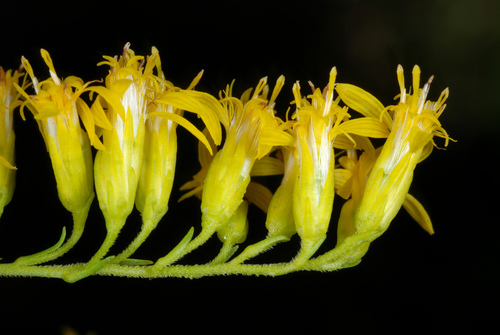
iNaturalist· cc-by-nc
(c) Tim Quinn, some rights reserved (CC BY-NC), uploaded by Tim Quinn
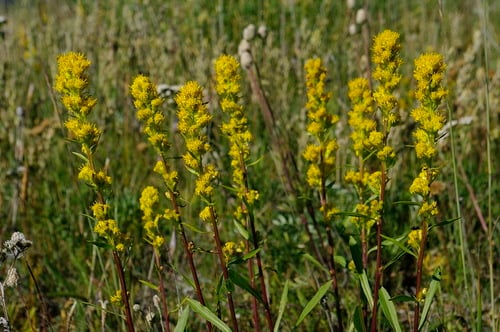
iNaturalist· cc-by-nc
(c) Matthew Beziat, some rights reserved (CC BY-NC), uploaded by Matthew Beziat
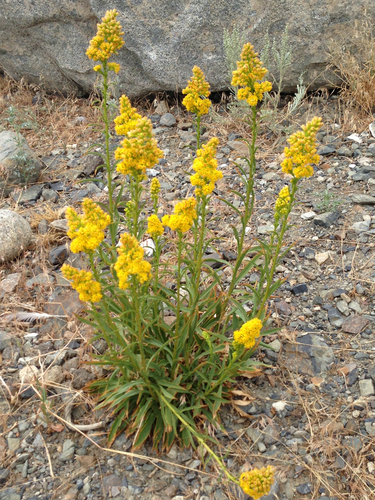
iNaturalist· cc-by-nc
(c) grinnin, some rights reserved (CC BY-NC), uploaded by grinnin
Summary
Source: WikipediaTaraxacum erythrospermum, known by the common name red-seeded dandelion, is a species of dandelion introduced to much of North America, but most commonly found in the north. It is often considered as a variety of Taraxacum laevigatum (i.e., Taraxacum laevigatum var. erythrospermum). In many characteristics, it is similar to the common dandelion, Taraxacum officinale.
Description
A herb. It keeps growing from year to year. It grows 35 cm tall. The leaves are in rings. They are oblong and 5-25 cm long by 1-4 cm wide. There are teeth along the edge.
Edible Uses
The basal leaves are eaten in salads, and flower stalks are used for tea.
Traditional Uses
Flower stalks are used for tea. The leaves at the base are eaten in salads.
This uses section is brief — help expand it
Distribution
It is a temperate or Mediterranean climate plant. In Argentina it grows below 500 m above sea level.
Where It Grows
Alaska, Argentina, Balkans, Britain, Croatia, Europe*, Germany, Hungary, Italy, Mediterranean, Mongolia, North America, South America, Spain, USA,
Notes
There are 50-60 Taraxacum species.
Synonyms
Also Known As
Picapolo, Rock dandelion, Teta de vaca
References (9)
- Biscotti, N. & Pieroni, A., 2015, The hidden Mediterranean diet: wild vegetables traditionally gathered and consumed in the Gargano area, Apulia, SE Italy. Acta Societatis Botanicorum Poloniae 84 (3): 327-338 (As Taraxacum laevigatum)
- Bowser, M., 2017, Handout on Edible Plants of the Kenai Peninsula. USFWS Kenai National Wildlife Refuge p 10 (As Taraxacum laevigatum)
- Denes, A., et al, 2012, Wild plants used for food by Hungarian ethnic groups living in the Carpathian Basin. Acta Societatis Botanicorum Poloniae 81 (4): 381-396 (As Taraxacum laevigatum)
- Luczaj et al, 2013, Wild vegetable mixes sold in the markets of Dalmatia (southern Croatia). Journal of Ethnobiology and Ethnomedicine. 8:2 (As Taraxacum laevigatum)
- Plants for a Future database, The Field, Penpol, Lostwithiel, Cornwall, PL22 0NG, UK. http://www.scs.leeds.ac.uk/pfaf/ (As Taraxacum laevigatum)
Show all 9 references Hide references
- Rivera, C., et al, 2005, The Ethnobotanical Study of Local Mediterranean Food Plants as Medicinal Resources in Southern Spain. Journal of Physiologyand Pharmacology. 56, Suppl. 1, 97-114 (As Taraxacum laevigatum)
- Tardio, J., et al, Ethnobotanical review of wild edible plants in Spain. Botanical J. Linnean Soc. 152 (2006), 27-71
- Urgamal, M., Oyuntsetseg, B., Nyambayar, D. & Dulamsuren, Ch. 2014. Conspectus of the vascular plants of Mongolia. (Editors: Sanchir, Ch. & Jamsran, Ts.). Ulaanbaatar, Mongolia. “Admon“ Press. 334pp. (p. 199-230).
- www.wildediblefood.com (As Taraxacum laevigatum)