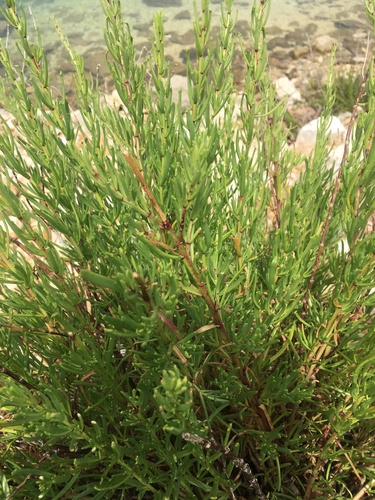
Artemisia frigida
Willd.
Fringed wormwood, Prairie sagewort
iNaturalist· cc-by-nc
(c) Jennifer Ackerfield, some rights reserved (CC BY-NC), uploaded by Jennifer Ackerfield
iNaturalist· cc-by-nc
(c) emeliasch, some rights reserved (CC BY-NC)
iNaturalist· cc-by-nc
(c) Joseph Petch, some rights reserved (CC BY-NC), uploaded by Joseph Petch
Summary
Source: WikipediaArtemisia frigida is a widespread species of flowering plant in the aster family, which is known as the sunflower family. It is native to Europe, Asia, and much of North America. In parts of the north-central and northeastern United States it is an introduced species.
Description
A herb. It grows 10-40 cm tall. The leaves are densely woolly. The leaves are finely divided 2 or 3 times. The thin segments are 1 mm wide. The flowers are in yellow nodding heads.
Edible Uses
Edible Parts: Edible Uses: Condiment Fringed sagewort offers a useful sage-like seasoning and occasional edible seeds, but is too bitter and strong for regular food use. Best as a culinary herb in small amounts. The leaves are used by the Hopi Indians as a flavouring for sweet corn.
Traditional Uses
The leaves are used to flavour corn. They are also steamed with flour and eaten as soup.
This uses section is brief — help expand it
Medicinal Uses
Antispasmodic Deodorant Disinfectant Poultice Stimulant Stomachic Vermifuge Women's complaints The leaves are stomachic, vermifuge and used in the treatment of women's complaints. The plant contains camphor, which is stimulant and antispasmodic. An infusion of the leaves is used in the treatment of biliousness, indigestion, coughs and colds whilst the leaves are chewed and the juice swallowed to treat heartburn. A poultice of the chewed leaves is used as a poultice to reduce swellings and the leaves are also placed in the nose to stop nosebleeds. A hot poultice of the leaves has been used to treat toothache. The leaves can be used as a sanitary towel to help reduce skin irritation. They are also drunk as a tea when the woman is menstruating or to treat irregular menstruation. The dried leaves are burnt in a room as a disinfectant. A decoction of the root is used as a stimulant and tonic.
Known Hazards
Although no reports of toxicity have been seen for this species, skin contact with some members of this genus can cause dermatitis or other allergic reactions in some people.
Distribution
It is a cool temperate plant. It grows on dry prairies. In China it grows on sub-alpine meadows and stable dunes between 1,000-4,000 m above sea level. It suits hardiness zone 2.
Where It Grows
America, Asia, Canada, Central Asia, China, Europe, Kyrgyzstan, Mongolia, North America, Russia, Siberia, Tajikistan, Tibet, USA,
Cultivation
Hardy perennial, mat-forming with silvery, aromatic foliage. Provides soil stabilization in prairies and forage for wildlife (though unpalatable to livestock). Blooms in summer; seeds mature late season. Requires a sunny position and a well-drained soil that is not too rich. Requires a lime-free soil. Established plants are very drought-tolerant. Plants are longer lived, more hardy and more aromatic when they are grown in a poor dry soil. A very ornamental plant. Members of this genus are rarely, if ever, troubled by browsing deer. For polyculture design, as well as the above-ground architecture (form - tree, shrub, etc., and size shown above), information on the habit and root pattern is also provided, if available.
Propagation
Seed - surface sow from late winter to early summer in a greenhouse in a very free-draining soil, but make sure that the compost does not dry out. The seed usually germinates within 1 - 2 weeks in a warm greenhouse. When large enough to handle, prick the seedlings out into individual pots and grow them on in the greenhouse for their first winter. Plant them out in late spring or early summer. Cuttings of half-ripe wood, July/August in a frame. Division in spring or autumn.
Other Uses
Deodorant Disinfectant Dye Essential Repellent Both the growing and the dried plant can be used as an insect repellent. The leaves can be placed on a camp fire to repel mosquitoes. The aromatic leaves have been used in pillows etc as a deodorant. Bunches of the soft leaves have been used as towels, toilet paper etc. A green dye is obtained from the leaves. Cultivated for its foliage effects, and has gained the Royal Horticultural Society's Award of Garden Merit. Used in landscaping and for erosion control and revegetation of rangeland. It is drought-resistant. Provides shelter for beneficial invertebrates: insects and other arthropods. A specialist nectary plant [1-2]. Groundcover [1-2]. Special Uses Attracts Wildlife Food Forest Ground Cover
Also Known As
Cagan siralzi, Xiao bai hao
References (10)
- Bircher, A. G. & Bircher, W. H., 2000, Encyclopedia of Fruit Trees and Edible Flowering Plants in Egypt and the Subtropics. AUC Press. p 42
- Brown, D., 2002, The Royal Horticultural Society encyclopedia of Herbs and their uses. DK Books. p 131
- Facciola, S., 1998, Cornucopia 2: a Source Book of Edible Plants. Kampong Publications, p 33
- https://en.wikipedia.org/wiki/List of wild edible plants in Mongolian cuisine
- Jackes, D. A., Edible Forest Gardens
Show all 10 references Hide references
- MacKinnon, A., et al, 2009, Edible & Medicinal Plants of Canada. Lone Pine. p 370
- Sachula, et al, 2020, Wild edible plants collected and consumed by the locals in Daqinggou, Inner Mongolia, China. Journal of Ethnobiology and Ethnomedicine (2020) 16:60
- Sp. pl. 3(3):1838. 1803
- Trendafilova, A., et al, 2020, Research Advances on Health Effects of Edible Artemisia Species and Some Sesquiterpene Lactones Constituents. Foods 2021, 10, 65. p 4
- Urgamal, M., Oyuntsetseg, B., Nyambayar, D. & Dulamsuren, Ch. 2014. Conspectus of the vascular plants of Mongolia. (Editors: Sanchir, Ch. & Jamsran, Ts.). Ulaanbaatar, Mongolia. “Admon“ Press. 334pp. (p. 199-230).