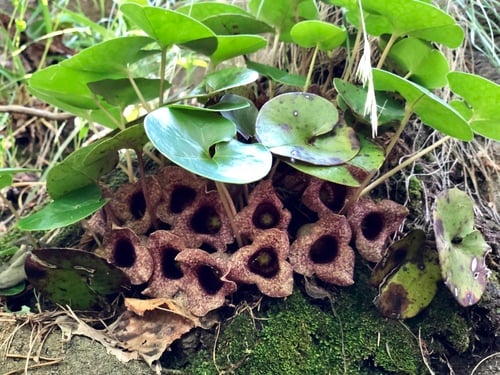
Aristolochia debilis
Sieb. & Zucc.
Ma dou ling, Birthwort, Horse-Bell
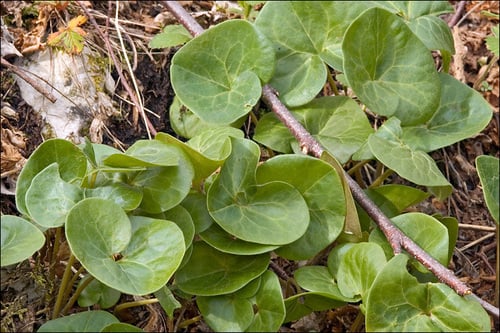
iNaturalist· cc-by-nc
(c) 李博恒, some rights reserved (CC BY-NC), uploaded by 李博恒
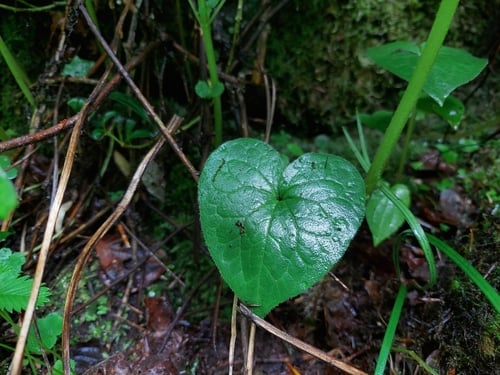
iNaturalist· cc-by-nc
(c) mmn_noriko, some rights reserved (CC BY-NC), uploaded by mmn_noriko
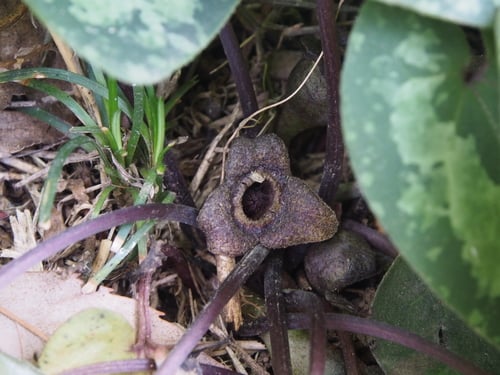
iNaturalist· cc-by-nc
(c) Frank Zhu, some rights reserved (CC BY-NC)
Summary
Source: WikipediaA perennial vine growing 1 m tall and wide, hardy to UK zone 8. Hermaphroditic flowers pollinated by flies bloom July to August with seeds ripening September to October. Adapts to light sandy, medium loamy, or heavy clay soils with good drainage. Tolerates mildly acidic to mildly alkaline pH. Grows in semi-shade to full sun and prefers consistently moist soil.
Description
A small herb. It is a scrambling plant with dark purple stems and branching. It grows 1 m tall and spreads 1 m wide. It keeps growing from year to year. The leaves are narrow and almost triangle shaped. They are 4-7 cm long by 5 cm wide. The flowers occur singly and are slender and yellow-green. The fruit is a round capsule.
Edible Uses
Edible Parts: Leaves Edible Uses: Leaves - cooked. It is said that the leaves of this species are not poisonous but caution is advised.
Traditional Uses
CAUTION: Many plants in this group are poisonous. The leaves are boiled and eaten with oil and salt. The roots and stems are poisonous.
This uses section is brief — help expand it
Medicinal Uses
Alterative Anodyne Antibacterial Antifungal Antiinflammatory Antitussive Carminative Cytotoxic Diuretic Expectorant Hypotensive Stomachic Tonic Alterative, antibacterial, antifungal, diuretic. Stimulates energy circulation. The fruit and its capsule are antiasthmatic, antiseptic, antitussive and expectorant. It is used internally in the treatment of asthma and various other chest complaints, haemorrhoids and hypertension. The root is anodyne and anti-inflammatory. It is used internally in the treatment of snakebite, gastric disorders involving bloating, and is clinically effective against hypertension. It is harvested in the autumn and dried for later use. The whole plant is antitussive, carminative, stimulant and tonic. The root contains aristolochic acid. This has anti-cancer properties and can be used in conjunction with chemotherapy and radiotherapy. Aristolochic acid can also be used in the treatment of acute and serious infections such as TB, hepatitis, liver cirrhosis and infantile pneumonia. It also increases the cellular immunity and phagocytosis function of the phagocytic cells. Aristolochic acid is said to be too toxic for clinical use.
Known Hazards
The species Aristolochia clematitis was highly regarded as a medicinal plant since the ancient Egyptians, Greeks and Romans, and on until the Early Modern era; it also plays a role in traditional Chinese medicine. Due to its resemblance to the uterus, the doctrine of signatures held that birthwort was useful in childbirth. A preparation was given to women upon delivery to expel the placenta, as noted by the herbalist Dioscurides in the 1st century AD. Despite its presence in ancient medicine, Aristolochia is known to contain the lethal toxin aristolochic acid. The Bencao Gangmu, compiled by Li Shi-Zhen in the latter part of the sixteenth century, was based on the author's experience and on data obtained from earlier herbals; this Chinese herbal classic describes 1892 "drugs" (with 1110 drawings), including many species of Aristolochia. For 400 years, the Bencao Gangmu remained the principal source of information in traditional Chinese medicine and the work was translated into numerous languages, reflecting its influence in countries other than China. In the mid-twentieth century, the Bencao Gangmu was replaced by modern Materia Medica, the most comprehensive source being Zhong Hua Ben Cao (Encyclopedia of Chinese Materia Medica), published in 1999. The Encyclopedia lists 23 species of Aristolochia, though with little mention of toxicity. The Chinese government currently lists the following Aristolochia herbs: A. manshuriensis (stems), A. fangchi (root), A. debilis (root and fruit), and A. contorta (fruit), two of which (madouling and qingmuxiang) appear in the 2005 Pharmacopoeia of the People's Republic of China. In traditional Chinese medicine Aristolochia species are used for certain forms of acute arthritis and edema. Despite the toxic properties of aristolochic acid, naturopaths claim that a decoction of birthwort stimulates the production and increases the activity of white blood cells, or that pipevines contain a disinfectant which assists in wound healing. Also, Aristolochia bracteolata is colloquially known as "worm killer" due to supposed antihelminthic activity. Aristolochia taxa have also been used as reptile repellents. A. serpentaria (Virginia snakeroot) is thus named because the root was used to treat snakebite, as "so offensive to these reptiles, that they not only avoid the places where it grows, but even flee from the traveler who carries a piece of it in his hand". A. pfeiferi, A. rugosa, and A. trilobata are also used in folk medicine to treat snakebites. In 1993, a series of end-stage renal disease cases was reported from Belgium associated with a weight loss treatment, where Stephania tetrandra in a herbal preparation was suspected of being replaced with Aristolochia fangchi. More than 105 patients were identified with nephropathy following the ingestion of this preparation from the same clinic from 1990 to 1992. Many required renal transplantation or dialysis. Aristolochia is a component of some Chinese herbal medicines. Aristolochia has been shown to be both a potent carcinogen and kidney toxin. Herbal compounds containing Aristolochia are classified as a Group 1 carcinogen by the International Agency for Research on Cancer. Epidemiological and laboratory studies have identified Aristolochia to be a dangerous kidney toxin; Aristolochia has been shown to be associated with more than 100 cases of kidney failure. Furthermore, it appears as if contamination of grain with European birthwort (A. clematitis) is a cause of Balkan nephropathy, a severe renal disease occurring in parts of southeast Europe. In 2001 the UK government banned the sale, supply and importation of any medicinal product consisting of or containing a plant of the genus Aristolochia. Several other plant species that do not cause themselves kidney poisoning, but which were commonly substituted with Aristolochia in the remedies, were prohibited in the same order. Aristolochic acid was linked to aristolochic acid-associated urothelial cancer in a Taiwanese study in 2012. In 2013, two studies reported that aristolochic acid is a strong carcinogen. Whole-genome and exome analysis of individuals with a known exposure to aristolochic acid revealed a higher rate of somatic mutation in DNA. Metabolites of aristolochic acid enter the cell nucleus and form adducts on DNA. While adducts on the transcribed DNA strand within genes are detected and removed by transcription-coupled repair, the adducts on the non-transcribed strand remain and eventually cause DNA replication errors. These adducts have a preference for adenine bases, and cause A-to-T transversions. Furthermore, these metabolites appear to show a preference for CAG and TAG sequences.
Distribution
It is a subtropical plant. It grows on thickets and on mountain slopes or in valleys, moist place between 200-1500 m altitude in China. It can tolerate frost.
Where It Grows
Asia, China, Japan,
Cultivation
Prefers a well-drained loamy soil, rich in organic matter, in sun or semi-shade. Succeeds in ordinary garden soil. This species is not very hardy in Britain, tolerating temperatures down to about -5°c. Most species in this genus have malodorous flowers that are pollinated by flies.
Propagation
Seed - best sown in a greenhouse as soon as it is ripe in the autumn. Pre-soak stored seed for 48 hours in hand-hot water and surface sow in a greenhouse. Germination usually takes place within 1 - 3 months at 20°c. Stored seed germinates better if it is given 3 months cold stratification at 5°c. When large enough to handle, prick the seedlings out into individual pots and grow them on in the greenhouse for their first winter. Plant out in late spring or early summer after the last expected frosts. Division in autumn. Root cuttings in winter.
Other Uses
None known Special Uses
Notes
The Aristolochiaceae are mostly tropical and subtropical. There are about 500 Aristolochia species.
Synonyms
References (6)
- Abh. Math.-Phys. Cl. Kounigl. Bayer. Akad. Wiss. 4:197. 1846
- Brown, D., 2002, The Royal Horticultural Society encyclopedia of Herbs and their uses. DK Books. p 129
- Hwang Shumei; Aristolochiaceae [Draft] in Flora of China
- Plants for a Future database, The Field, Penpol, Lostwithiel, Cornwall, PL22 0NG, UK. http://www.scs.leeds.ac.uk/pfaf/
- READ
Show all 6 references Hide references
- Wilson, S., 1997, Some Plants are Poisonous. Reed. p 21