Symphonia louvelii
Jum. & H. Perrier
iNaturalist· cc-by-nc
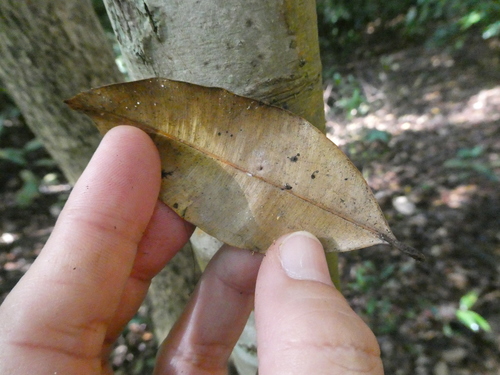
(c) Franck Rakotonasolo, some rights reserved (CC BY-NC), uploaded by Franck Rakotonasolo
iNaturalist· cc-by-nc
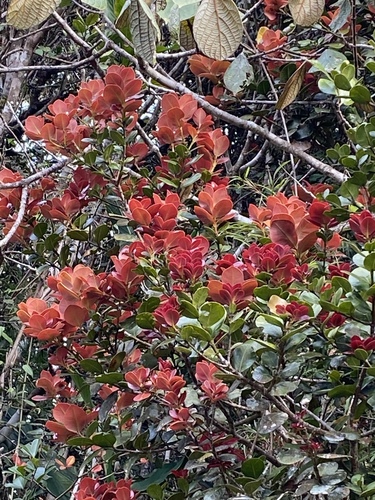
(c) yuansoup, some rights reserved (CC BY-NC)
Description
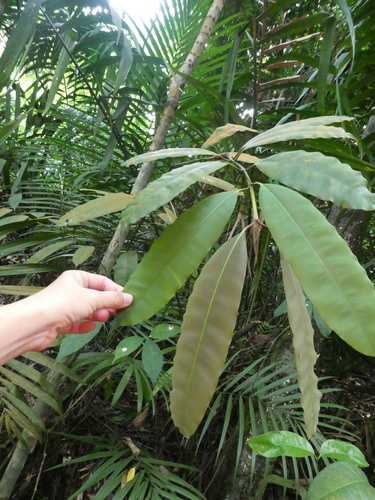
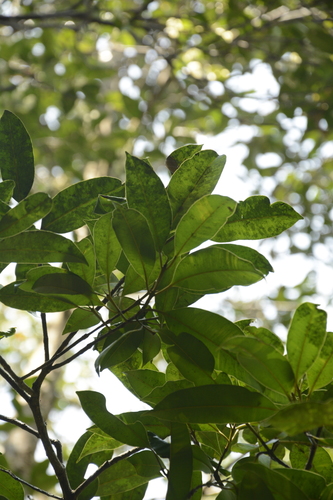
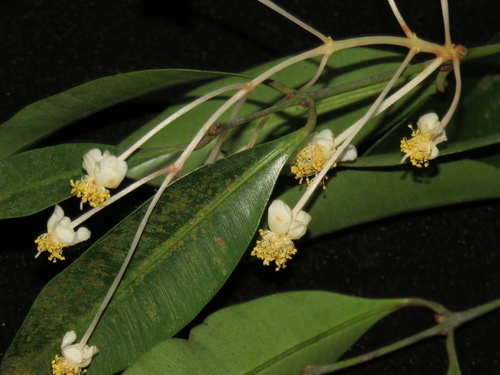
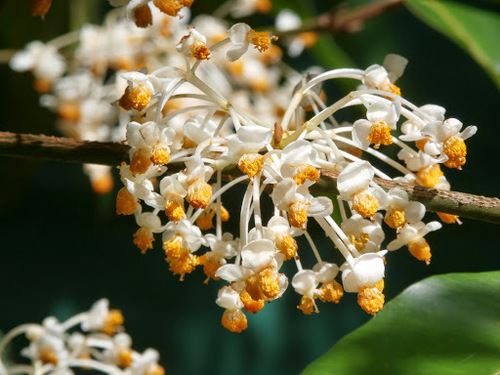
An evergreen tree. It grows 20 m tall. It has a sticky yellow exudate. The bark is smooth and yellowish. The leaves and simple and opposite. The blade is broadly oval and 3-6 cm long by 1-2.5 cm wide. They are wedge shaped at the base and rounded at the tip. The flowers are orange-red and have both sexes. The fruit is an oval fleshy berry with 5 rounded sides. It is 16 cm long by 10 cm wide and pointed. It is pale brown with 3-5 seeds. The seeds are kidney shaped.
Edible Uses
The fruit pulp is edible and often fermented to make a distilled drink. The fruit is a pale brown, ovoid, fleshy berry with 5 rounded sides; it is up to 16cm long and 10cm wide with a smooth or warty skin and containing 3 - 5 seeds.
Traditional Uses
The fruit is eaten and also fermented to make a drink.
This uses section is brief — help expand it
Medicinal Uses
The fruit is fermented to make a drink.
Distribution
A tropical plant. It grows in moist evergreen forest in the shade and grows from sea level to 1,700 m above sea level.
Where It Grows
Africa, East Africa, Indian Ocean, Madagascar,
Other Uses
The exudate obtained by incision of the bark is used to caulk boats and to fix tool handles. Seed is collected for its oil, which is not edible, but used as hair and body oil and in pharmaceutical ointments. The seeds yield about 40% oil. The melting-point of the oil is 15 - 16°c. The oil contains about 65% unsaturated fatty acids, mainly oleic acid. It is suited for soap and candle production. Branches of several Symphonia species are used to make wreaths that are worn on the head during ceremonies and festivals.. The heartwood is buff-brown with shades of yellow or orange; it is distinctly demarcated from the sapwood. The grain is generally straight, texture moderately coarse to coarse; lustre medium with a mealy appearance, conspicuous lines and arches on the radial surface and mottling on the tangential surface. The wood is moderately heavy, hard, flexible, moderately durable under humid conditions or in contact with the ground, but it is not easily affected by salt water. Shrinkage during drying is considerable. The wood works easily; gluing, painting and varnishing properties are good; it has excellent steam-bending properties. A favourite wood for shipbuilding, it is also highly valued for furniture, cabinet making and joinery, and is also suitable for interior construction, flooring, boxes, crates and implements. The wood is used for fuel.
Other Information
Fruit is sold in local markets.
Also Known As
Voandrapotika
References (6)
- Jardin, C., 1970, List of Foods Used In Africa, FAO Nutrition Information Document Series No 2.p 164
- PROTA4U
- Styger, E., et al, 1999, Indigenous fruit trees of Madagascar: potential components of agroforestry systems to improve human nutrition and restore biological diversity. Agroforestry Systems 46: 289-310
- Useful Tropical Plants.
- Wiersema, J. H. & Leon, B., 2013, World Economic Plants. A Standard Reference CRC Press. 2nd Ed. p 668
Show all 6 references Hide references
- World Checklist of Useful Plant Species 2020. Royal Botanic Gardens, Kew