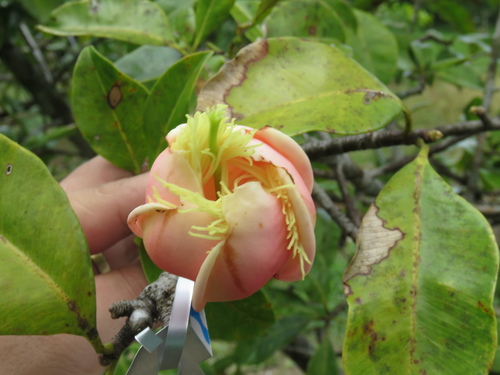
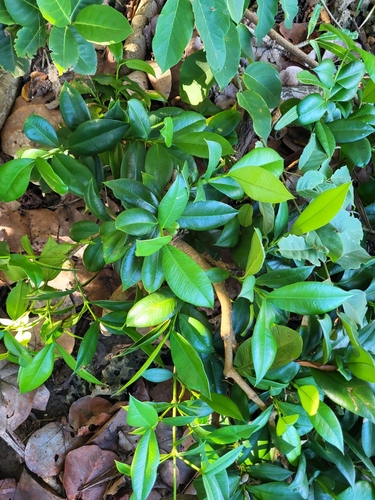
Garcinia stipulata
T. Anderson
gbif· cc0
President and Fellows of Harvard College
Description
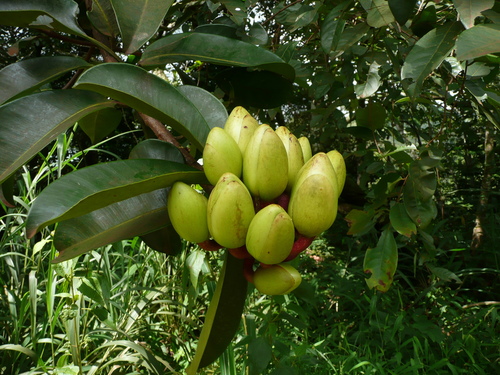
A tree. It grows 20 m tall. The leaves are 16-30 cm long. The fruit are yellow.
This description is brief — help expand it
Edible Uses
The yellow fruit is sometimes eaten[146 1808]. The globose-oblong fruit is a fleshy berry 30 - 40mm x 8 - 15mm across containing a few large seeds covered with a juicy creamy-white pulp.
Traditional Uses
The fruit are eaten.
This uses section is brief — help expand it
Distribution
A tropical plant. It often grows near streams. It grows up to 900 m above sea level.
Where It Grows
Asia, Himalayas, India, Myanmar, Northeastern India, SE Asia, Sikkim,
Cultivation
A dioecious species, both male and female forms usually need to be grown if fruit and seed are required. At least some dioecious Garcinia species, however, are able to produce fertile seed even in the absence of fertilization (asexual reproduction). Such seeds would be expected to be genetically identical to the parent
Other Uses
A yellow resinous latex is obtained from the plant - chiefly from the fruit. It does not appear to be used. The light orange-yellow wood is moderately hard, close-grained.
Notes
There are about 300 Garcinia species.
Synonyms
Also Known As
Dur-lampatay, Lampate, Sanaka-dan-kung
References (5)
- Ambasta, S.P. (Ed.), 2000, The Useful Plants of India. CSIR India. p 231
- J. D. Hooker, Fl. British India 1:267. 1874
- Savita, et al, 2006, Studies on wild edible plants of ethnic people in east Sikkim. Asian J. of Bio Sci. (2006) Vol. 1 No. 2 : 117-125
- Singh, H.B., Arora R.K.,1978, Wild edible Plants of India. Indian Council of Agricultural Research, New Delhi. p 61
- Singh, V. B., et al, (Ed.) Horticulture for Sustainable Income and Environmental Protection. Vol. 1 p 217