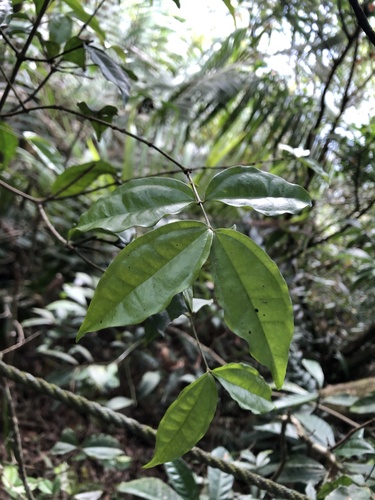
Strychnos madagascariensis
Poiret
Black monkey orange
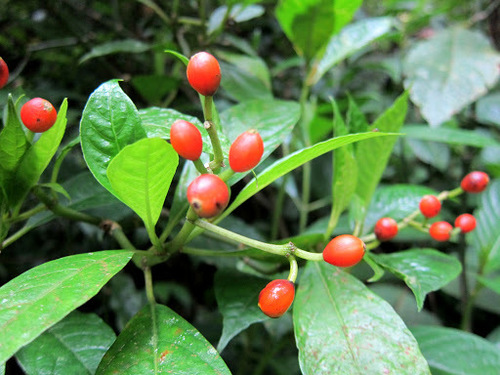
iNaturalist· cc-by-nc
(c) Sune Holt, some rights reserved (CC BY-NC), uploaded by Sune Holt
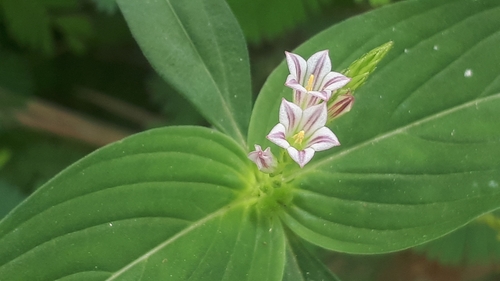
iNaturalist· cc-by-nc
(c) feno, some rights reserved (CC BY-NC), uploaded by feno
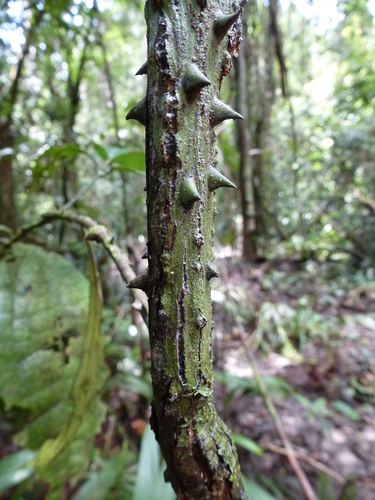
iNaturalist· cc-by-nc
(c) Solofo Eric Rakotoarisoa, some rights reserved (CC BY-NC), uploaded by Solofo Eric Rakotoarisoa
Summary
Source: WikipediaStrychnos madagascariensis, the black monkey orange, is an African tropical and sub-tropical tree belonging to the Loganiaceae family. It is a tree with characteristically large fruit but can confused with some other species of the genus.
Description
It can be a bush or a tall spineless tree. It can have one or many stems. They can grow to 15 m high. It loses its leaves during the year. The leaves are in opposite pairs. They are 2-9 cm long by 1.3-6 cm wide. They are oblong and narrow to the base. The leaves are thickish. The flowers are small and yellow. They are borne in bunches in the axils of leaves or on old wood. The fruit are large. They can be 4-10 cm across and round. They have a hard woody shell. They are blue-green but become yellow-brown when ripe. There are a large number of flat seeds. These are in a pleasant tasting pulp.
Edible Uses
The fruit flesh can be eaten fresh or dried and eaten with honey, and can also be made into a drink. Dried fruit can be ground into powder for making porridge. The seeds are not eaten as they contain strychnine and other poisonous alkaloids.
Traditional Uses
The flesh is removed and dried then eaten with honey. It can also be eaten when fresh. It can be used for a drink. The dried fruit are ground into a fine powder then used for making porridge. The seeds are not eaten. They contain strychnine and other poisonous alkaloids. (It has been recorded that the dried seeds are edible) CAUTION: Many Loganiaceae are very poisonous.
Medicinal Uses
The fruit flesh is traditionally used as food and prepared with honey in some regions.
Known Hazards
The tree is a close relative of Strychnos nux-vomica, the seed of which is a source of strychnine. Fishing with poisonous plants used to be a common practice in Africa, and though outlawed is still employed in remote areas. As with other species of Strychnos the seeds are pulverised and thrown into a pool or dammed sections of a stream, affected fish soon rising to the surface, while subsequent cooking breaks down the poison. Oils extracted from the inner skin of the fruit have a high oleic acid content.
Distribution
A tropical plant. It occurs in woodland and along rivers and in the coastal forest. In Tanzania it grows between 900-1,500 m above sea level. In Brisbane Botanical Gardens.
Where It Grows
Africa, Australia, Botswana, East Africa, Eswatini, Kenya, Madagascar, Mozambique, Namibia, South Africa, Southern Africa, Swaziland, Tanzania, Zambia, Zimbabwe, Zululand,
Cultivation
Plants are grown from seeds. Seed germinate easily.
Propagation
Seed -an easy method of propagating the plant.
Other Uses
The wood is used for construction of local houses, tool handles, woven doors, storage containers and spoons. The wood is used for fuel.
Production
Plants are fairly fast-growing. Fruit are normally available during the wet season.
Other Information
It is a significant wild food in some areas.
Nutrition
| Part | Moisture | kJ | kcal | Protein | Vit A | Vit C | Iron | Zinc |
|---|---|---|---|---|---|---|---|---|
| Fruit | 73.7 | 421 | 101 | 1 | — | 12.2 | 1.5 | 0.5 |