Streblus asper
Lour.
Crooked rough brush
iNaturalist· cc-by-nc
(c) சூழல் அறிவோம், some rights reserved (CC BY-NC)
iNaturalist· cc-by-nc
(c) சூழல் அறிவோம், some rights reserved (CC BY-NC)
iNaturalist· cc-by-nc
(c) சூழல் அறிவோம், some rights reserved (CC BY-NC)
Summary
Source: WikipediaStreblus asper is a species of flowering plant in the family Moraceae. This tree is sometimes referred to by the common names Siamese rough bush, khoi, serut, and toothbrush tree. It is a medium-sized tree native to dry regions in the Andaman Islands, Assam, Bangladesh, Cambodia, South-Central and Southeast China, East and West Himalaya, Hainan, India, Indonesia, Java, Laos, the Lesser Sunda Islands, Malaysia, Myanmar, Nepal, the Nicobar Islands, Pakistan, the Philippines, Sri Lanka, Sumatra, Thailand, and Vietnam. In the Philippines, it is commonly known as "bogta-e","bogtalay", and "Kalyos". In Cambodia, it is known as Snay. Several rural communes in Cambodia were named after the tree such as Snay Pol village (Poisonous Snay) of Prey Veng and Krang Snay (Hill of Snay) of Kampot Province. In Malaysia, it is known as "kesinai".
Description
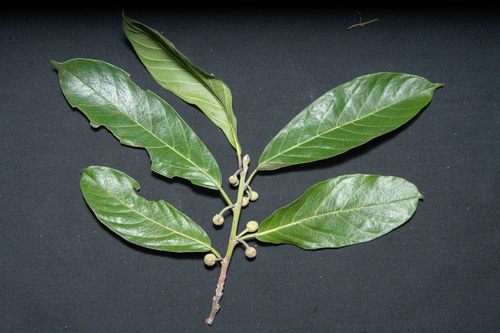
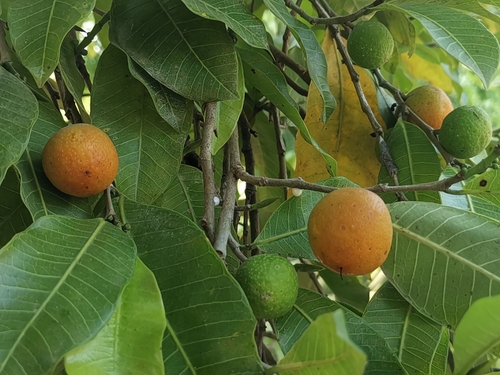
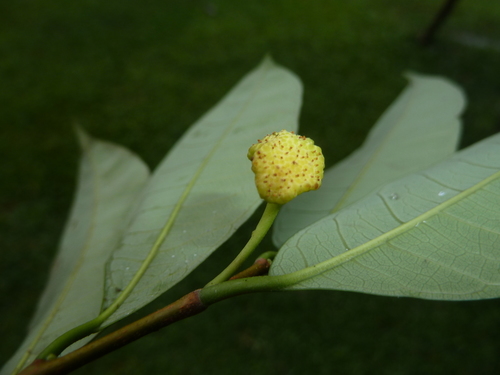
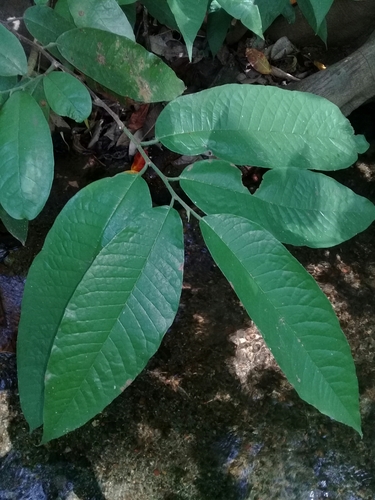
A tree up to 15 m high and 30 cm across the trunk. It is a scraggly tree with stiff branches. The bark is smooth and grey. The small branches are hairy and interwoven. The leaves are alternate and 4 to 12 cm long by 1-4 cm wide. They have a narrow base and a pointed tip. There are narrow teeth along the edge. They are somewhat rough textured. The flowers are yellow or green and small. Male flowers are in round masses and female flowers occur singly. The fruit are oval and pale yellow. They are red when mature. They are 8 to 10 mm long and fleshy with seeds 5 to 6 mm long. The fruit are sweet and edible.
Edible Uses
The ripe fruit are eaten raw and used for juice; young leaves are cooked and eaten. The sap contains a milk-clotting enzyme used to coagulate milk.
Traditional Uses
The fruit are eaten raw when ripe. They are also used for juice. They should possibly not be eaten in large amounts. The sap contains a milk clotting enzyme used to coagulate milk. The young leaves are cooked and eaten.
Medicinal Uses
A decoction of the stem bark is used in the treatment of dysentery, diarrhoea and fevers. It is also taken internally as a depurative to treat the skin disease called 'culebra'. The bark is chewed as an antidote in snake poisoning. Water in which the bark of this tree has been boiled is used for disinfecting wounds. The powdered root bark is used to treat toothache and to cure peritonitis. The leaves are depurative and laxative. They are given, with a little added salt, to mothers who have just given birth. Combined with a mixture of other plants, they are given as a galactagogue. A decoction of the branchlets is drunk to relieve a swollen abdomen. The seed is considered tonic and carminative, as well as an appetizer. The smoke from the wood is used to treat nasal polyps. A decoction of the roots is used to treat diphtheria. The latex from the plant, rubbed on the temples, is considered effective in treating neuralgia.
Known Hazards
The fruit should possibly not be eaten in large amounts.
Distribution
A tropical plant. They are widely distributed in the Philippines in areas of shrub at low altitudes and very common in regions with a very long dry season. Plants can tolerate heat, drought and flood. In Nepal is grows up to 500 m altitude. In India is grows in deciduous forests. In China it grows near villages and in forests between 200-1000 m altitude in S China. In XTBG Yunnan.
Where It Grows
Asia, Bhutan, Cambodia, China, Himalayas, India, Indochina, Indonesia, Laos, Malaysia, Myanmar, Nepal, Northeastern India, Pacific, Philippines, SE Asia, Sikkim, Sri Lanka, Thailand, Vietnam,
Cultivation
Plants are grown from seed. The seeds are often spread by termites. Plants can be grown from root suckers. It can also be grown from cuttings.
Other Uses
A fibre from the plant is used for making paper. The old leaves are rough and coarse. They can be used like sandpaper for smoothing and polishing wood, ivory etc and are also used as a scouring pad for cleaning cooking utensils. A latex obtained from the plant is used medicinally.
Other Information
The ripe fruit are especially eaten by children.
Notes
There are 14-22 Streblus species. They are in tropical and subtropical Asia. The plant is used in medicine.
Synonyms
Also Known As
Ajara, Barinki, Barivenkachettu, Cheri theso, Cherootpathi, Choriya, Chur hesto, Daheya, Dahia, Dieng-soh-khyrdang, Geta netul, Geta nithul, Hkajang-nai, Jindi, Kakkabedi, Kakshi, Kalios, Karchanua, Khaksi pate, Khande, Kharanchi-bol, Kharaoli, Kharota, Khoi, Khorua, Khorus, Koi, Kuchna, Kurripla, Kuttippirai, Mai-hkwai, Mitlemare, Mitligade, Okhne, Pakki, Parava, Paraya, Paruka, Pasuna, Peleh, Pira, Piraayamaram, Pirasu, Pohon serut, Poi, Ponaligade, Pukki, Punje, Que sheng shu, Ranjih, Ruoi, Rusa, Sahada, Sahra, Sahuda, Sehora, Seora, Serphang, Serut, Shakhotaka, Shoura, Siamese rough bush, Sihora dahya, Siora, Sitanike, Snay, Tempinis, Tintapparuya, Toothbrush tree, Vittil
References (30)
- Altschul, S.V.R., 1973, Drugs and Foods from Little-known Plants. Notes in Harvard University Herbaria. Harvard Univ. Press. Massachusetts. no. 680
- Ambasta, S.P. (Ed.), 2000, The Useful Plants of India. CSIR India. p 603
- Arinathan, V., et al, 2007, Wild edibles used by Palliyars of the western Ghats, Tamil Nadu. Indian Journal of Traditional Knowledge. 6(1) pp 163-168
- Ashton, M. S., et al 1997, A Field Guide to the Common Trees and Shrubs of Sri Lanka. WHT Publications Ltd. pdf p 282
- Burkill, I.H., 1966, A Dictionary of the Economic Products of the Malay Peninsula. Ministry of Agriculture and Cooperatives, Kuala Lumpur, Malaysia. Vol 2 (I-Z) p 2122
Show all 30 references Hide references
- Carig, Elizabeth T., 2020, Guidebook on Native Trees within the Quirino Forest Landscape. Plaridel, Bulacan, St. Andrew Publishing House. p 65
- Cengel, D. J. & Dany, C., (Eds), 2016, Integrating Forest Biodiversity Resource Management and Sustainable Community Livelihood Development in the Preah Vihear Protected Forest. International Tropical Timber Organization p 123
- Engel, D.H., & Phummai, S., 2000, A Field Guide to Tropical Plants of Asia. Timber Press. p 114
- Ethnobotany of Karbis. Chapter 4 in p 106
- Facciola, S., 1998, Cornucopia 2: a Source Book of Edible Plants. Kampong Publications, p 156
- Fl. cochinch. 2:615. 1790
- Flora of China @ efloras.org Volume 5
- Krishen P., 2006, Trees of Delhi, A Field Guide. DK Books. p 136
- Jadhav, V. D. et al, 2011, Documentation and ethnobotanical survey of wild edible plants from Kolhapur district. Recent Research in Science and Technology. 3(12): 58-63
- Jiwajinda, S., et al, 2002, Suppressive Effects of Edible Thai Plants on Superoxide and Nitric Oxide Generation. Asian Pacific Journal of Cancer Prevention, Vol 3, 2002
- Kachenchart, B., et al, 2008, Phenology of Edible Plants at Sakaerat Forest. In Proceedings of the FORTROP II: Tropical Forestry Change in a Changing World. Bangkok, Thailand.
- Majumdar, K and Datta, N., 2009, Traditional wild edible fruits for the forest dwellers of Tripura, India. Pleione 3(2) 167-178
- Manandhar, N.P., 2002, Plants and People of Nepal. Timber Press. Portland, Oregon. p 443
- Medhi, P., Sarma, A and Borthakur, S. K., 2014, Wild edible plants from the Dima Hasao district of Assam, India. Pleione 8(1): 133-148
- Misra S. & Misra M., 2016, Ethnobotanical and Nutritional Evaluation of Some Edible Fruit Plants of Southern Odisha, India. International Journal of Advances in Agricultural Science and Technology, Vol.3 Issue.1, March- 2016, pg. 1-30
- Monsalud, M.R., Tongacan, A.L., Lopez, F.R., & Lagrimas, M.Q., 1966, Edible Wild Plants in Philippine Forests. Philippine Journal of Science. p 499
- Nurfadilah, S., et al, 2017, Species richness, conservation status, and potential uses of plants in Segara Anakan Area of Sempu Island, East Java, Indonesia. BIODIVERSITAS. Volume 18, Number 4
- Patiri, B. & Borah, A., 2007, Wild Edible Plants of Assam. Geethaki Publishers. p 139
- Reis, S. V. and Lipp, F. L., 1982, New Plant Sources for Drugs and Foods from the New York Botanical Garden herbarium. Harvard. p 45
- Sarma, H., et al, 2010, Updated Estimates of Wild Edible and Threatened Plants of Assam: A Meta-analysis. International Journal of Botany 6(4): 414-423
- Singh, H.B., Arora R.K.,1978, Wild edible Plants of India. Indian Council of Agricultural Research, New Delhi. p 72
- Sukarya, D. G., (Ed.) 2013, 3,500 Plant Species of the Botanic Gardens of Indonesia. LIPI p 528
- Swaminathan, M.S., and Kochnar, S.L., 2007, An Atlas of major Flowering Trees in India. Macmillan. p 241
- Upreti, K., et al, 2010, Diversity and Distribution of Wild Edible Fruit Plants of Uttarakhand. Bioversity Potentials of the Himalaya. p 188
- www.eFloras.org. Flora of China