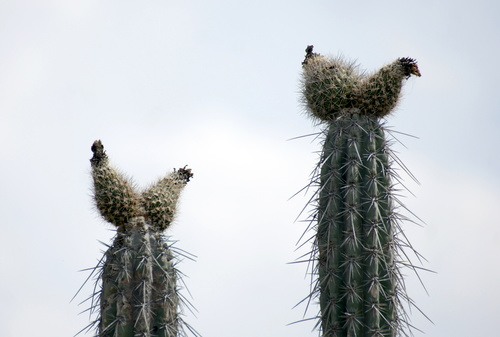
Stenocereus stellatus
(Pfeiffer) Riccobono
Joconostle cactus, Baja organ pipe cactus
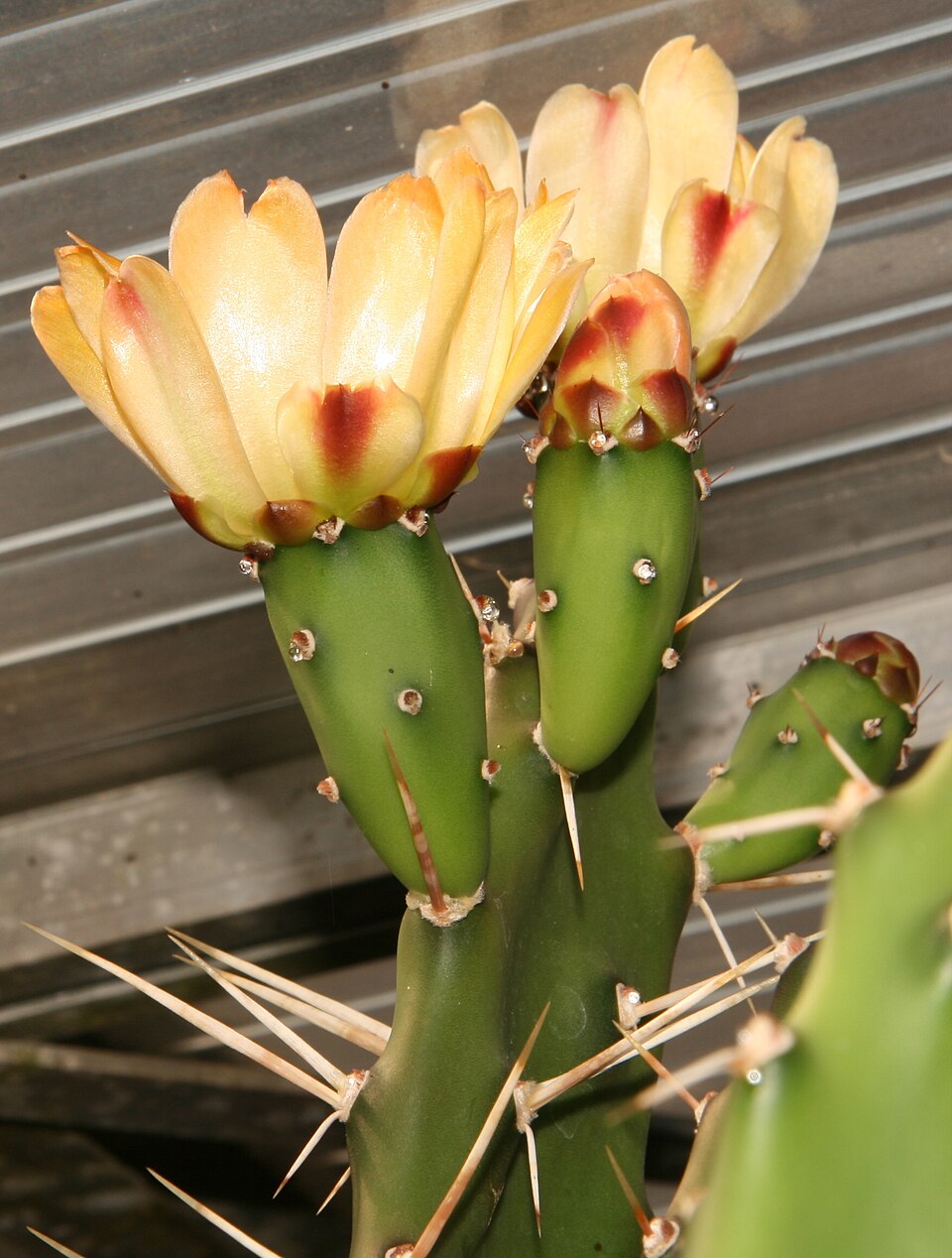
iNaturalist· cc-by-nc
(c) Juan Carlos López Domínguez, some rights reserved (CC BY-NC)
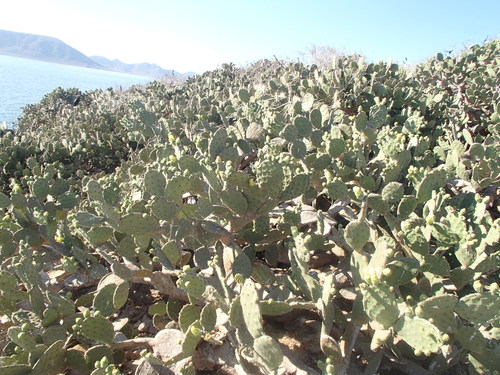
iNaturalist· cc-by-nc
(c) Leticia Soriano Flores, some rights reserved (CC BY-NC)
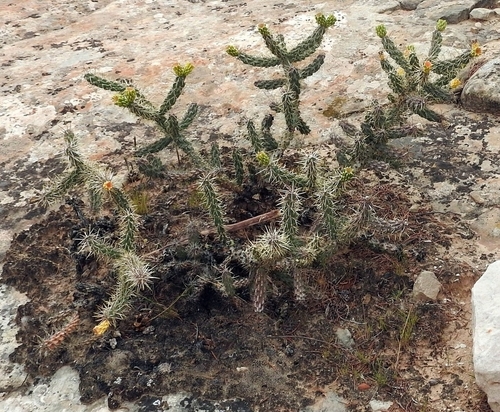
iNaturalist· cc-by-nc
(c) Joseph Scheer, some rights reserved (CC BY-NC)
Summary
Source: WikipediaStenocereus stellatus is a flowering plant in the family Cactaceae that is found in Oaxaca, Mexico
Description
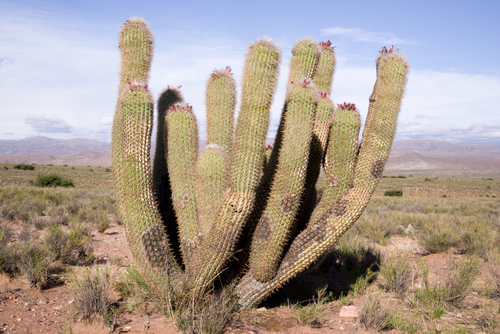
A cactus. It is shrubby or treelike. It branches near the base. It grows 2-4 m high. It has a short trunk. The stems are dark bluish-green. They are 7-10 cm wide. There are 8-12 ribs and they are rounded and lumpy. They are 2 cm high. There are usually 3 central spines with one pointing down and 2 pointing up. They are 2-6 cm long. There are 7-9 spines around these. They are short and grey with dark tips. The flowers open at night. They are at the ends of the branches. They are a narrow bell shape. They are pale red and 4.5-6 cm long.
Edible Uses
The fruit can be eaten raw or cooked and has a slightly acid flavour. It is said to make the most delicious of all cactus jams in Mexico and is also used as a filling in turnovers. Fruits can be dried for later use and are around 3cm in diameter. The fruit juice is used to prepare an alcoholic beverage called 'colonche'. Flowers and seeds are occasionally eaten as well; flower buds are parboiled then prepared with onions and vinegar. Stems are also occasionally eaten.
Traditional Uses
The fruit are eaten fresh or dried. They are used for jam. It is also served hot with local goat cheese. The juice of the fruit is used to prepare an alcoholic drink. Caution: Alcohol is a cause of cancer. The seeds, stems and flower are occasionally eaten. The flower buds are parboiled then fried with egg or prepared with onions and vinegar.
Medicinal Uses
None known
Distribution
It is a tropical plant. It grows in arid places.
Where It Grows
Asia, Australia, Central America, Indonesia, Mexico*, North America, SE Asia,
Cultivation
Plants can be grown from seeds and cuttings. It can be cultivated as a hedge.
Propagation
Propagate by seed.
Other Uses
Can be used for fencing and as biomass. Provides fodder.
Production
Plants fruit after 5-10 years. Yields of fruit of 3.3 tons per hectare are recorded.
Other Information
It is a cultivated food plant. Fruit are sold in local markets.
Synonyms
Also Known As
Kaktus pipa organ baja, Ndichicaya, Pitaya, Xoconochtli, Xoconostle
References (20)
- Anderson, E.F., 2001, The Cactus Family, Timber Press. p 55, 648
- Arellanes, Y., et al, 2013, Influence of traditional markets on plant management in the Tehuacan Valley. Journal of Ethnobiology and Ethnomedicine 9:38
- Boll. Reale Orto Bot. Giardino Colon. Palermo 8:253. 1909
- Casas, A., et al, 1996, Plant Management Among the Nahua and the Mixtec in the Balsas River Basin, Mexico: An Ethnobotanical Approach to the Study of Plant Domestication. Human Ecology, Vol. 24, No. 4 pp. 455-478
- Casas, A., et al, 2016, Evolutionary Ethnobotanical Studies of Incipient Domestication of Plants in Mesoamerica. In Lira, R., et al, (eds.) Ethnobotany of Mexico, Ethnobiology. Springer p 266
Show all 20 references Hide references
- Facciola, S., 1998, Cornucopia 2: a Source Book of Edible Plants. Kampong Publications, p 66
- Gonzalez-Insuasti, M. S. and Caballero, J., 2007, Managing Plants Resources: How Intensive Can it be? Human Ecology, 35:303-314
- Gonzalez-Insuasti, M. S., et al, 2011, Intra-cultural Differences in the Importance of Plant Resources and Their Impact on Management Intensificaton in the Tehuacan Vallet, Mexico. Human Ecology 39:191-202
- Hibbert, M., 2002, The Aussie Plant Finder 2002, Florilegium. p 294
- Kermath, B. M., et al, 2014, Food Plants in the Americas: A survey of the domesticated, cultivated and wild plants used for Human food in North, Central and South America and the Caribbean. On line draft. p 478 (As Lemaireocereus stellatus)
- Lira, R., et al, 2009, Traditional Knowledge and Useful Plant Richness in the Tehuacan-Cuicatlan Valley, Mexico. Economic Botany XX(X): 1-17
- Martin, F. W., et al, 1987, Perennial Edible Fruits of the Tropics. USDA Handbook 642 p 87 (As Lemaireocereus stellatus)
- Perez-Negron, E., et al, 2014, Use of columnar cacti in the Tehuacan Valley, Mexico: perspectives for sustainable management of non-timber forest products. Journal of Ethnobotany and Ethnomedicine, 10:79
- Segura, S., et al, 2018, The edible fruit species in Mexico. Genet Resour Crop Evol (2018) 65:1767–1793
- Sukarya, D. G., (Ed.) 2013, 3,500 Plant Species of the Botanic Gardens of Indonesia. LIPI p 1047
- Tanaka,
- USDA, ARS, National Genetic Resources Program. Germplasm Resources Information Network - (GRIN). [Online Database] National Germplasm Resources Laboratory, Beltsville, Maryland. Available: www.ars-grin.gov/cgi-bin/npgs/html/econ.pl (10 April 2000)
- Wiersema, J. H. & Leon, B., 2013, World Economic Plants. A Standard Reference CRC Press. 2nd Ed. p 660
- World Checklist of Useful Plant Species 2020. Royal Botanic Gardens, Kew
- www.desert-tropicals.com