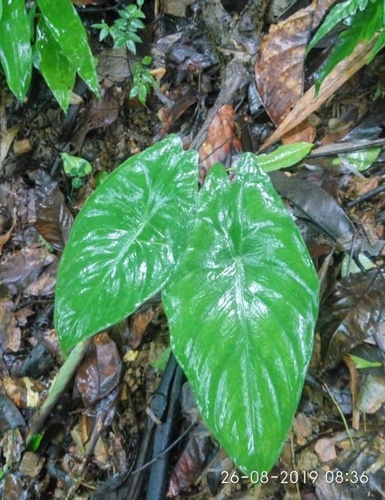
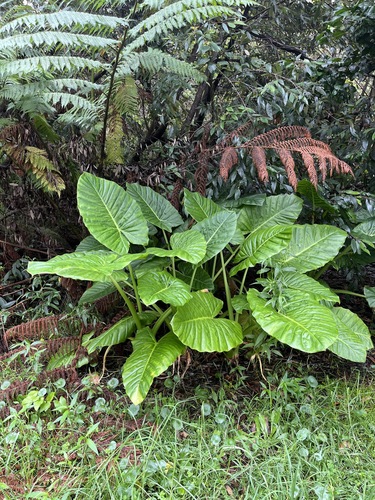
Arisaema concinnum
Schott
Chinese cobra lily
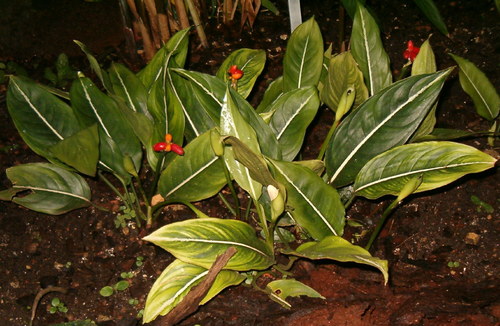
iNaturalist· cc-by-nc
(c) Bon Pradhan, some rights reserved (CC BY-NC), uploaded by Bon Pradhan
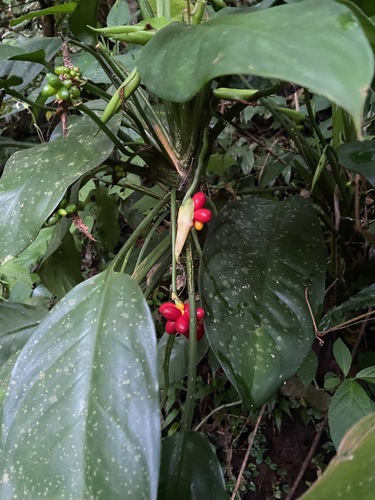
iNaturalist· cc-by-nc
(c) Bon Pradhan, some rights reserved (CC BY-NC), uploaded by Bon Pradhan
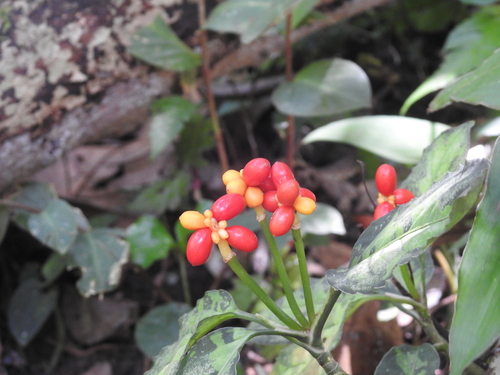
iNaturalist· cc-by-nc
(c) Gary Yong Gee, some rights reserved (CC BY-NC), uploaded by Gary Yong Gee
Description
A fleshy herb. It keeps growing from year to year. It grows 75 cm high. The corm is rounded and 5 cm across. There are 7-11 leaflets. They are oblong to sword shaped and 15-30 cm long by 2-5 cm wide. The leaf stalk is 60 cm long. The blade ends in a curved tail.
Edible Uses
The corms are eaten as a famine food but only after repeated boiling to remove oxalates.
Traditional Uses
The corms are eaten but only after repeated boiling. This removes the oxalates. It is used as a famine food.
This uses section is brief — help expand it
Known Hazards
The corms contain oxalates that must be removed through repeated boiling before consumption.
Distribution
It is a temperate plant. It grows in pine forest, broad-leaved forest between 2100-3100 m in China. They suit cool shady forest areas.
Where It Grows
Asia, Australia, Bhutan, China, Himalayas, India, Indochina, Malaysia, Myanmar, Nepal, Northeastern India, SE Asia, Tibet,
Cultivation
They can be grown from corms or pieces of the rhizome.
Notes
There are about 150-170 Arisaema species.
Synonyms
Also Known As
Wange, Zhou xu nan xing
References (11)
- Ambasta S.P. (Ed.), 2000, The Useful Plants of India. CSIR India. p 52
- Bircher, A. G. & Bircher, W. H., 2000, Encyclopedia of Fruit Trees and Edible Flowering Plants in Egypt and the Subtropics. AUC Press. p 41
- Bonplandia 7:27. 1859
- Burkill, I.H., 1966, A Dictionary of the Economic Products of the Malay Peninsula. Ministry of Agriculture and Cooperatives, Kuala Lumpur, Malaysia. Vol 1 (A-H) p 240
- Li Heng, Araceae, Flora of China
Show all 11 references Hide references
- Lim, T. K., 2015, Edible Medicinal and Non Medicinal Plants. Volume 9, Modified Stems, Roots, Bulbs. Springer p 11
- PROSEA handbook Volume 9 Plants yielding non-seed carbohydrates. p166
- Ryan, S., 2008, Dicksonia. Rare Plants Manual. Hyland House. p 121
- Singh, H.B., Arora R.K.,1978, Wild edible Plants of India. Indian Council of Agricultural Research, New Delhi. p11
- Tsering, J., et al, 2017, Ethnobotanical appraisal on wild edible plants used by the Monpa community of Arunchal Pradesh. Indian Journal of Traditional Knowledge. Vol 16(4), October 2017, pp 626-637
- World Checklist of Useful Plant Species 2020. Royal Botanic Gardens, Kew