Acacia mellifera subsp. detinens
(Vahl) Benth., (Burchell) Brenan
Black thorn, Hook-thorn
gbif· cc-by-nc-sa
MBG
gbif· cc-by
Royal Botanic Gardens, Kew
gbif· cc-by-nc-sa
MBG
Description
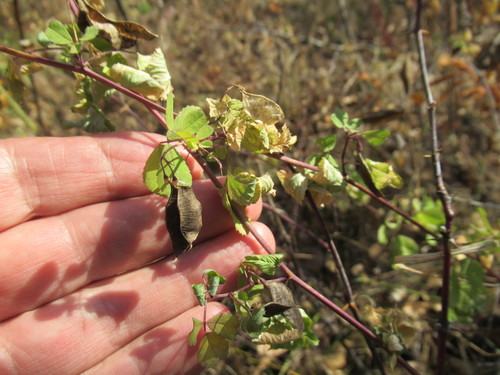
A shrub or small tree. It grows 5 m tall. There are prickles along the stem. The leaves are twice divided and there are 8-18 pairs of pinnae. There are up to 50 pairs of pinnules on each pinnae. The flowers are yellow. They are in large clusters at the ends of branches. The pods are flattened.
Edible Uses
The edible gum is produced when branches are damaged and is particularly enjoyed by children. The leaves, fruit, and pods are edible, and the roots are used as a curdling agent and to sour milk.
Traditional Uses
The edible gum is produced when branches are damaged. The roots are used to sour milk and as a curdling agent.
This uses section is brief — help expand it
Medicinal Uses
The roots are used to sour milk and as a curdling agent.
Distribution
It is a tropical and subtropical plant. It grows in dry bushveld. It is often on sand and semi-desert. It can tolerate drought and frost. It grows in areas with annual rainfalls between 60-1,300 mm. The dry season can be 6-11 months. It can grow in salty and alkaline soils. It grows from sea level to 1,800 m above sea level. It can grow in arid places.
Where It Grows
Africa, Angola, Australia, Botswana, Central Africa, East Africa, Eswatini, Mozambique, Namibia, South Africa, Southern Africa, Swaziland, Tanzania, Zambia, Zimbabwe,
Cultivation
Plants can be grown from seeds. The seeds can be soaked in hot water overnight then planted. It is best grown in a nursery in sand then transplanted early without damaging the taproot.
Production
It grows at a moderate rate.
Other Information
The gum is enjoyed especially by children.
Notes
There are about 1,350 Acacia species. Over 1,000 occur in Australia. Also as Mimosaceae.
Synonyms
Also Known As
Katogwa, Magokwe, Mongana, Monka, Muguhungu, Mukotokwa, Oiti, Omuzoana, Swarthaak, Umngaga
References (19)
- Cundall, P., (ed.), 2004, Gardening Australia: flora: the gardener's bible. ABC Books. p 77
- Fox, F. W. & Young, M. E. N., 1982, Food from the Veld. Delta Books. p 201
- Grivetti, 1976, 1979,
- Kew Bull. 11:191. 1956
- Lee, 1979,
Show all 19 references Hide references
- Long, C., 2005, Swaziland's Flora - siSwati names and Uses http://www.sntc.org.sz/flora/
- Mbuya, L.P., Msanga, H.P., Ruffo, C.K., Birnie, A & Tengnas, B., 1994, Useful Trees and Shrubs for Tanzania. Regional Soil Conservation Unit. Technical Handbook No 6. p 58
- Marshall, 1976,
- Palgrave, K.C., 1996, Trees of Southern Africa. Struik Publishers. p 244
- Palmer, E and Pitman, N., 1972, Trees of Southern Africa. Vol. 2. A.A. Balkema, Cape Town p 700
- Peters, C. R., O'Brien, E. M., and Drummond, R.B., 1992, Edible Wild plants of Sub-saharan Africa. Kew. p 127
- Roodt, V., 1998, Trees & Shrubs of the Okavango Delta. Medicinal Uses and Nutritional value. The Shell Field Guide Series: Part 1. Shell Botswana. p 169
- Royal Botanic Gardens, Kew (1999). Survey of Economic Plants for Arid and Semi-Arid Lands (SEPASAL) database. Published on the Internet; http://www.rbgkew.org.uk/ceb/sepasal/internet [Accessed 26th April 2011]
- Silberbauer, 1981,
- Story, 1958,
- Swaziland's Flora Database http://www.sntc.org.sz/flora
- van Wyk, B, van Wyk, P, and van Wyk B., 2000, Photographic guide to Trees of Southern Africa. Briza. p 36
- Venter, F & J., 2009, Making the most of Indigenous Trees. Briza. p 24
- www.zimbabweflora.co.zw 2011