Sonneratia caseolaris
(L.) Engl.
Firefly mangrove, Red-flowered Pornupan mangrove
iNaturalist· cc-by-nc-sa
(c) Jane Gosden, some rights reserved (CC BY-NC-SA), uploaded by Jane Gosden
iNaturalist· cc-by-nc
(c) Shiwalee Samant, some rights reserved (CC BY-NC)
iNaturalist· cc-by-nc
(c) cpgibson, some rights reserved (CC BY-NC), uploaded by cpgibson
Summary
Source: WikipediaSonneratia caseolaris, commonly known as mangrove apple, or pagatpat is a species of plant in the family Lythraceae. The fruit is noted for its outward similarity to the persimmon fruit. This tree is a type of mangrove growing up to 20 m in height and with a trunk reaching a maximum diameter of 50 cm. It is present in tropical tidal mud flats from Africa to Indonesia, southwards down to northeast Australia and New Caledonia and northwards up to Hainan Island in China and the Philippines. It has pneumatophores or "knees" up to 2 m (6 ft 7 in) in height and conical in form The fruit of this tree is the subject of a legend of Maldivian folklore, Kulhlhavah Falu Rani. Kuhlhavah (ކުއްޅަވައް) is the Dhivehi name for the mangrove apple (Sonneratia caseolaris). The tree is associated with congregating fireflies throughout southeast Asia and is the food source of moth and other insects.
Description
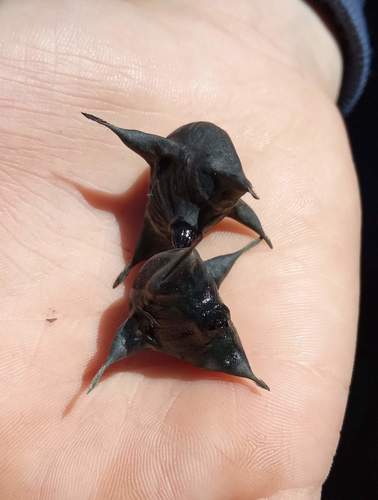
A medium sized tree. It grows 6-20 m tall. The trunk is swollen at the base when young. The trunk can be 30 cm across. Air roots are up to 60 cm long. The smallest branches are jointed and 4 angled. The leaves are thick, leathery and narrow. They are opposite. They are 5-13 cm long by 2-5 cm wide. The flowers occur singly. The petals are red and narrow and fall off very early. The outer case of sepals is green. The fruit are hard, round and pressed down at the tip. They are 4 cm long by 7.5 cm wide. They contain many seeds.
Edible Uses
Young berries can be eaten raw or cooked — either as a fruit or prepared as a vegetable. They have a sour, cheese-like flavour. The fruits are also a source of pectin. Young leaves can be eaten raw.
Traditional Uses
The fruit is cooked and eaten as food and used for vinegar. It has a sour taste. The young fruit are used for flavouring chutnies and curries. The ripe fruit can be eaten raw or cooked. They are also used for juice. The seeds and skin are removed. In Indonesia fruit are used to make syrup called Pedada.
Medicinal Uses
The plant is considered haemostatic and is used as a folk remedy for sprains, swellings, and worms. Old fruit walls are used to treat worms. Half-ripe fruits are used for coughs. The fruits are made into poultices. Pounded leaves are applied as a treatment for haematuria and smallpox. Leaves can also be crushed, mixed with salt, and applied as a poultice on cuts and bruises.
Distribution
A tropical plant. It grows in tropical places in Asia. It grows in swamps of brackish water. They occur along the seashore and along the upper stretches of tidal streams throughout the Philippines. It grows in wetlands. It grows in mangroves. It can grow up to 900 m above sea level. In Townsville palmetum.
Where It Grows
Africa, Andamans, Asia, Australia, Bangladesh, Cambodia, China, Chuuk, FSM, India, Indochina, Indonesia, Malaysia, Maldives, Myanmar, New Caledonia, Pacific, Pakistan, Papua New Guinea, PNG, Philippines, SE Asia, Solomon Islands, Sri Lanka, Thailand, Vanuatu, Vietnam,
Cultivation
Plants can be grown from seeds.
Propagation
Seed has low viability of less than three months.
Other Uses
This tree plays an important role in coastal swamp communities, helping prevent soil erosion and providing wildlife habitat. It is a fast-growing pioneer species that colonises newly formed mudflats and can spread rapidly, particularly where salinity is low. The pneumatophores — vertical roots that rise above the ground — are used as floats for fish nets and, due to their corky texture, are made into inner soles for shoes and can substitute for cork or pith; they are boiled before use. The bark yields tannins. The heartwood ranges from light brown to dark chocolate, while the sapwood is light greyish brown and 3–8cm thick. Under varnish or when wet, the heartwood of old mature trees appears almost black. The grain is straight or very slightly crossed, the texture fine, homogeneous, and smooth but not glossy, with a distinct salty taste and a fishy or swampy odour when fresh. The wood is moderately hard and moderately heavy to heavy, easy to work, and durable in the ground; the sapwood is rarely attacked by insects and the heartwood resists teredos well. Its salt content means copper nails and screws must be used. It is used for piles, posts, poles, railway ties, paving blocks, ship, bridge, and wharf construction, doors, siding, sheathing, ceilings, flooring, interior finish, ship planking and decking, furniture, cabinetwork, and musical instruments. It serves as firewood when better options are unavailable.
Other Information
A very minor food. The juice is important in some places. Trees are also cultivated. In some places the fruit are widely used in chutneys and curries. Fruit are also sold in some local markets.
Notes
Also put in the family Sonneratiaceae.
Nutrition
| Part | Moisture | kJ | kcal | Protein | Vit A | Vit C | Iron | Zinc |
|---|---|---|---|---|---|---|---|---|
| Fruit | 79.2 | 380 | 91 | 2.3 | — | 0.6 | 0.9 | 8.7 |
Synonyms
Also Known As
Ampie-lpu, Archa, Archaka, Ban chua, Bedat, Bedata, Berembang, Berombong, Betah, Bidada, Blatti, Bogem, Chipi, Crab apple mangrove, Gedaba, Jedaba, Kandale, Kapidada, Kinnari, Kirala, Kirilla, Kulha, Lam pu, Lampoo, Ora, Orali, Orcha, Orua, Pat, Pedada, Perepat, Pohon perepay merah, Pohon pidada merah, Shoila, Sundarignua, Thirala, Tiwar
References (41)
- Ambasta, S.P. (Ed.), 2000, The Useful Plants of India. CSIR India. p 584
- Argent, G et al, nd, Manual of the Larger and More important non Dipterocarp Trees of Central Kalimantan Indonesia. Volume 2 Forest Research Institute, Samarinda, Indonesia. p 602
- Baba, S., et al, 2013, Useful products from mangrove and other coastal plants. ISME Mangrove Educational Book Series No. 3 p 47
- BARC, 2016, State of Biodiversity for Food and Agriculture in Bangladesh. Bangladesh Agricultural Research Council.
- Borrell, O.W., 1989, An Annotated Checklist of the Flora of Kairiru Island, New Guinea. Marcellin College, Victoria Australia. p 138, 222
Show all 41 references Hide references
- Burkill, I.H., 1966, A Dictionary of the Economic Products of the Malay Peninsula. Ministry of Agriculture and Cooperatives, Kuala Lumpur, Malaysia. Vol 2 (I-Z) p 2088
- Castillo, C., 2013, The Archaeobotany of Khao Sam Kaeo and Phu Khao Thong: The Agriculture of Late Prehistoric Southern Thailand. Ph. D. thesis University College, London p 379
- Centofanti, T. & Banuelos, G., 2019, Practical uses of Halophytic Plants as Sources of Food and Fodder. CAB International. p 327
- Cooper, W. and Cooper, W., 2004, Fruits of the Australian Tropical Rainforest. Nokomis Editions, Victoria, Australia. p 524
- Dunlop, C.R., Leach, G.J. & Cowie, I.D., 1995, Flora of the Darwin Region. Vol 2. Northern Territory Botanical Bulletin No 20. p 132 (As Sonneratia lanceolata)
- Facciola, S., 1998, Cornucopia 2: a Source Book of Edible Plants. Kampong Publications, p 238
- Flora and Livestock in Coastal Karnataka. 2007, Report. EMPRI p 60
- Flora of Pakistan. www.eFloras.org
- Floyd, A.G., 1977, Ecology of the Tidal Forests in the Kikori-Romilly Sound Area Gulf of Papua. Ecology Report No 4 Division of Botany, Lae, Papua New Guinea. p 47
- Frodin, D.G. & Leach, G.L., 1982, Mangroves of the Port Moresby Region. Biology Department Occasional Paper No 3 Revised edition. Papua New Guinea, p 66
- Forest Inventory and Planning Institute, 1996, Vietnam Forest Trees. Agriculture Publishing House p 682
- French, B.R., 2010, Food Plants of Solomon Islands. A Compendium. Food Plants International Inc. p 389
- Havel, J.J., 1975, Forest Botany, Volume 3 Part 2 Botanical taxonomy. Papua New Guinea Department of Forests, p 221
- Hedrick, U.P., 1919, (Ed.), Sturtevant's edible plants of the world. p 627 (As Sonneratia acida)
- Hoe, V. B. & Siong, K. H., 1999, The nutritional value of indigenous fruit and vegetables in Sarawak. Asia Pacific J. Clin. Nutr. 8(1):24-31
- Hosen, M. Z., et al, 2020, Comparison or Physicochemical and Antioxidant Properties of Edible Fruits in the Sundarbans' Mangrove Forest, Bangladesh. Bangladesh J. Bot. 49 (3): 671-678
- Lazarides, M. & Hince, B., 1993, Handbook of Economic Plants of Australia, CSIRO. p 225 (As Sonneratia lanceolata)
- Lovelock, C., & Clarke, S., 1999, Field Guide to the Mangroves of Queensland. Australian Institute of Marine Science. p 52
- Martin, F.W. & Ruberte, R.M., 1979, Edible Leaves of the Tropics. Antillian College Press, Mayaguez, Puerto Rico. p 220
- Milow, P., et al, 2013, Malaysian species of plants with edible fruits or seeds and their evaluation. International Journal of Fruit Science. 14:1, 1-27
- Mishra, N., et al, 2016, Indigenous knowledge in utilization of wetland plants in Bhadrak district, Odisha, India. Indian Journal of Natural Products and Resources. Vol. 7(1) pp. 82-89
- Monsalud, M.R., Tongacan, A.L., Lopez, F.R., & Lagrimas, M.Q., 1966, Edible Wild Plants in Philippine Forests. Philippine Journal of Science. p 547
- Pasha, M. K. & Uddin, S. B., 2019, Minor Edible Fruits of Bangladesh. Bangladesh J. Plant Taxon. 26(2): 299–313
- Phon, P., 2000, Plants used in Cambodia. © Pauline Dy Phon, Phnom Penh, Cambodia. p 563
- Rajapaksha, U., 1998, Traditional Food Plants in Sri Lanka. HARTI, Sri Lanka. p 491
- Roy, S. D., et al, 2009, Mangroves of Andaman and Nicobar Islands. ICAR p 26
- Scarth-Johnson, V., 2000, National Treasures. Flowering Plants of Cooktown and Northern Australia. Vera Scarth-Johnson Gallery Association. Cooktown, Australia. p 30
- Selvam, V., 2007, Trees and shrubs of the Maldives. RAP Publication No. 2007/12 p 202
- Singh, H.B., Arora R.K.,1978, Wild edible Plants of India. Indian Council of Agricultural Research, New Delhi. p 72
- Singh, H.B., Arora R.K.,1978, Wild edible Plants of India. Indian Council of Agricultural Research, New Delhi. p 86 (As Sonneratia acida)
- Soepadmo, E. and Wong, K. M., 1995, Tree Flora of Sabah and Sarawak. Forestry Malaysia. Volume One. p 450
- Sujanapal, P., & Sankaran, K. V., 2016, Common Plants of Maldives. FAO & Kerala FRI, p 246
- Sukarya, D. G., (Ed.) 2013, 3,500 Plant Species of the Botanic Gardens of Indonesia. LIPI p 516
- Tanaka,
- Uphof,
- World Checklist of Useful Plant Species 2020. Royal Botanic Gardens, Kew