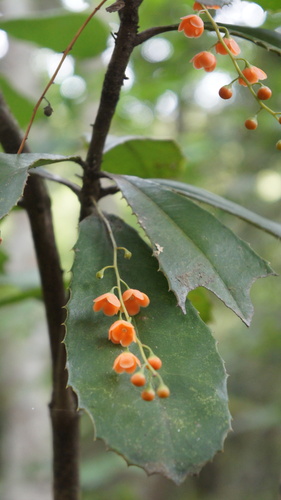
Ardisia humilis
Vahl.
Ardisia, Low shoe-button berry
iNaturalist· cc-by-nc
(c) Peter Zika, some rights reserved (CC BY-NC), uploaded by Peter Zika
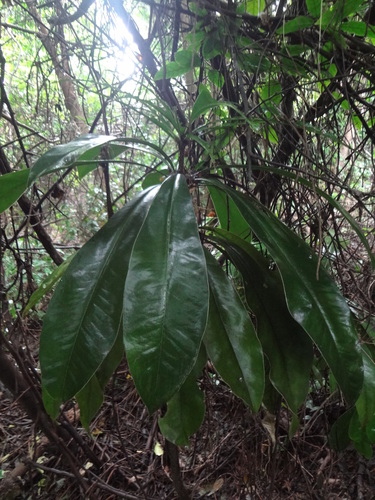
iNaturalist· cc-by-nc
(c) 洪阿愷, some rights reserved (CC BY-NC), uploaded by 洪阿愷
iNaturalist· cc-by-nc-sa
(c) Cody Hinchliff, some rights reserved (CC BY-NC-SA)
Summary
Source: WikipediaArdisia humilis (jet berry) is a species of flowering plant in the genus Ardisia in the family Primulaceae, native to southeastern Asia in southern China (Guangdong, Hainan), the Philippines, and Vietnam.
Description
A small tree. It grows to 3 m high. The branches are 5-7 mm across. The leaf stalk has a canal and is 6-10 mm long. The leaves are sword shape but fattest in the middle. They are 15-18 cm long by 5-7 cm wide. They are leathery. There are about 12 side veins on each side of the midrib. The flower arrangement is like a pyramid at the top of the plant. This is 8-17 cm high. The flowers are leathery. They are pink or purplish red and 5-6 mm across. The fruit are red or purplish black and round. They are 6 mm across.
Edible Uses
The leaves are eaten as a vegetable.
Distribution
A tropical plant. It grows in mixed forest and open fields between sea level and 1100 m altitude in S China. It needs rich moist soils It is best in a shaded position. It is damaged by frost or drought. Adelaide Botanical Gardens. Melbourne Botanical gardens hothouse.
Where It Grows
Africa, Andamans, Asia, Australia, China, India, Indochina, Indonesia*, Malaysia, Myanmar, Northeastern India, Pacific, Philippines, SE Asia, Sri Lanka, Vietnam,
Cultivation
It can be grown from seed or cuttings.
Notes
There are about 250-300 Ardisia species. They are mainly in the tropics. Also put in the family Myrsinaceae.
Synonyms
Also Known As
Ai zi jin niu, Comnguoi thap, Duck's eye, Jet berry, Lempei ata itik, Parok detok, Rumpeni
References (11)
- Bircher, A. G. & Bircher, W. H., 2000, Encyclopedia of Fruit Trees and Edible Flowering Plants in Egypt and the Subtropics. AUC Press. p 39
- Bodkin, F., 1991, Encyclopedia Botanica. Cornstalk publishing, p 97
- Chen Jie, Pipoly 3, J.J., Myrsinaceae. Flora of China.
- Grubben, G. J. H. and Denton, O. A. (eds), 2004, Plant Resources of Tropical Africa 2. Vegetables. PROTA, Wageningen, Netherlands. p 559 (Has Ardisia solanacea as synonym)
- Lord, E.E., & Willis, J.H., 1999, Shrubs and Trees for Australian gardens. Lothian. p 205
Show all 11 references Hide references
- Martin, F.W. & Ruberte, R.M., 1979, Edible Leaves of the Tropics. Antillian College Press, Mayaguez, Puerto Rico. p 206
- Pham-Hoang Ho, 1999, An Illustrated Flora of Vietnam. Nha Xuat Ban Tre. p 703
- Sukarya, D. G., (Ed.) 2013, 3,500 Plant Species of the Botanic Gardens of Indonesia. LIPI p 582
- Symb. bot. 3:40. 1794
- Teron, R. & Borthakur, S. K., 2016, Edible Medicines: An Exploration of Medicinal Plants in Dietary Practices of Karbi Tribal Population of Assam, Northeast India. In Mondal, N. & Sen, J.(Ed.) Nutrition and Health among tribal populations of India. p 153
- World Checklist of Useful Plant Species 2020. Royal Botanic Gardens, Kew