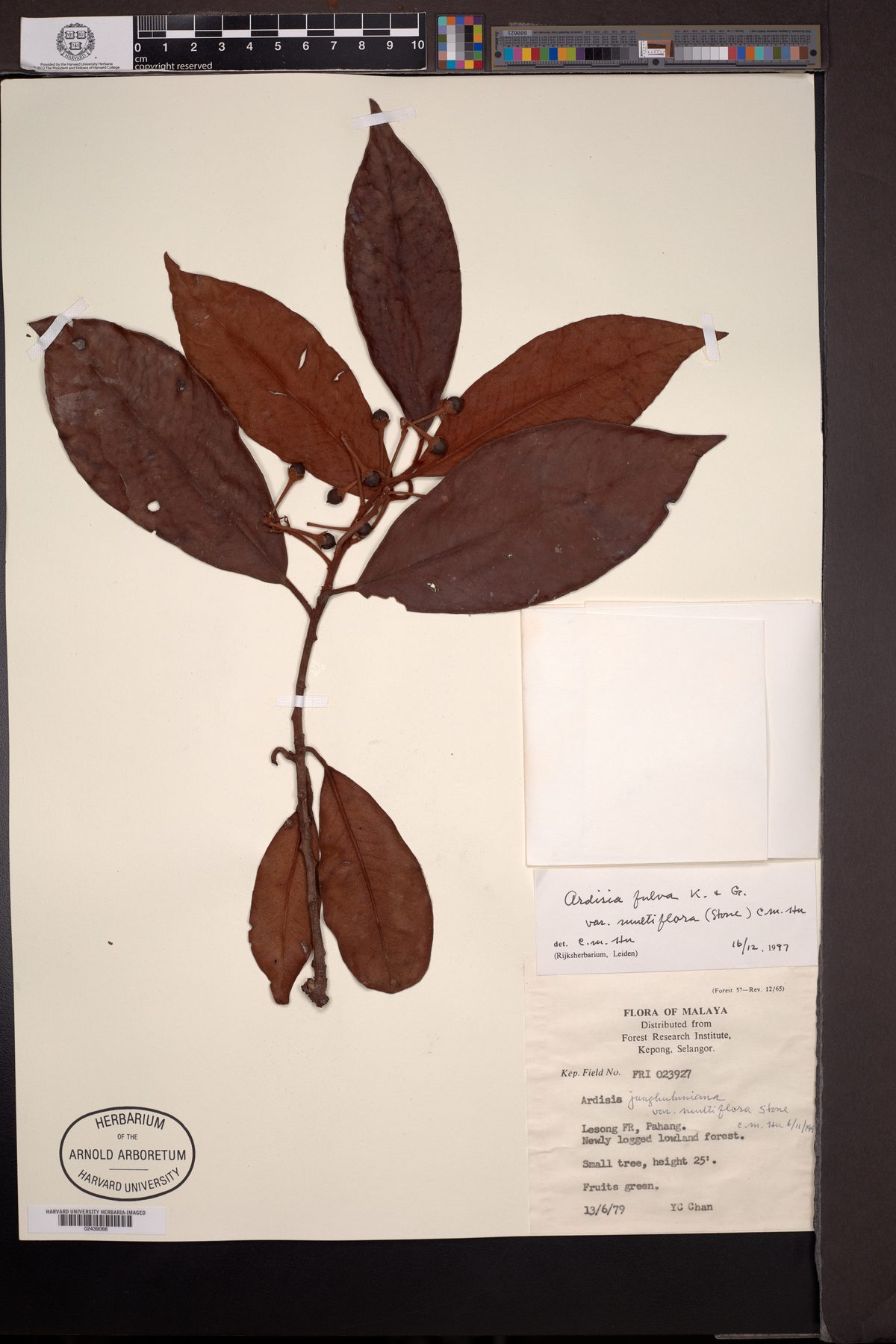
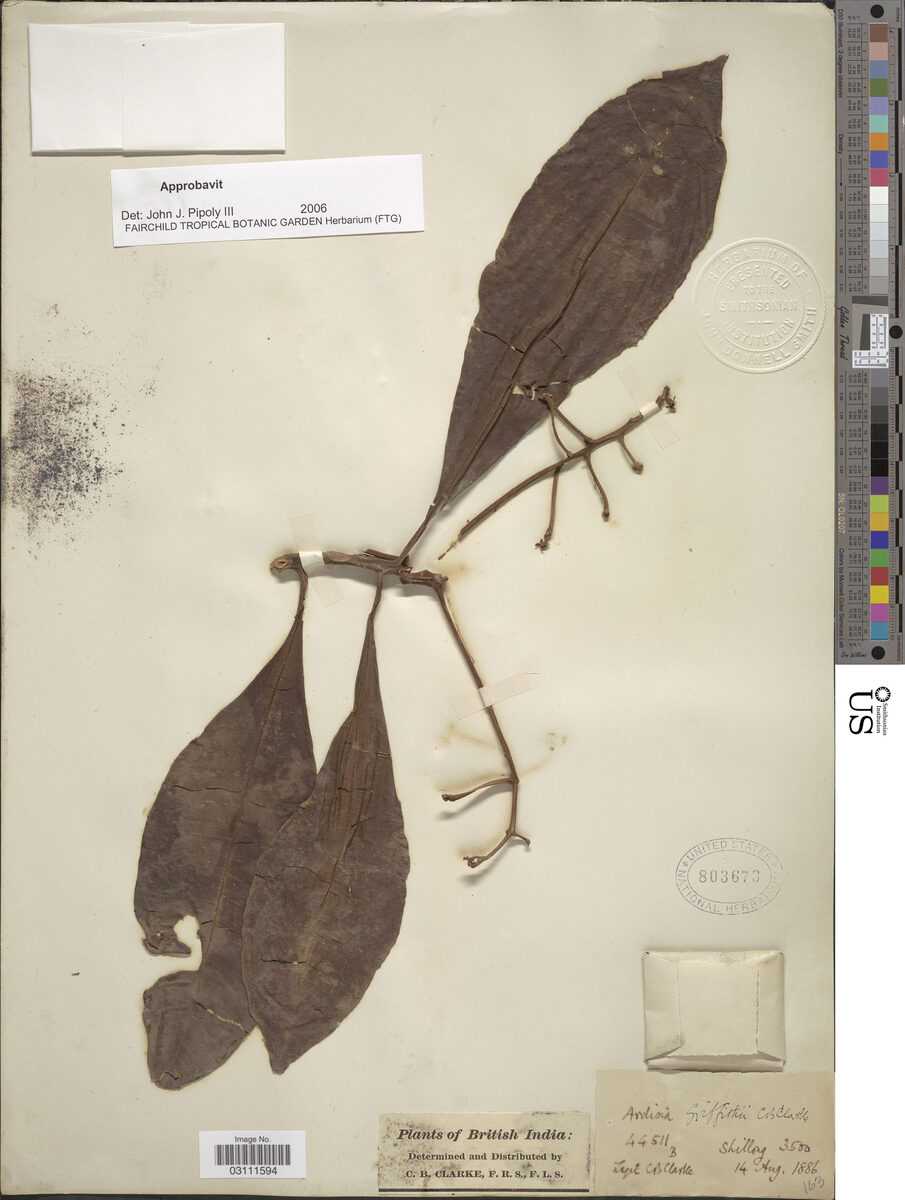
Ardisia elliptica
Thunb.
Sea-shore ardisia, Shoe-button ardisia
iNaturalist· cc0
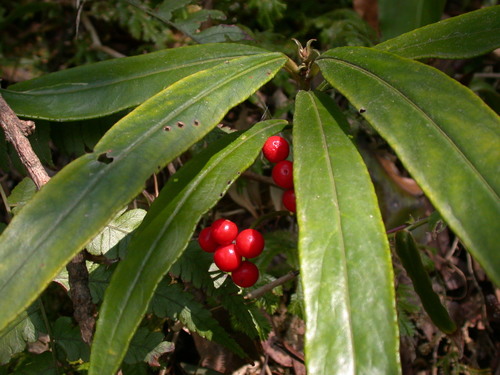
no rights reserved, uploaded by 葉子
iNaturalist· cc-by-nc
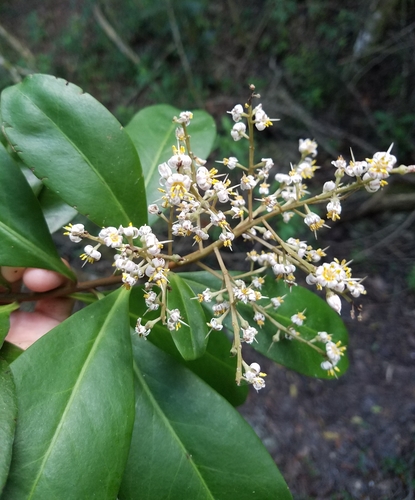
(c) gena of Jesus, some rights reserved (CC BY-NC), uploaded by gena of Jesus
iNaturalist· cc-by-sa
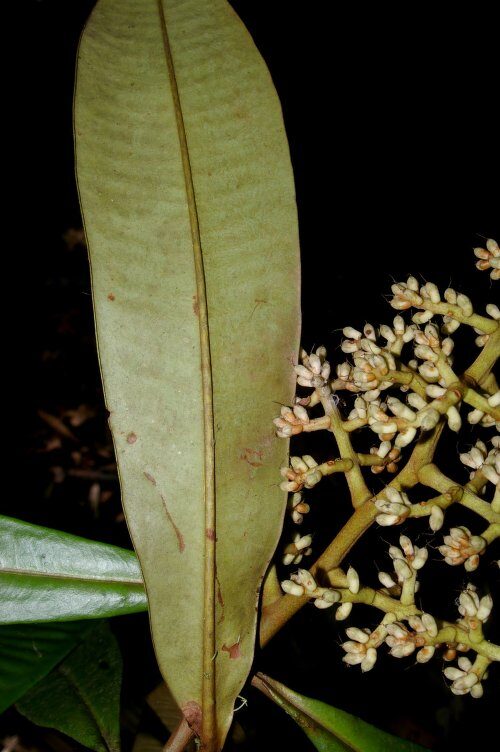
(c) Douglas Goldman, some rights reserved (CC BY-SA), uploaded by Douglas Goldman
Summary
Source: WikipediaArdisia elliptica is an evergreen tree, also known as the shoebutton ardisia, duck's eye and coralberry, native to the west coast of India, Sri Lanka, Indochina, Malaysia, Indonesia and New Guinea. It is a prolific reproducer which has made it a successful invasive species in other locations in the tropics where it has been introduced as a garden ornamental.
Description
A shrub. It grows 5 m tall. The leaves are alternate and leathery. They are narrowly oval. The flower groups are in the axils of leaves. The flowers are light pink. The fruit turn red as they ripen, then deep purple to black. The fruit are 8 mm across. The seeds are round and 5 mm across.
Edible Uses
Fruit - raw. A slightly sour taste with a hint of starch, but otherwise lacking flavour. The fruit is a drupe 6 - 11mm in diameter containing a single seed - it turns from red to a deep purple-black as it matures. The pulp from the fruits will stain fingers a deep purple. Young shoots - raw or cooked. The flowers and fruits are cooked as a flavouring.
Traditional Uses
The fruit are sweet and edible. The young shoots are eaten.
This uses section is brief — help expand it
Medicinal Uses
Antiplatelet and Antibacterial. In Malaysia, a decoction of leaves is said to assuage retrosternal pains, and a paste made from the leaves is used to treat herpes and measles. In Thai traditional medicine, the fruits are used to cure diarrhoea with fever. In Southeast Asia leaves are used to treat scabies, and fruit for intestinal worms.
Distribution
It is a tropical plant. It often grows on islands along the coast. A bush that grows in tidal swamps. It grows on the edges of mangroves. In XTBG Yunnan.
Where It Grows
Asia, Australia, China, Cook Islands, Guianas, Guyana, Haiti, India, Indochina, Indonesia, Japan, Laos, Malaysia, Maldives, North America, Papua New Guinea, PNG, Philippines, SE Asia, South America, Sri Lanka, Suriname, Taiwan, Thailand, Vietnam, West Indies,
Cultivation
Plants can be grown from seeds.
Propagation
Seed - around 99% of fresh seed is viable. Sown without any pretreatment in a commercial potting mix, 75% of the seed germinated within 42 - 81 days after sowing.
Other Uses
The wood can be used for fuel.
Notes
The leaves and fruit are used in medicine. Also put in the family Myrsinaceae.
Synonyms
Also Known As
Buah letus, Cham, Chempenai, Kashavaa, Kayu lampilan, Kayu lundu, keravaki, Lempeni kancing sepatu, Limjong, Mata pelanduk, Mempenai, Merjima, Pak cham, Penai, Pis-pis, Rempenai, Sarusup, Semporna, Serusop, Serusup, Surusup, Turang kasah, Tapiok Tursop laut
References (9)
- Ali, R. M., et al, (Eds.), 2010, ASEAN Herbal and Medicinal Plants. Forestry research Institute Malaysia. p 147
- Burkill, I.H., 1966, A Dictionary of the Economic Products of the Malay Peninsula. Ministry of Agriculture and Cooperatives, Kuala Lumpur, Malaysia. Vol 1 (A-H) p 219, 221 (As Ardisia littoralis)
- INFOODSUpdatedFGU-list.xls
- Kuo, W. H. J., (Ed.) Taiwan's Ethnobotanical Database (1900-2000), http://tk.agron.ntu.edu.tw/ethnobot/DB1.htm
- Martin, F.W. & Ruberte, R.M., 1979, Edible Leaves of the Tropics. Antillian College Press, Mayaguez, Puerto Rico. p 206 (As Ardisia littoralis)
Show all 9 references Hide references
- Slik, F., www.asianplant.net
- Sujanapal, P., & Sankaran, K. V., 2016, Common Plants of Maldives. FAO & Kerala FRI, p 40
- Sukarya, D. G., (Ed.) 2013, 3,500 Plant Species of the Botanic Gardens of Indonesia. LIPI p 581
- World Checklist of Useful Plant Species 2020. Royal Botanic Gardens, Kew