Ardisia crenata
Sims
Coral berry
iNaturalist· cc-by-sa
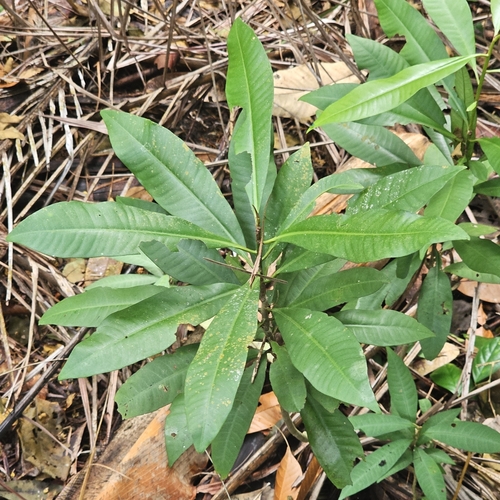
(c) Tatters ✾, some rights reserved (CC BY-SA)
iNaturalist· cc-by-sa
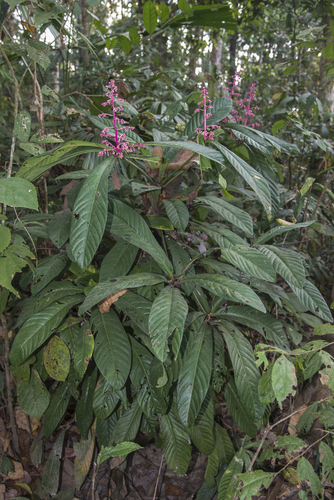
(c) Douglas Goldman, some rights reserved (CC BY-SA), uploaded by Douglas Goldman
iNaturalist· cc-by-nc
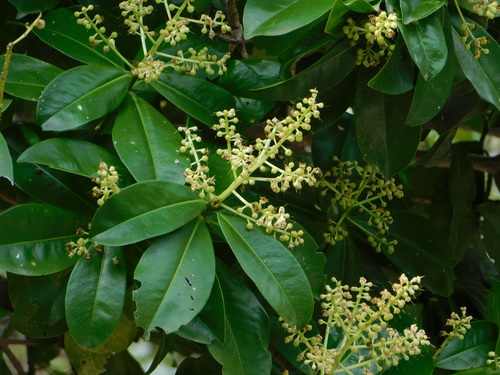
(c) Eric Vanbergen, some rights reserved (CC BY-NC), uploaded by Eric Vanbergen
Summary
Source: WikipediaArdisia crenata is a species of flowering plant in the primrose family, Primulaceae, that is native to East Asia. It is known by a variety of names such as Christmas berry, coral ardisia, coral bush, coralberry, coralberry tree, hen's-eyes, and spiceberry. A. crenata is a compact shrub that reaches 1 metre (3.3 ft), often with a single stem. Leaves are dark green, thick, glossy, and have tightly waved edges. The flowers are small, white or reddish, fragrant, and form clusters. The fruit is a glossy, bright red drupe. The seeds are able to germinate under a dense canopy and are dispersed by birds and humans. A. crenata was introduced to the United States in the early twentieth century as an ornamental species. It was observed to have escaped cultivation in 1982 and is now considered an invasive species. Preparations made from the root of Ardisia crenata are used as an ingredient in traditional Chinese medicine.
Description
An evergreen shrub. It grows 1 m high and spreads 1 m wide. The stems are erect and branching. The leaves are shiny green. They have wavy edges. The leaves are arranged in rings around the stem. The flowers are white or pink. They have a scent. The fruit are bright red berries.
Edible Uses
Fruit - raw. A sweet flavour. The fruit is a red, globose drupe 5 - 8mm in diameter. Leaves - used as a vegetable in salads.
Traditional Uses
The leaves and fruit are cooked as a vegetable.
This uses section is brief — help expand it
Medicinal Uses
Anodyne Depurative Febrifuge The root is anodyne, depurative, febrifuge. It is used to stimulate blood circulation.
Distribution
It is a tropical plant. It is best in a rich, moist well-drained soil. It needs a partly shaded position. It is damaged by frost and drought. In China it grows between 100-2,400 m above sea level. Tropical Fruit World. In Brisbane Botanical Gardens. In XTBG Yunnan.
Where It Grows
Asia, Australia, Cambodia, China, Hawaii, Himalayas, India, Indochina, Indonesia, Japan, Korea, Laos, Malaysia, North America, Northeastern India, Philippines, SE Asia, Taiwan, Thailand, Tibet, USA, Vietnam,
Cultivation
Prefers a well-drained humus rich soil in partial shade in a position sheltered from cold drying winds. We are not sure if this plant is hardy outdoors in Britain. One report says that it is hardy in zone 7 (tolerating temperatures down to between -10 and -15°c) but then goes on to suggest that it needs an essentially frost-free climate and is often grown as an indoor pot plant in Britain. This species is closely related to A. pseudocrispa, from which it differs in having crenate leaves with a distinct marginal vein. There has been some confusion between this species and A. crispa, the name Ardisia crispa was misapplied by de Candolle to Ardisia crenata.
Propagation
Seed - best harvested when it is ripe in the winter and sown immediately in a greenhouse. Sow stored seed as early in the year as possible. When large enough to handle, prick the seedlings out into individual pots and grow them on in a shady part of the greenhouse for at least their first winter. Plant out into their permanent positions in late spring or early summer, once the plants are 20cm or more tall. Cuttings of half-ripe wood in summer. Grow on in cool, shaded humid conditions until well rooted.
Other Uses
Landscape Uses: Container. Used as an ornamental plant in shady conditions. Special Uses
Notes
It is used in medicine. Also put in the family Myrsinaceae.
Synonyms
Also Known As
Comnguoi rang, Hen's eyes, Huomo, Jiangpu-jiangyapami, Kandetmean, Lempeni mata ayam, Lempeni natal, Mata itik, Trong-dua
References (12)
- Bircher, A. G. & Bircher, W. H., 2000, Encyclopedia of Fruit Trees and Edible Flowering Plants in Egypt and the Subtropics. AUC Press. p 39
- Bodkin, F., 1991, Encyclopedia Botanica. Cornstalk publishing, p 97
- Ghorbani, A., et al, 2012, A comparison of the wild food plant use knowledge of ethnic minorities in Naban River Watershed Nature Reserve, Yunnan, SW China. Journal of Ethnobiology and Ethnomedicine; 8:17
- Mohd, N. G. et al, 2014, A Preliminary Flora Survey in Gunung Kajang, Pulau Tioman, Pahang Darul Makmur, Malaysia. Malays. Appl. Biol. 43(2): 17-23
- Kermath, B. M., et al, 2014, Food Plants in the Americas: A survey of the domesticated, cultivated and wild plants used for Human food in North, Central and South America and the Caribbean. On line draft. p 84
Show all 12 references Hide references
- MARDI Malaysia
- Samy, J., Sugumaran, M., Lee, K. L. W., 2009, Herbs of Malaysia, Marshall Cavendish. p 51
- Singh, V. B., et al, (Ed.) Horticulture for Sustainable Income and Environmental Protection. Vol. 1 p 214
- Sukarya, D. G., (Ed.) 2013, 3,500 Plant Species of the Botanic Gardens of Indonesia. LIPI p 581
- Turreira Garcia, N., et al, 2017, Ethnobotanical knowledgeof the Kuy and Khmer people in Prey Lang, Cambodia. Cambodian Journal of Natural History 2017 (1): 76-101
- World Checklist of Useful Plant Species 2020. Royal Botanic Gardens, Kew
- Xu, You-Kai, et al, 2004, Wild Vegetable Resources and Market Survey in Xishuangbanna, Southwest China. Economic Botany. 58(4): 647-667.