Schleichera oleosa
(Lour.) Oken
Lac tree, Ceylon oak
iNaturalist· cc-by-nc
(c) Rujuta Vinod, some rights reserved (CC BY-NC), uploaded by Rujuta Vinod
iNaturalist· cc-by
(c) Siddarth Machado, some rights reserved (CC BY), uploaded by Siddarth Machado
iNaturalist· cc0
no rights reserved, uploaded by S.MORE
Summary
Source: WikipediaSchleichera oleosa is a deciduous tree growing to 30 m in height and 25 m in spread at a slow rate. Hardy to UK zone 10, it is not self-fertile. It grows in light sandy, medium loamy, and heavy clay soils, including very acidic soils, across mildly acidic to mildly alkaline pH ranges. It tolerates semi-shade to full sun and adapts to dry or moist soil.
Description
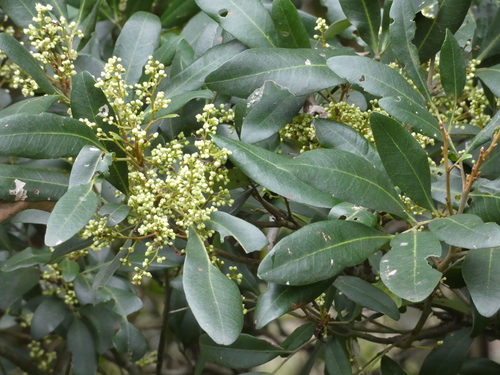
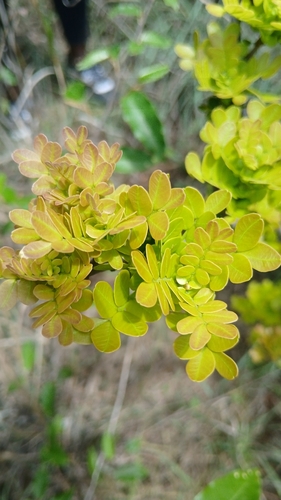
A tree 15-25 m tall. It keeps its leaves most of the year. The bark is grey and flaky. The bark is reddish brown inside. The leaves have stalks and are divided into leaflets along the stalk. The leaflets are in 2-4 pairs. They have short leaflets. They are 6-26 cm long by 3-9 cm wide. They are oblong. New leaves are reddish. The flowers have short stalks. They are yellowish. They occur in side stalks with equal stalk length flowers along it. These appear with new purple leaves. Flowers can be male or of both sexes. The fruit is oval and green when ripe. They are 2 cm long and 1.5 cm across. The fruit have blunt prickles. There are 1-2 oily seeds.
Edible Uses
Young leaves and shoots can be eaten raw, cooked in soups, or steamed and served with rice. Ripe fruit is eaten raw and has a pleasantly acid flavour; unripe fruits are pickled. The fruit is a broadly ovoid to subglobular berry measuring 15–25mm x 10–20mm. An oil extracted from the seed, known as macassar oil, is sometimes used for culinary purposes, but it contains cyanogenic compounds that may cause giddiness and must be removed before the oil is safe for human consumption. The plant is considered a staple oil crop.
Traditional Uses
The fruit arillus is used to make some dishes acid. Seed oil is used for cooking. It needs to be carefully refined. It is then edible. The ripe fruit are eaten raw. Young fruit are pickled. The seeds are eaten raw or cooked. The young leaves and shoots are eaten raw. They are also used in soups or steamed and served with rice or fish.
Medicinal Uses
Powdered seeds are applied to wounds and ulcers of cattle to remove maggots. The bark is astringent and used against leprotic ruptures, skin inflammations, and ulcers; an infusion of the bark is taken against malaria. The bark contains about 10% tannin and the analgesic compound lupeol. The antitumor agents betulin and betulic acid have also been isolated from it. In traditional medicine, seed oil is applied externally to treat itching, acne, and other skin afflictions. Massaging the oil into the scalp is said to promote regrowth of hair lost through baldness. The fruit pulp is astringent and appetite-inducing.
Distribution
A tropical plant. It suits moist tropical regions. It grows in wet dense forests. In Nepal it grows up to 300 m altitude. In India they occur all over the country in mixed deciduous forests. In Indonesia it grows up to 1,000 m above sea level.
Where It Grows
Afghanistan, Africa, Asia, Australia, Bangladesh, Cambodia, East Timor, Himalayas, India, Indochina, Indonesia, Laos, Malaysia, Myanmar, Nepal, Northeasten India, Pakistan, SE Asia, Sri Lanka, Thailand, Timor-Leste, Vietnam, West Africa, West Timor,
Cultivation
Plants are grown from seed. Seed should be sown fresh. Seedlings do not transplant well. They can also be grown using root suckers.
Propagation
Sow seed direct into thoroughly prepared soil.
Other Uses
Seed oil, known as kusum oil, is a key component of true Macassar oil used in hairdressing, and is also used for lighting, in the batik industry, and as a cooling bath oil in southern India. The kernel oil content ranges from 59–72%; the oil is yellowish-brown and semi-solid, composed of oleic acid (52%), arachidic acid (20%), stearic acid (10%), and gadoleic acid (9%). The bark contains about 10% tannin and yields a dye. The heartwood is reddish to pinkish-brown, clearly demarcated from the sapwood. The wood is very hard, heavy, and strong — durable in water according to some reports, though not according to others. It cracks easily during seasoning and is difficult to saw, but can be planed to a smooth surface that takes a high, lasting polish. It is excellent for pestles, cartwheels, axles, ploughs, tool handles, and rollers for sugar mills and oil presses, and is also used in house construction, shipbuilding, and musical instruments. The wood makes good firewood and excellent charcoal, with an energy value of about 20,800 kJ/kg.
Production
Plants grow slowly. In India fruit are available May to July. Fruit can be stored for 4-5 days.
Other Information
The fruit are often sold in markets. It is a cultivated food plant.
Notes
There is only one Schleichera species.
Synonyms
Also Known As
Ai-dak, Bak kawe, Baro, Baru, Botanga, Busi, Chendala, Gausam, Gyo, Jamoa, Jendala chakota, Joyna, Kaitxava, Karanchi, Khor, Kodalipulusa, Kohan, Kojub, Kok khosom, Kolama, Kon, Konji, Koon, Koosambi, Kosab, Kosam, Kosano, Koshimb, Kosum, Kosumb, Kosumba, Kula, Kusambi, Kusamo, Kussum, Kusum, Kusuma, Kusumb, Luk kawe, Maak kawe, Macassar oiltree, Madaka-pulusu, Mai-hkao, Mai-kyang, Mak ko som, Malay lactree, Mavita-vitiki, Peduman, Pong roa, Pongro, Pongror, Poovam, Poovanam, Poovathi, Posuku, Pulachi, Pulipoocha, Pulusura-marajati, Pumaratha, Pusku, Puvam, Puvathipuvam, Puvu, Raj-kusumo, Rusam, Sagade kendala, Sagade-pusuku, Sama, Swad, Swad kusum, Ta takror, Ta tok, Thakabti, Tomroos, Yun-ha
References (87)
- Acharya K. P. and Acharya, R., 2010, Eating from the Wild: Indigenous knowledge on wild edible plants in Parroha VDC of Rupandehi District, Central Nepal. International Journal of Social Forestry. 3(1):28-48
- Adema, Leenhouts, P. W., 1994, Sapindaceae, Flora Malesiana Ser 1 Vol 11 (3) p 728
- Ajesh, T. P., et al, 2012, Ethnobotanical Documentation of Wild Edible Fruits used by Muthuvan Tribes of Idukki, Kerala-India. International Journal of Pharma and Bio Sciences 3(3): 479-487
- Allg. Naturgesch. 3(2):1341. 1841
- Ambasta S.P. (Ed.), 2000, The Useful Plants of India. CSIR India. p 557
Show all 87 references Hide references
- Ashton, M. S., et al 1997, A Field Guide to the Common Trees and Shrubs of Sri Lanka. WHT Publications Ltd. pdf p 359
- Bahuguna, A. et al, 2010, Floristic Diversity and Indigenous uses of Forest Vegetation of Dabka Watershed in Indian Central Himalayas. Ethnobotanical Leaflets 14:491-510 (As Schleichera trijuga)
- BARC, 2016, State of Biodiversity for Food and Agriculture in Bangladesh. Bangladesh Agricultural Research Council.
- Behera K. K., et al, 2008, Wild Edible Plants of Mayurbhanj District, Orissa, India. J. Econ. Taxon. Bot. Vol. 32 (Suppl.) pp 305-314
- Bhogaonkar, P. Y. & Devarkar, V. D., 2018, Inventory for ethnovegetable knowledge of the tribals of Satpura hill area-Melghat, Dist. Amravati (India), Plantae Scientia, 2018; Vol. 01 Issue 01: 01-08
- Bole, P.V., & Yaghani, Y., 1985, Field Guide to the Common Trees of India. OUP p 75
- Burkill, H. M., 1985, The useful plants of west tropical Africa, Vol. 5. Kew.
- Burkill, I.H., 1966, A Dictionary of the Economic Products of the Malay Peninsula. Ministry of Agriculture and Cooperatives, Kuala Lumpur, Malaysia. Vol 2 (I-Z) p 2013
- Chandrakumar, P., et al, 2015, Ethnobotanical studies of wild edible plants of Gond, Halba and Kawar tribes of Salekasa Taluka, Gondia District, Maharashtra State, India. International Research Journal of Pharmacy 6(8)
- Chandrashekara, U. M., 2009, Tree species yielding edible fruit in the coffee-based homegardens of Kerala, India: their diversity, uses and management. Food Sec. 1:361-370
- Chauhan, S. H., et al, 2018, Consumption patterns of wild edibles by the Vasavas: a case study from Gujarat, India. Journal of Ethnobiology and Ethnomedicine (2018) 14:5
- Cowie, I, 2006, A Survey of Flora and vegetation of the proposed Jaco-Tutuala-Lore National Park. Timor-Lests (East Timor) www.territorystories.nt/gov.au p 52
- Cruz-Garcia, G. S., & Price, L. L., 2011, Ethnobotanical investigation of 'wild' food plants used by rice farmers in Kalasin, Northeast Thailand. Journal of Ethnobiology and Ethnomedicine 7:33
- Dangol, D. R., 2002, Economic uses of forest plant resources in western Chitwan, Nepal. Banko Janakari, 12(2): 56-64
- Dangol, D. R. et al, 2017, Wild Edible Plants in Nepal. Proceedings of 2nd National Workshop on CUAOGR, 2017.
- DARLINGTON & AMMAL,
- Davis, S.D., Heywood, V.H., & Hamilton, A.C. (eds), 1994, Centres of plant Diversity. WWF. Vol 1 or 2. p 125
- Dobriyal, M. J. R. & Dobriyal, R., 2014, Non Wood Forest Produce an Option for Ethnic Food and Nutritional Security in India. Int. J. of Usuf. Mngt. 15(1):17-37
- Eiadthong, W., et al, 2010, Management of the Emerald Triangle Protected Forests Complex. Botanical Consultant Technical Report. p 23
- Facciola, S., 1998, Cornucopia 2: a Source Book of Edible Plants. Kampong Publications, p 226
- Forest Inventory and Planning Institute, 1996, Vietnam Forest Trees. Agriculture Publishing House p 661 (As Schleichera trijuga Willd.)
- Friday, J. B., 2005, Forestry and Agroforestry Trees of East Timor. http://www.ctahr.hawaii.edu/forestry/data/Timor/Timor trees.html
- Gardner, S., et al, 2000, A Field Guide to Forest Trees of Northern Thailand, Kobfai Publishing Project. p 134
- Gautam, R. S., et al, 2020, Wild Edible Fruits of Nepal. Int. J. Appl. Sci. Biotechnol. Vol 8(3): 289-304
- GUPTA,
- Hardwick, G., 2001, Economically Useful Plants for Northern Australia: Master Species List. Crusader eBooks.
- Hearne, D.A., & Rance, S.J., 1975, Trees for Darwin and Northern Australia. AGPS, Canberra p Pl 33
- Hedrick, U.P., 1919, (Ed.), Sturtevant's edible plants of the world. p 597 (As Schleichera trijuga)
- Jadhav, R., et al, 2015, Forest Foods of Northern Western Ghats: Mode of Consumption, Nutrition and Availability. Asian Agri-History Vol. 19, No. 4: 293-317
- Jose, D. T. & Sasidharan, N., 2016, Checklist of wild edible plants of Aralam Wildlife sanctuary, Kerala, India. South Indian Journal Of Biological Sciences 2016; 2(1); 141‐144
- Kachenchart, B., et al, 2008, Phenology of Edible Plants at Sakaerat Forest. In Proceedings of the FORTROP II: Tropical Forestry Change in a Changing World. Bangkok, Thailand.
- Kahlon, L. K. & Singh, R., 2019, Traditional knowledge & Dynamics of edible plants of primitive tribal group ‘Paudi Bhuyan’ with changing demography migration patterns in Northern Odisha. Indian Journal of Traditional Knowledge Vol 18(1), pp 7-15
- Kiran, K. C., et al, 2019, Diversity and Seasonal Availability of Potential Wild Edible Plants from Vidarbha Region of Maharashtra State, India. Int.J.Curr.Microbiol.App.Sci (2019) 8(2): 1434-1446
- Krishen P., 2006, Trees of Delhi, A Field Guide. DK Books. p 224
- Kuvar, S. D. & Shinde, R. D., 2019, Wild Edible Plants used by Kokni Tribe of Nasik District, Maharashtra. Journal of Global Biosciences. Volume 8, Number 2, 2019, pp. 5936-5945
- Luczaj, L., et al, 2021, Wild food plants and fungi sold in the markets of Luang Prabang, Lao PDR. Journal of Ethnobiology and Ethnomedicine (2021) 17:6
- Manandhar, N.P., 2002, Plants and People of Nepal. Timber Press. Portland, Oregon. p 416
- Martin, F.W. & Ruberte, R.M., 1979, Edible Leaves of the Tropics. Antillian College Press, Mayaguez, Puerto Rico. p 218
- Martin, F.W. & Ruberte, R.M., 1979, Edible Leaves of the Tropics. Antillian College Press, Mayaguez, Puerto Rico. p 218 (As Schleichera trijuga Willd.)
- Martin, M.A., 1971, Introduction L'Ethnobotanique du Cambodge. Centre National de la Recherche Scientifique. Paris.
- Mehta, P. S. et al, 2010, Native plant genetic resources and traditional foods of Uttarakhand Himalaya for sustainable food security and livelihood. Indian Journal or Natural products and Resources. Vol 1(1), March 2010 pp 89-96
- Menninger, E.A., 1977, Edible Nuts of the World. Horticultural Books. Florida p 71 (As Schleichera trijuga Willd.)
- Mishra, S. & Chaudhury, S. S., 2012, Ethnobotanical flora used by four major tribes of Koraput, Odisha, India. Genetic Resources Crop Evolution 59:793-804
- Misra S. & Misra M., 2016, Ethnobotanical and Nutritional Evaluation of Some Edible Fruit Plants of Southern Odisha, India. International Journal of Advances in Agricultural Science and Technology, Vol.3 Issue.1, March- 2016, pg. 1-30
- Narayanan, M. K., R., et al, 2011, Ethnobotanically important trees and their uses by Kattunaikka tribe in Wayanad Wildlife Sanctuary, Kerala, India. Journal of Medicinal Plants research. 5(4): 704-612
- Natuhara, Y., et al, 2011, Uses of trees in paddy fields in Champasak Province, Southern Lao PDR. Landscape and Ecological Engineering. p 8
- Karki, S., et al, 2017, Minor Fruits in Nepal: Utilization and Conservation Efforts. Proceedings of 2nd National Workshop on CUAPGR, 2017.
- Ochse, J. J. et al, 1931, Vegetables of the Dutch East Indies. Asher reprint. p 652
- Pandy, R. K. & Saini, S. K., 2007, Edible plants of tropical forests among tribal communities of Madhya Pradesh. Indian Journal of Traditional Knowledge. 6(1), pp 185-190
- Pasha, M. K. & Uddin, S. B., 2019, Minor Edible Fruits of Bangladesh. Bangladesh J. Plant Taxon. 26(2): 299–313
- Phon, P., 2000, Plants used in Cambodia. © Pauline Dy Phon, Phnom Penh, Cambodia. p 550
- Prabha, Y. P., et al, 2010, Documentation of Wild Edible Plants of Melghat Forest, Dist. Amravati, Maharashtra State, India. Ethnobotanical Leaflets 14: 751-58, 2010.
- Prachi, K., et al, 2012, Underutilized wild fruits of North Maharashtra. Journal of Research in Plant Sciences. (2012) 1:071-076
- Pradhan, R., et al, 2020, Potential Wild Edible Plants and its Significance in Livelihood of Indigenous People of Male Mahadeshwara Hills, Karnataka. Economic Affairs Vol. 64, No. 4 pp. 01-14
- Purseglove, J.W., 1968, Tropical Crops Dicotyledons, Longmans. p 644
- Rajapaksha, U., 1998, Traditional Food Plants in Sri Lanka. HARTI, Sri Lanka. p 452
- Ramachandran, V.S. and Nair, V.J., 1981, Ethnobotanical studies in Cannanore District, Kerala State (India). J Econ. Tax. Bot. Vol 2 pp 65-72
- Ramakrishna, N. & Singh, DSR, R., 2020, Ethno-Botanical Studies of Edible Plants Used by Tribal Women in Nirmal District. IJSRSET p 310
- Rasingam, L., 2012, Ethnobotanical studies on the wild edible plants of Irula tribes of Pillur Valley, Coimbatore district, Tamil Nadu, India. Asian Pacific Journal of Tropical Biomedicine. (2012) S1493-S1497
- Ramachandran, V. S., 2007, Wild edible plants of the Anamalais, Coimbatore district, western Ghats, Tamil Nadu. Indian Journal or Traditional Knowledge. 6(1) pp 173-176
- Rao, M. L. S., et al, 2014, Indigenous Plant Foods which are commonly consumed by the tribal communities in Dumbriguda Area of Visakhapatnam District, Andhra Pradesh, India. Biolife. Vol 2, Issue 3
- Reddy, K. N. et al, 2007, Traditional knowledge on wild food plants in Andhra Pradesh. Indian Journal of Traditional Knowledge. Vol. 6(1): 223-229
- Rijal, A., 2011, Surviving on Knowledge: Ethnobotany of Chepang community from mid-hills of Nepal. Ethnobotany Research & Applications 9:181-215
- Sahni, K.C., 2000, The Book of Indian Trees. Bombay Natural History Society. Oxford. p 63
- Setiya, A. V., et al, 2016, Exploration and documentation of some wild edible plants used by the aboriginals from Gadchiroli District (M.S.) India. International Advanced Research Journal in Science, Engineering and Technology. 3(7)
- Singh, H.B., Arora R.K.,1978, Wild edible Plants of India. Indian Council of Agricultural Research, New Delhi. p 79
- Singh, V. and Singh, P., 1981, Edible Wild Plants of Eastern Rajasthan. J. Econ. Tax. Bot. Vol 2 pp 197-207
- Sukarya, D. G., (Ed.) 2013, 3,500 Plant Species of the Botanic Gardens of Indonesia. LIPI p 501
- Swaminathan, M.S., and Kochnar, S.L., 2007, An Atlas of Major Flowering Trees in India. Macmillan. p 92
- Tanaka,
- Thitiprasert, W., et al, 2007, Country report on the State of Plant Genetic Resources for Food and Agriculture in Thailand (1997-2004). FAO p 95
- Tomar, A., Kumar, A., & Dubey, K., 2002, Underutilized Wild Edible fruits of Nutritional and Medicinal Value. J. Res. Educ. Indian Med., Vol XX1
- Turreira Garcia, N., et al, 2017, Ethnobotanical knowledgeof the Kuy and Khmer people in Prey Lang, Cambodia. Cambodian Journal of Natural History 2017 (1): 76-101
- Upreti, K., et al, 2010, Diversity and Distribution of Wild Edible Fruit Plants of Uttarakhand. Bioversity Potentials of the Himalaya. p 185
- Uprety, Y., et al, 2010, Non-timber Forest Products in Bardiya District of Nepal: Indigenous Use, Trade and Conservation. J Hum Ecol, 30(3): 143-158
- Uprety, Y., et al, 2012, Diversity of use and local knowledge of wild edible plant resources in Nepal. Journal of Ethnobotany and Ethnomedicine 8:16
- Uphof,
- USDA, ARS, National Genetic Resources Program. Germplasm Resources Information Network - (GRIN). [Online Database] National Germplasm Resources Laboratory, Beltsville, Maryland. Available: www.ars-grin.gov/cgi-bin/npgs/html/econ.pl (10 April 2000)
- Wickens, G.E., 1995, Edible Nuts. FAO Non-wood forest products. FAO, Rome. p151
- Wiersema, J. H. & Leon, B., 2013, World Economic Plants. A Standard Reference CRC Press. 2nd Ed. p 619
- World Checklist of Useful Plant Species 2020. Royal Botanic Gardens, Kew
- Yadav, D. K., 2011, Study on Biodiversity and Edible Bioresources of Betla National Park, Palamu, Jharkhand (India). The 2011 Las Vegas International Academic Conference.