Schinziophyton rautanenii
(Schinz) Radcl.-Sm
Mongongo nut, Manketti tree
iNaturalist· pd
NoodleToo, no known copyright restrictions (public domain)
iNaturalist· cc-by
(c) Murphy Tladi, some rights reserved (CC BY)
iNaturalist· cc-by
(c) Murphy Tladi, some rights reserved (CC BY)
Summary
Source: WikipediaA deciduous tree growing to 12m, reaching medium growth rate. Hardy to UK zone 10. Non-self-fertile and wind-intolerant. Tolerates light sandy to medium loamy soils with mildly acid to very alkaline pH. Requires full sun and handles drought well despite preferring well-drained soil. Grows in nutritionally poor soil.
Description
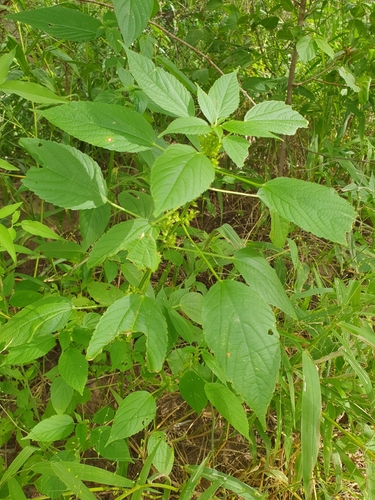
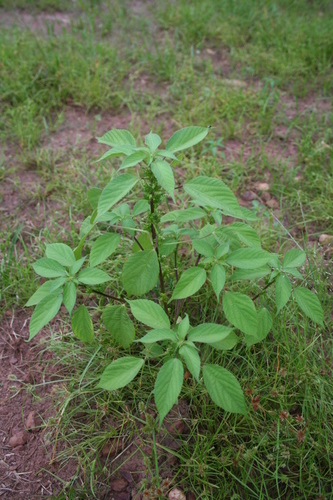
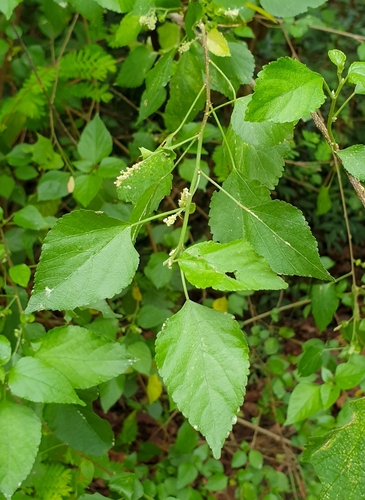
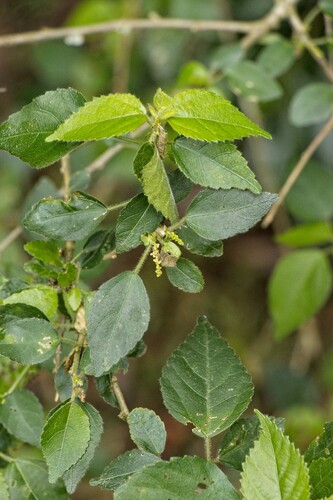
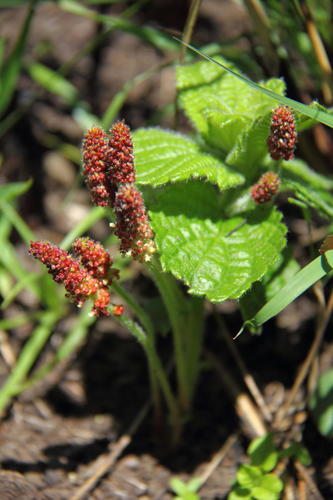
A large spreading tree. It has a sturdy trunk up to 1 m across. It usually grows 7-9 m tall but can be 24 m tall. The crown is rounded. It has smooth green or golden bark. It has stubby branches. There are reddish-brown furry hairs on the young branches and stalks. These disappear with age. The plant has a cloudy latex. The leaves are produced one after another along the stalk. The leaves are compound and leaflets arranged like fingers on a hand. The leaves have 3-7 leaflets and these are 5-13 cm long and 2.5-9 cm wide. They are velvety grey underneath. The leaf stalks are 15 cm long. The base of the leaflets is unequal. They are dark green on top and paler underneath. The leaves have star shaped hairs in both sides. There are 1-3 flat dark glands where the leaf joins the stalk. It loses its leaves during summer. The male and female flowers on on different plants. The buds are rusty red and velvety and on long furry stalks. The flowers are small and white or yellow. The female flowers are more tightly grouped together than the male flowers. The fruit is egg shaped and 35 mm long by 25 mm wide. They are velvety. When young they are hairy and when mature have a tough brown shell. There is a thick layer of pulp around a very hard and finely pitted stone. Inside this are 2 light coloured kernels. The fruit are edible. The kernel is edible.
Edible Uses
The fruit can be eaten raw or cooked. When fresh, it has a flowery pulp resembling a date, though it is less sweet; after boiling it turns maroon and tastes like apple sauce. It can also be dried and ground into a powder for use in porridge. The fruit is a good source of carbohydrates, potassium and thiamine. It is an egg-shaped drupe measuring 35 x 20–35mm when dry and up to 70 x 50mm when fresh, weighing 8–10g. The seeds are also eaten raw or roasted — when roasted they taste similar to cashews or Brazil nuts, and after prolonged roasting they develop the flavour of fine old cheese. Seeds are up to 25mm long and 20mm wide, enclosed in a hard shell, and contain around 60% oil. An edible drying oil extracted from the seed is used locally for cooking, though it deteriorates rapidly once removed from the seed. Traditionally, the oil is extracted by boiling shelled and crushed seeds in water and skimming the oil from the surface.
Traditional Uses
The fresh and dried fruits are eaten. The fruit flesh and the seeds are eaten raw or cooked. The nuts are also eaten. They are eaten raw, dried, cooked, whole or pounded and mixed with other ingredients to make a variety of dishes. The fruit is eaten raw or cooked. It is also used to make soup and beer. The nuts also produce an oil used for cooking.
Medicinal Uses
The roots have been used to treat stomach aches.
Distribution
A tropical plant. It grows on Kalahari sand. It needs a hot subtropical climate. It grows in deep, well-drained, dry sandy soils. It is often over limestone material. It does well with average temperatures above 20°C and often above 30°C. It will grow with rainfall between 200-1,000 mm per year. It grows at altitudes between 200-1,000 m. It can tolerate frost. It can grow in arid places.
Where It Grows
Africa, Angola, Botswana, Central Africa, Congo, Congo DR, East Africa, Malawi, Mozambique, Namibia, South Africa, Southern Africa, Tanzania, Zambia, Zimbabwe,
Cultivation
Cultivation has proven difficult. Seed grow more easily if they have passed through an elephant!
Propagation
The woody endocarp makes germination difficult and should be removed or have one end cut off to expose the kernel before sowing. After shelling, seeds can be soaked in water for a week, then stored under high temperature and humidity for two days to improve germination. Without pre-treatment a germination rate of around 26% has been recorded; removing the shell and treating the kernel with ethylene can raise this to 80% or more within 6 days. Germination is erratic and occurs over an extended period, and seedling mortality is high, though established plants need little further attention. Sow in sandy soil in partial shade, keeping temperature above 7°C. Seedlings develop deep roots quickly — the radicle grows slowly at first, and when it reaches 5–10cm, 5–12 secondary roots emerge in a ring just above the root tip, resembling a Medusa's head; the plumule begins to emerge once these secondary roots are 20–50mm long. Seed remains viable for 2 years when stored at 10°C. Truncheons root readily and are also used for propagation.
Other Uses
Cuttings have been used in Angola to establish live fences, and the tree shows potential for preventing desert encroachment — there are recorded cases of fence posts made from freshly cut wood growing into large trees. The seeds contain 50–60% of a drying oil used commercially in soaps, cosmetics, paints and varnishes. In cosmetic applications the oil is valued for its hydrating, regenerating and restructuring properties, as well as UV protection for hair and skin, though it deteriorates rapidly once extracted. The fibrous inner bark is used to make string for nets and similar purposes. The seeds are also used as playing pieces in board games. The heartwood is pale yellow to straw-coloured, not clearly distinct from the sapwood; grain is straight or wavy and the texture coarse. The wood is very soft and light yet comparatively strong for its weight, though it is not durable and is susceptible to termite and Lyctus attack. It air-dries rapidly with little distortion but tends to become woolly when sawn, requiring sharp tools for a clean finish; nailing properties are good. It can serve as a substitute for balsa wood and is used for floats, canoes, notice boards, boxes, tools, musical instruments and carvings.
Production
Trees take 25 years until fruiting. Fruit are harvested off the ground.
Other Information
It is an important staple in some parts of Southern Africa. The fruit and kernels are popular. They are a staple of the Bushmen. (They form 50% of the vegetable diet of some Bushmen. 100-300 nuts per day are eaten.) It is important in Mozambique.
Nutrition
| Part | Moisture | kJ | kcal | Protein | Vit A | Vit C | Iron | Zinc |
|---|---|---|---|---|---|---|---|---|
| Nuts | 4.2 | 2717 | 650 | 26.3 | — | — | 3.4 | 3.5 |
| Fruit | 8.6 | 1409 | 337 | 7.8 | — | 27 | 2.5 | 1.7 |
| Press cake | 12 | 1338 | 320 | 56.5 | — | — | — | — |
Synonyms
Also Known As
Dikelekese, Mangetti, Mogongo, M'paca, M'panga, Mankettibaum, Mankettiboom, Mgomwa, Mkanganaugu, Mokongwa, Mongongo, Mugongo, Mukusu, Mungongo, Mungongoma, Muoma, Nalungue, Omunkete, Ugongo, Umganuompobola, Umgoma, Ungoma
References (43)
- Baidu-Forson, J.J., et al ,2014,. Assessment of agrobiodiversity resources in the Borotse flood plain, Zambia. CGIAR Research Program on Aquatic Agricultural Systems. Penang, Malaysia. Working Paper: AAS-2014-12.
- Cheikhyoussef, A & Embashu, W., 2013, Ethnobotanical knowledge on Indigenous fruits in Ohangwena and Oshito regions in Northern Namibia. Journal of Ethnobiology and Ethnomedicine 9:34
- Facciola, S., 1998, Cornucopia 2: a Source Book of Edible Plants. Kampong Publications, p 101 (As Ricinodendron rautanenii)
- Fowler, D. G., 2007, Zambian Plants: Their Vernacular Names and Uses. Kew. p 27
- Fox, F. W. & Young, M. E. N., 1982, Food from the Veld. Delta Books. p 193 (As Ricinodendron rautanenii)
Show all 43 references Hide references
- Graz, F.P., 2007. Schinziophyton rautanenii (Schinz) Radcl.-Sm. [Internet] Record from Protabase. van der Vossen, H.A.M. & Mkamilo, G.S. (Editors). PROTA (Plant Resources of Tropical Africa), Wageningen, Netherlands. < http://database.prota.org/search.htm>. Accessed 22 October 2009
- http://www.fao.org/forestry/25323-096344a3de335832e8f363c3ac5184a66.pdf (As Ricinodendron rautanenii)
- INFOODSUpdatedFGU-list.xls (As Ricinodedron rautanenii)
- INFOODS:FAO/INFOODS Databases (As Ricinodendron rautanenii)
- Jardin, C., 1970, List of Foods Used In Africa, FAO Nutrition Information Document Series No 2.p 47, 158 (As Ricinodendron rautanenii)
- Kew Bull. 45:157. 1990
- Kiple, K.F. & Ornelas, K.C., (eds), 2000, The Cambridge World History of Food. CUP p 1815 (As Ricinodendron rautanenii)
- Larson, T. J., 1970, Hambukushu Ethno-botany. Botswana Notes and Records. Vol 13. (As Ricinodendron rautanenii)
- Lautenschläger, T., et al, 2018, First large-scale ethnobotanical survey in the province of Uíge, northern Angola. Journal of Ethnobiology and Ethnomedicine (2018) 14:51
- Lee, 1979,
- Leger, S., 1997, A Description of Today's Use of Plants in West Bushmanland (Namibia). German Development Service. PO Box 220035, 14061 Berlin, Germany. http://www.sigridleger.de/book/
- Lyle, S., 2006, Discovering fruit and nuts. Land Links. p 387
- Maguire, 1978,
- Malaisse, F., 1997, Se nourrir en floret claire africaine. Approche ecologique et nutritionnelle. CTA., p 67
- Mannheimer, C. A. & Curtis. B.A. (eds), 2009, Le Roux and Muller's Field Guide to the Trees and Shrubs of Namibia. Windhoek: Macmillan Education Namibia. p 260
- Maroyi, A. & Cheikhyoussef, A., 2017, Traditional knowledge of wild edible fruit in southern Africa: A comparative use patterns in Namibia and Zimbabwe. Indian Journal of Traditional Knowledge. 16(3): 385-392
- Marshall, 1976,
- Menninger, E.A., 1977, Edible Nuts of the World. Horticultural Books. Florida p 54 (As Ricinodendron rautanenii)
- Palgrave, K.C., 1996, Trees of Southern Africa. Struik Publishers. p 432 (As Ricinodendron rautanenii)
- Palmer, E and Pitman, N., 1972, Trees of Southern Africa. Vol. 2. A.A. Balkema, Cape Town p 1151 (As Ricinodendron rautanenii)
- Peters, C. R., 1987, Ricinodendron rautanenii (Euphorbiaceae): Zambezian Wild Food Plant for All Seasons. Economic Botany 41(4): 494-502
- Peters, C. R., O'Brien, E. M., and Drummond, R.B., 1992, Edible Wild plants of Sub-saharan Africa. Kew. p 112
- Rodin, 1985,
- Royal Botanic Gardens, Kew (1999). Survey of Economic Plants for Arid and Semi-Arid Lands (SEPASAL) database. Published on the Internet; http://www.rbgkew.org.uk/ceb/sepasal/internet [Accessed 16th April 2011] (As Ricinodendron raitanenii)
- Ruffo, C. K., Birnie, A. & Tengnas, B., 2002, Edible Wild Plants of Tanzania. RELMA p 566 (As Ricinodendron rautanenii)
- Ruiters-Welcome, A. K., 2019, Food plants of southern Africa. Ph.D. thesis. Univ. of Johannesburg p 55
- Tredgold, M.H., 1986, Food Plants of Zimbabwe. Mambo Press. p 118 (As Ricinodendron rautanenii)
- USDA, ARS, National Genetic Resources Program. Germplasm Resources Information Network - (GRIN). [Online Database] National Germplasm Resources Laboratory, Beltsville, Maryland. Available: www.ars-grin.gov/cgi-bin/npgs/html/econ.pl (10 April 2000)
- van Wyk, Be., & Gericke, N., 2007, People's plants. A Guide to Useful Plants of Southern Africa. Briza. p 56
- van Wyk, B, van Wyk, P, and van Wyk B., 2000, Photographic guide to Trees of Southern Africa. Briza. p 10, 279
- van Wyk, B., 2005, Food Plants of the World. An illustrated guide. Timber press. p 339
- Van Wyk, Br. and van Wyk P., 2009, Field Guide to Trees of Southern Africa. Struik Nature. p 474
- Wehmeyer, A. S, 1986, Edible Wild Plants of Southern Africa. Data on the Nutrient Contents of over 300 species (As Ricinodendron rautanenii)
- Welcome, A. K. & Van Wyk, B.-E., 2019, An inventory and analysis of the food plants of southern Africa. South African Journal of Botany 122 (2019) 136–179
- Wickens, G.E., 1995, Edible Nuts. FAO Non-wood forest products. FAO, Rome. p 122
- Wiersema, J. H. & Leon, B., 2013, World Economic Plants. A Standard Reference CRC Press. 2nd Ed. p 618
- World Checklist of Useful Plant Species 2020. Royal Botanic Gardens, Kew
- www.worldagroforestrycentre.org/treedb/