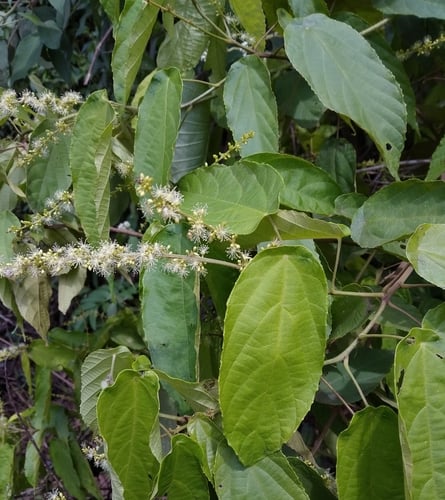
Aleurites moluccanus
(L.) Willd.
Candle nut, Country walnut
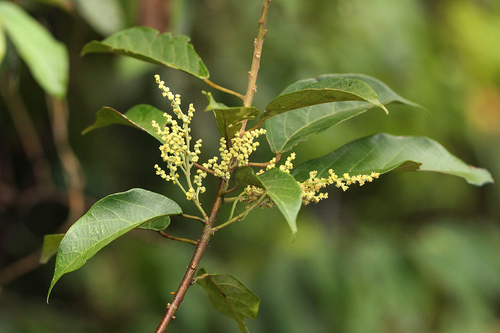
iNaturalist· cc0
no rights reserved, uploaded by 葉子
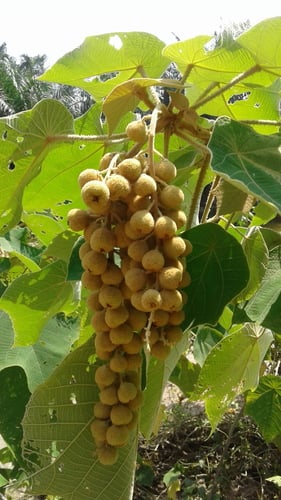
iNaturalist· cc0
no rights reserved, uploaded by 葉子
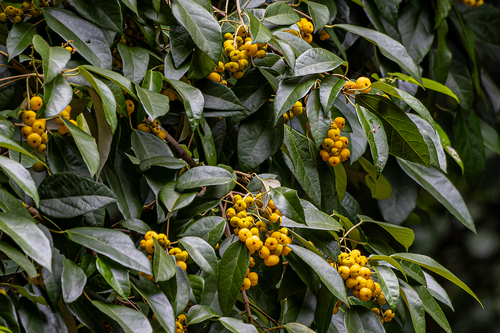
iNaturalist· cc-by
(c) Ron Burkert, some rights reserved (CC BY), uploaded by Ron Burkert
Summary
Source: WikipediaAleurites moluccanus, commonly known as candlenut, Indian walnut or, in Hawaii, kukui, is a tree in the spurge family Euphorbiaceae. It grows to about 30 m (98 ft) tall and produces drupe fruit. First described by Carl Linnaeus in 1753, the species' origin is unclear due to its spread by humans, but it can be found in many tropical rainforests and gallery forests. Various parts of the plant have regional or cultural uses.
Description
A large tree up to 40 m tall and 1 m through at the base. The bark is rough. The leaves are large and can be round, triangular or have several lobes. The leaves have a pale colour. The leaves are alternate, silvery green and crowded near the tips. Young leaves are hairy and sometimes lobed. The leaves, leaf stalks and flowers are all covered with short soft hairs. There are 2 distinct brown glands where the leaf blade and stalk join. The flowers are small and white and in large groups on the ends of branches. Male and female flowers are separate but on the same tree. The female flowers are on the end surrounded by small male flowers. The fruit is a large (4 to 5 cm across) green 2 lobed berry with 1 or 2 large (2.5 cm across) seeds with a hard corrugated shell. They do not open naturally to release the seeds.
Edible Uses
The kernel is the primary edible portion, eaten cooked and roasted, though only in small quantities as larger amounts have a laxative effect. A variety grown in Vanuatu can be consumed in greater quantities without apparent toxic effect. Once the hard outer coat is removed, the seed can be pounded into a meal and used as a sauce, or added to curries. In Indonesian cuisine, where it is known as 'kemiri,' the seed is an indispensable spice — it has little flavour of its own but acts as a flavour enhancer, added raw or briefly roasted, pounded and mixed with other ingredients. In Hawaii, a spice called 'inamona' is made from the seeds mixed with seaweed and salt. Seeds should be stored and thoroughly dried before eating. The residual oil cake is sometimes processed into an Indonesian snack food called 'dage kemiri': the cake is pounded, soaked for 48 hours in running water, steamed, then pressed under a weighted banana leaf to expel remaining liquid, and finally fermented for 48 hours in a dark place. The fruit has a thick rind enclosing two large seeds surrounded by a thin layer of pulp. The oil extracted from the seed is inedible. The seed is a reasonably important nut in several areas of Papua New Guinea and is a cultivated food plant.
Traditional Uses
The nuts are normally roasted. The hard, oily nut is used for thickening in Asian dishes. They are used in a sauce for the greens eaten with rice. CAUTION The nuts contain a moderately poisonous substance so should be cooked before eating. The raw kernels of candle nut are poisonous. They are a strong purgative. Before eating they must be well cooked. Mostly the nuts are roasted in the fire until the shell is blackened and half burnt, then the kernels are taken out by cracking the shells. The nuts should probably only be eaten in moderate amounts. Because the kernels are high in oil, they can be burnt as candles. An edible oil can be extracted from the nuts.
Medicinal Uses
Candlenut is widely used in traditional medicine across the Pacific Islands, though some caution is warranted given reports of toxicity. The bark is used to treat wounds, tumours, bloody diarrhoea, and dysentery, and bark juice combined with coconut milk treats sprue. In Tonga, a decoction of the bark is drunk daily to treat infertility in women, and secondary amenorrhoea is treated the same way. In Polynesia, gargling with a bark infusion treats thrush, sore throat, tonsillitis, and mouth sores. The oil is purgative and used similarly to castor oil; rubbed on the scalp, the irritant oil acts as a hair stimulant. In the Cook Islands and Tahiti, candlenut oil is used as a massage oil for a certain kind of headache, possibly caused by meningitis. The kernels are laxative, stimulant, and sudorific; pulped kernels are applied in poultices for headache, fevers, ulcers, and swollen joints. In Papua New Guinea, the seeds are applied externally to the male genitals as a contraceptive. The leaves treat constipation and food poisoning; a leaf decoction addresses coughs, diarrhoea, chest pains, and hernia; a leaf infusion is used as a lotion or ingested for mouth infections in infants; and boiled leaves are applied as a poultice for headaches and gonorrhoea.
Known Hazards
The roasted seed should only be eaten in small quantities, as larger amounts are laxative. Larger quantities can apparently be eaten without toxic effect from a type grown in Vanuatu. There are reports of toxicity associated with this plant, so some caution is advised when using it medicinally.
Distribution
It is a tropical tree. It mostly grows in the lowland rainforest but can be at up to 2000 m altitude. It suits drier climates but can grow in humid conditions. It does well on well drained sandy soil. It must have a temperature above 8°C. In the Pacific it usually grows between 0-700 m altitude in areas with a rainfall of 600-4,300 mm per year. It can grow in arid places. It suits hardiness zones 10-12.
Where It Grows
Africa, American Samoa, Asia, Australia, Bangladesh, Brunei, Cambodia, Central Africa, China, Congo DR, Cook Islands, Cuba, Dominican Republic, East Africa, East Timor, Eswatini, Fiji, French Polynesia, FSM, Georgia, Grenada, Guam, Haiti, Hawaii, India, Indochina, Indonesia, Kosrae, Laos, Malawi, Malaysia, Marquesas, Mexico, Micronesia, Mozambique, Myanmar, New Caledonia, New Zealand, Niue, Pacific, Pakistan, Palau, Papua New Guinea, PNG, Philippines, Pohnpei, Polynesia, Rotuma, Samoa, SE Asia, Slovenia, Solomon Islands, South Africa, Southern Africa, Sri Lanka, Swaziland, Tahiti, Taiwan, Thailand, Timor-Leste, Tonga, Uganda, USA, Vanuatu, Vietnam, Wallis & Futuna, West Africa, West Africa, West Indies, West Timor, Zambia, Zimbabwe,
Cultivation
The trees grow wild but are transplanted. Often candle nut trees are just self sown, growing in the bush where the seeds fell. These small trees can be transplanted to a more suitable place if needed. Seeds are very hard shelled. To get seeds to start growing more quickly, the seed coat needs to be cracked. To do this a single layer of seeds are put on the ground covered with dry grass then burnt. Immediately after burning while the seeds are still hot they are thrown into cold water, and then planted. This cracks the shells allowing more rapid germination. Without this it may take many months for this hard shell to break down and germination to commence. Trees can also be grown from cuttings.
Propagation
Seeds are very hard-shelled; untreated seeds can remain in a seedbed for 38–150 days before germinating. The most effective treatment is to lay seeds in a single layer on the ground, cover with dried grass or leaves, and burn the material. While the seeds are still hot from the fire, immediately plunge them into cold water, which cracks the hard shells. This method produces an average germination rate of over 30%. For faster germination, seeds can be cracked manually, though the kernels adhere to the shell walls and are difficult to separate. Cuttings can also be used.
Other Uses
The tree is used in reforestation projects. Moderately fast growing, tolerant of strong winds and full sun, it is a good pioneer species for restoring native woodland and establishing woodland gardens, though its ability to naturalise means it should only be used where already established. It is commonly planted as a living fence or boundary marker. The seed yields 57–80% of an inedible semi-drying oil that is liquid at ordinary temperatures and solidifies at -15°C, containing oleostearic acid. It dries faster than linseed oil and is used as a wood preservative, in varnishes and paint oils, as an illuminant, for soap making, cosmetics, linoleum manufacture, waterproofing paper, rubber substitutes, and insulating material. It can be painted on the bottoms of small craft to protect against marine borers and also prevents feeding by striped cucumber beetle. Oil yields as high as 300 kg/ha have been reported. The seeds are so rich in oil that they have been strung together and burned as candles. The oil is also suitable, with modification, as a substitute for diesel fuel, with residues convertible to alcohol or burnt directly as fuel. A copper-red dye obtained from the plant is used for decorating cloth. Powdered seed is used as an adjuvant in palm sugar manufacture. The seed press cake makes a suitable fertiliser. The bark contains approximately 4–6% tannin. The hardness of the seed case is exploited in a gambling game where players attempt to crack each other's nut, and a special cultivar is grown for this purpose in Indonesia. Seed shells are used in traditional garlands. The whitish wood is fine-grained, light, soft, not durable, and susceptible to termite attack; it is used for furniture, plywood, carving, small utensils, and matches, and is suitable for paper pulp. The tree is sometimes planted as a firewood source.
Production
The tree grows quickly. They can grow 0.5-1.5 m in a year. Yields of 30-45 kg of nuts can be produced on a tree in one year. Yields of 80 kg per tree are possible under good cultivation. Trees can start producing after one year.
Other Information
A reasonably important nut in several areas of Papua New Guinea. It is a cultivated food plant.
Notes
The black soot from the burnt seeds is used as a black paint for faces. There are 2-5 Aleurites species.
Nutrition
| Part | Moisture | kJ | kcal | Protein | Vit A | Vit C | Iron | Zinc |
|---|---|---|---|---|---|---|---|---|
| Kernel cooked | 1.4 | 2836 | 678 | 20.6 | — | — | 22.6 | 3.2 |
| Kernel | 24.4 | 2426 | 580 | 7.8 | — | — | 2.7 | 2.7 |
| Kernel treated | 12.8 | 1400 | 335 | 0.5 | — | — | — | — |
Synonyms
Also Known As
Ai-kami, Akhrot, 'Ama, Bancoulier, Belgaum walnut, Buah kareh, Buah keras, Calunban, Candleberry, Hai, Kabakanjagala, Kanyin-ni, Kekuna, Kemiri, Kuikui, Kukui, Kyainthee, Lama, Lauci, Lumbang bato, Lumbingi, Mai-yao-lik, Mak-man-yao, Mat-yao-hkai, Mayow, Miri, Munchang, Nbu, Napa, Nepa, la India, Nues de Pu'a, Qereqere, Rama, Sekeci, Shan-kanyin-ni, Sikeci, Sikethi, Tanyin-si, Taw-thit-kya, Tel kekuna, Tiairi, Toto, Tutui, Tuitui, Waiwai
References (125)
- Candle nut references
- Altschul, S.V.R., 1973, Drugs and Foods from Little-known Plants. Notes in Harvard University Herbaria. Harvard Univ. Press. Massachusetts. no. 2351
- Ambasta S.P. (Ed.), 2000, The Useful Plants of India. CSIR India. p 26
- Barrau, J., 1976, Subsistence Agriculture in Polynesia and Micronesia. Bernice P. Bishop Museu, Bulletin 223 Honolulu Hawaii. Kraus reprint. p 56
- Barwick, M., 2004, Tropical and Subtropical Trees. A Worldwide Encyclopedic Guide. Thames and Hudson p 19
Show all 125 references Hide references
- Bircher, A. G. & Bircher, W. H., 2000, Encyclopedia of Fruit Trees and Edible Flowering Plants in Egypt and the Subtropics. AUC Press. p 17
- Blench, R., 2004, Fruits and Arboriculture in the Indo-Pacific Region. Indo-Pacific Prehistory Association Bulletin 24. (Taipei Papers Volume 2) p 34
- Bodkin, F., 1991, Encyclopedia Botanica. Cornstalk publishing, p 64
- Bourret, D., 1981, Bonnes-Plantes de Nouvelle-Caledonie et des Loyaute. ORSTOM. p 21
- Bremness, L., 1994, Herbs. Collins Eyewitness Handbooks. Harper Collins. p 35
- Brown, F.B.H., 1933, Flora of South Eastern Polynesia 3, Dicots. Bishop Museum Bulletin 130 p151
- Brown, 1951, Useful Plants of the Philippines 3 vols. p 281
- Burkill, H. M., 1985, The useful plants of west tropical Africa, Vol. 2. Kew.
- Burkill, I. H., 1935, A Dictionary of the Economic Products of the Malay Peninsula 2 vols. p 92.
- Bussman, R. W., et al, 2021, Unity in diversity—food plants and fungi of Sakartvelo (Republic of Georgia), Caucasus. Journal of Ethnobiology and Ethnomedicine (2021) 17:72 p 9
- Chandrashekara, U. M., 2009, Tree species yielding edible fruit in the coffee-based homegardens of Kerala, India: their diversity, uses and management. Food Sec. 1:361-370
- Cherikoff V. & Isaacs, J., The Bush Food Handbook. How to gather, grow, process and cook Australian Wild Foods. Ti Tree Press, Australia p 144, 198
- Clarke, W.C. & Thaman, R.R., 1993, Agroforestry in the Pacific Islands: Systems for sustainability. United Nations University Press. New York. p 222
- Cooper, W., & Cooper, W.T., 1994, Fruits of the Rainforest. RD Press. p 26, 27
- Cooper, W. and Cooper, W., 2004, Fruits of the Australian Tropical Rainforest. Nokomis Editions, Victoria, Australia. p 171
- Corner, Wayside Trees of Malaya.
- Cribb, A.B.& J.W., 1976, Wild Food in Australia. Fontana, p 78, plate 3
- Cronin, L., 1989, The Concise Australian Flora. Reed. p 169
- Cundall, P., (ed.), 2004, Gardening Australia: flora: the gardener's bible. ABC Books. p 124
- Darley, J.J., 1993, Know and Enjoy Tropical Fruit. P & S Publishers. p 75
- Dastur, J.F., 1951, Useful Plants of India and Pakistan. p 24
- Dharani, N., 2002, Field Guide to common Trees & Shrubs of East Africa. Struik. p 47
- Duke, J.A., 1989, CRC Handbook of Nuts CRC Press p 12,13
- Elevitch, C.R.(ed.), 2006, Traditional Trees of the Pacific Islands: Their Culture, Environment and Use. Permanent Agriculture Resources, Holualoa, Hawaii. p 41
- Elliot, W.R., & Jones, D.L., 1982, Encyclopedia of Australian Plants suitable for cultivation. Vol 2. Lothian. p 173
- Etherington, K., & Imwold, D., (Eds), 2001, Botanica's Trees & Shrubs. The illustrated A-Z of over 8500 trees and shrubs. Random House, Australia. p 85
- Facciola, S., 1998, Cornucopia 2: a Source Book of Edible Plants. Kampong Publications, p 100
- Flora of Pakistan. www.eFloras.org
- Franklin, J., Keppel, G., & Whistler, W., 2008, The vegetation and flora of Lakeba, Nayau and Aiwa Islands, Central Lau Group, Fiji. Micronesica 40(1/2): 169–225, 2008
- French, B., 1986, Food Plants of Papua New Guinea, Asia Pacific Science Foundation p 181
- French, B.R., 2010, Food Plants of Solomon Islands. A Compendium. Food Plants International Inc. p 198
- Friday, J. B., 2005, Forestry and Agroforestry Trees of East Timor. http://www.ctahr.hawaii.edu/forestry/data/Timor/Timor trees.html
- Gillaumin, R., 1954, Les Plantes utiles des Nouvelles-Hebrides (fin et complement) In: Journal d'agriculture tropicale et de botanique appliquee Vol. 1, No. 10-12 pp 453-460
- Gilliland, H.B., 1962, Common Malayan Plants Univ of Malaya.
- GTZ 1996, A Guide to some Indigenous Fijian Trees. GTZ Suva. p 115
- Hardwick, G., 2001, Economically Useful Plants for Northern Australia: Master Species List. Crusader eBooks.
- Hariyadi, B., 2008, The Entwined Tree: Traditional Natural Resource Management of Serampas, Jambi, Indonesia. Ph. D thesis. Univ. or Hawaii. p 427
- Havel, J.J., 1975, Forest Botany, Volume 3 Part 2 Botanical taxonomy. Papua New Guinea Department of Forests, p 143
- Hedrick, U.P. (ed). 1919, Sturtevant's Edible Plants of the World. Dover p 32
- Hemphill, I, 2002, Spice Notes. Macmillan. p 94
- Hiddins, L., 1999, Explore Wild Australia with the Bush Tucker Man. Penguin Books/ABC Books. p 133
- Henty, E.E., 1980, Nuts. Proc. 2nd PNG Food Crops Conference.
- Henty, E.E., 1980, Harmful Plants in Papua New Guinea. Botany Bulletin No 12. Division Botany, Lae, Papua New Guinea. p 49, 48
- Hill, M. & Hallam, D., (eds), 1997, Na Hang Nature Reserve, Tat Ke Sector. Site description and conservation evaluation. Hanoi. p 77
- Hutton, W., 1997, Tropical Herbs and Spices of Indonesia. Periplus. p 16
- Hu, Shiu-ying, 2005, Food Plants of China. The Chinese University Press. p 509
- Jones D, L, 1986, Ornamental Rainforest Plants in Australia, Reed Books, p 180
- Johns, R.J., 1976, Common Forest Trees of Papua New Guinea. Part 5 Angiospermae, Forestry College Bulolo, PNG p 224
- Katende, A.B., Birnie, A & Tengnas B., 1995, Useful Trees and Shrubs for Uganda. Identification, Propagation and Management for Agricultural and Pastoral Communities. Technical handbook No 10. Regional Soil Conservation Unit, Nairobi, Kenya. p 90
- Kiple, K.F. & Ornelas, K.C., (eds), 2000, The Cambridge World History of Food. CUP p 1743
- Krishen P., 2006, Trees of Delhi, A Field Guide. DK Books. p 155
- Kunkel, G., 1978, Flowering Trees in Subtropical gardens. p147
- Lamberton, K (Ed.), 2004, The Australian gardening encyclodepia. Murdoch Books, NSW Australia. p 156
- Lamoureux, C.H., 1976, Trailside Plants of Hawaii's National Parks. Hawaii Natural History Association. p 43
- Latham, P. & Mbuta, A. K., 2014, Useful Plants of Bas-Congo Province, Democratic Republic of Congo. Volume 1. p 34
- Latham, P. & Mbuta, A. K., 2017, Plants of Kongo Central Province, Democratic Republic of Congo. Volume 1. 3rd ed p 35
- Lazarides, M. & Hince, B., 1993, Handbook of Economic Plants of Australia, CSIRO. p 13
- Lebot, V. & Sam, C., Green desert or ‘all you can eat’? How diverse and edible was the flora of Vanuatu before human introductions?. Terra australis 52 p 410
- Leon, J., 1968, Fundamentos Botanicos de Los Cultivos Tropicales. p 348
- Liefting, A., et al, Samoan plant names. http://en.wikipedia.org
- Llamas, K.A., 2003, Tropical Flowering Plants. Timber Press. p 187
- Lord, E.E., & Willis, J.H., 1999, Shrubs and Trees for Australian gardens. Lothian. p 12
- Low, T., 1991, Wild Food Plants of Australia. Australian Nature FieldGuide, Angus & Robertson. p 93
- Low, T., 1992, Bush Tucker. Australia’s Wild Food Harvest. Angus & Robertson. p 90, 91
- Maiden, J. H., 1889, The Useful Native Plants of Australia (including Tasmania). The Technology Museum of NSW, Sydney. p 5
- Massal, E. and Barrau, J., 1973, Food Plants of the South Sea Islands. SPC Technical Paper No 94. Nounea, New Caledonia. p 32
- Menninger, E. A., 1977, Edible Nuts of the World. p 49 Horticultural Books.
- Miguel, E., et al, 1989, A checklist of the cultivated plants of Cuba. Kulturpflanze 37. 1989, 211-357
- Neal, C.M., 1965, In Gardens of Hawaii. Bishop Museum Press p 504.
- Nicholson, N & H., 1996, Australian Rainforest Plants 2, Terania Rainforest Publishing. NSW. p 6
- Ochse J.J., 1931, Vegetables of the Dutch East Indies. p 262
- Owen, S., 1993, Indonesian Food and Cookery, INDIRA reprints. p 68
- Oyen, L.P.A., 2007. Aleurites moluccana (L.) Willd. [Internet] Record from Protabase. van der Vossen, H.A.M. & Mkamilo, G.S. (Editors). PROTA (Plant Resources of Tropical Africa / Ressources végétales de l’Afrique tropicale), Wageningen, Netherlands. < http://database.prota.org/search.htm>. Accessed 13 October 2009.
- Peekel, P.G., 1984, (Translation E.E.Henty), Flora of the Bismarck Archipelago for Naturalists, Division of Botany, Lae, PNG. p 312, 311 Perry, F., and Hay, R., 1982, Guide to Tropical and Subtropical Plants. Sun Books p 10
- Plants of Haiti Smithsonian Institute http://botany.si.edu/antilles/West Indies
- Plants of Papua New Guinea LAE herbarium record (As var. floccosa)
- Powell, J.M., Ethnobotany. In Paijmans, K., 1976, New Guinea Vegetation. Australian National University Press. p 108
- Price, S.H. & J.L., Wild Food, Medicine and useful plants of the Wet tropics. Kwik Kopy, Cairns. p 4
- Radke, P & A, Sankowsky, G & N., 1993, Growing Australian Tropical Plants. Frith & Frith, Australia. p 16
- Recher, P, 2001, Fruit Spirit Botanical Gardens Plant Index p 1
- Royal Botanic Gardens, Kew (1999). Survey of Economic Plants for Arid and Semi-Arid Lands (SEPASAL) database. Published on the Internet; http://www.rbgkew.org.uk/ceb/sepasal/internet [Accessed 16th April 2011]
- Safford, W.E., 1905, Useful Plants of Guam.
- Sam, H. V. et al, 2004, Trees of Laos and Vietnam: A Field Guide to 100 Economically or Ecologically Important Species. BLUMEA 49: 201-349
- Seidemann J., 2005, World Spice Plants. Economic Usage, Botany, Taxonomy. Springer. p 14
- Segura, S., et al, 2018, The edible fruit species in Mexico. Genet Resour Crop Evol (2018) 65:1767–1793
- Slik, F., www.asianplant.net
- Smith, A.C., 1981, Flora Vitiensis Nova, Lawaii, Kuai, Hawaii, Volume 2 p 548
- Solomon, C., 2001, Encyclopedia of Asian Food. New Holland. p 63
- Sotheeswaran, S., and Sharif, M. R. et al, 1994, Lipids from the seeds of seven Fijian plant species. Food Chemistry. 49:11-13
- Sp. pl. 4(1):590. 1805 "moluccana"
- Staples, G.W. and Herbst, D.R., 2005, A tropical Garden Flora. Bishop Museum Press, Honolulu, Hawaii. p 281
- Sunanto, H., 1997, Kemiri Komoditas Ekspor, Penerbit Kanisius, Jogyakarta
- Sukarya, D. G., (Ed.) 2013, 3,500 Plant Species of the Botanic Gardens of Indonesia. LIPI p 119
- Sukenti, K., et al, 2016, Ethnobotanical study on local cuisine of the Sasak tribe in Lombok Island, Indonesia. Journal of Ethnic Foods. 3 (2016) 189-200 p 198
- Suwardi, A. B., et al, 2020, Ethnobotany and conservation of indigenous edible fruit plants in South Aceh, Indonesia. Biodiversitas Vol. 21, No. 5, pp 1850-1860
- Swaziland's Flora Database http://www.sntc.org.sz/flora
- Tanaka,T., 1976, Tanaka's Cyclopedia of Edible Plants of the World. Keigaku Pub. Co., Tokyo.
- Thaman, R.R., 1976, The Tongan Agricultural System, University of the South Pacific, Suva, Fiji. p 378
- Thaman, R. and W. Clarke, Paper on Agroforestry on Aneityum and Tanna, Vanuatu from Internet
- Townsend, K., 1994, Across the Top. Gardening with Australian Plants in the tropics. Society for Growing Australian Plants, Townsville Branch Inc. p 75
- Ulian, T., et al, 2020, Unlocking plant resources to support food security and promote sustainable agriculture. Plants, People, Planet. 2020;2:421–445.
- United Nations University. Appendix One hundred Pacific Island agroforestry trees (2)
- van Wyk, B., 2005, Food Plants of the World. An illustrated guide. Timber press. p 46
- Walter, A & Sam, C., 1995, Indigenous Nut Trees in Vanuatu: Ethnobotany and Variability. In South Pacific Indigenous Nuts. ACIAR Proceedings No 69. Canberra. p 57
- Walter, A. & Sam C., 2002, Fruits of Oceania. ACIAR Monograph No. 85. Canberra. p 87
- Wealth of India. 1948, p48
- Whistler, W.A., 2004, Rainforest Trees of Samoa. Isle Botanica Honolulu, Hawaii. p 55
- Wickens, G.E., 1995, Edible Nuts. FAO Non-wood forest products. FAO, Rome. p 121
- Williamson, J., 2005, Useful Plants of Malawi. 3rd. Edition. Mdadzi Book Trust. p 18
- Wit, F., 1979, Tung, in Simmonds N.W.,(ed), Crop Plant Evolution. Longmans. London. p 74
- http://www.worldagroforestrycentre.org/sea/products/afdbases/af/asp
- Flora of Thailand. www.nationalherbarium.nl/thaueuph/
- Van Sam, H. et al, 2004, Trees of Laos and Vietnam: A Field Guide to 100 Economically or Ecologically Important Species. Blumea 29 (2004) 201-349
- Wiersema, J. H. & Leon, B., 2013, World Economic Plants. A Standard Reference CRC Press. 2nd Ed. p 31
- Wong, M., 2006, Edible Plants for Hawai'i Landscapes. College of Tropical Agriculture and Human Resources. Univ. of Hawai'i
- World Checklist of Useful Plant Species 2020. Royal Botanic Gardens, Kew
- Yuncker, T. G., 1943, The Flora of Niue Island. Bernice P. Bishop Museum Bulletin 178 p 74
- Yuncker, T.G., 1959, Plants of Tonga, Bernice P. Bishop Museum, Hawaii, Bulletin 220. p 164
- Zawiah, N. & Othaman, H., 2012, 99 Spesies Buah di FRIM. Institut Penyelidikan Perhutanan Malaysia. p 20
- Zeven, A. C. & de West, J. M. J., 1982, Dictionary of cultivated plants and their regions of diversity. Wageningen. p 52