Santalum acuminatum
(R. Br.) DC.
Desert quandong, Sweet Quandong
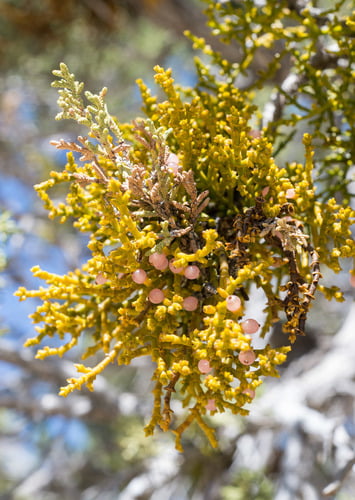
iNaturalist· cc-by-nc
(c) Geoff Agars, some rights reserved (CC BY-NC), uploaded by Geoff Agars
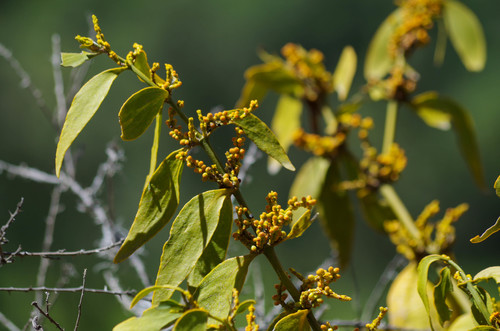
iNaturalist· cc-by-nc
(c) Harvey Perkins, some rights reserved (CC BY-NC)
Summary
Source: WikipediaSantalum acuminatum, the desert quandong, is a hemiparasitic plant in the sandalwood family, Santalaceae, (Native to Australia) which is widely dispersed throughout the central deserts and southern areas of Australia. The species, especially its edible fruit, is also commonly referred to as quandong or native peach. The use of the fruit as an exotic flavouring, one of the best known bush tucker (bush food), has led to the attempted domestication of the species. Desert quandong is an evergreen tree, its fruit can be stewed to make pie filling for quandong pies or made into a fruit juice drink. The seed (kernel) inside the tough shell can be extracted to be crushed into a paste then be used on sore gums or an oral gum boil to ease the pain. Because it is one of the few drought-tolerant fruit trees in far-west New South Wales, it is popular to grow among many Aboriginal communities and the non-Indigenous Australians who are aware of it.
Description
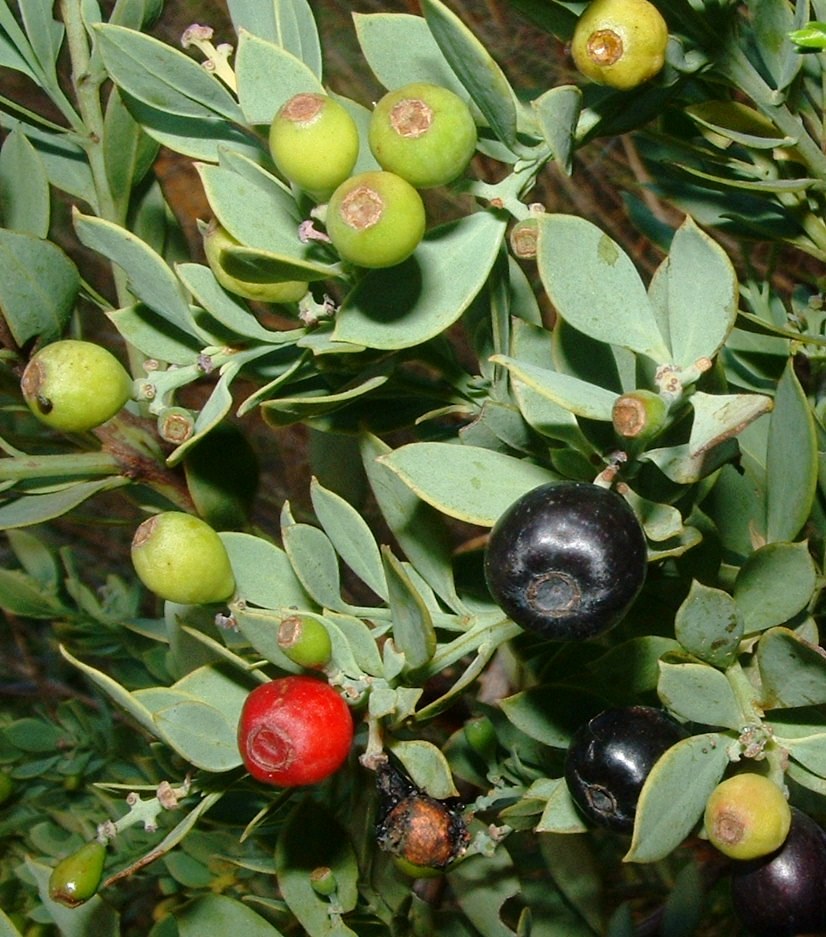
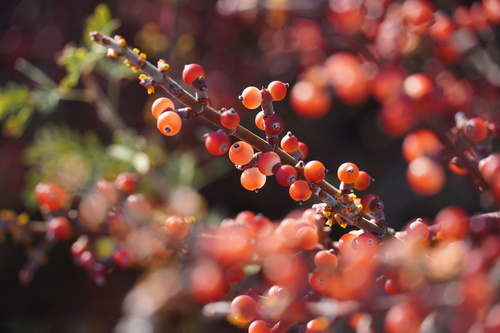
A small tree. It has an upright growth habit. It grows to 5-8 m high. It forms clumps in dunes due to underground suckers. The leaves are yellowish-green. They are leathery and slightly sickle shaped. The fruit are attractive, round and succulent. They turn bright red when ripe. They have a red outer skin surrounding a hard outer kernel which can be cracked open to reveal a nut. The nuts are edible. The fruit are 2-4 cm across. They have a single seed.
Edible Uses
The fruit can be eaten raw or cooked and is suitable for drying to preserve for later use. The seed is oily and nutritious but not considered very palatable.
Traditional Uses
The ripe fruit are eaten raw or cooked. They can be dried for later use. They can be used for jam and pies, syrups and chutneys. The seeds or nuts are eaten roasted. The seed kernel is 60% oil.
Medicinal Uses
The plant provides a liniment used on sores and boils.
Distribution
A tropical plant. It is native to Australia. It grows naturally in sandy soils in the drier interior regions of Australia. In tropical Queensland it grows from sea level to 900 m altitude. In the Inland Botanical Gardens Mildura. They are grown commercially near Quorn, South Australia. It can grow in arid places. It suits hardiness zones 9-11.
Where It Grows
Australia*,
Cultivation
Plants are grown from seed. They grow as a parasite on other roots.
Propagation
Propagate by seed.
Other Uses
The bark contains up to 18% tannin. The seed is rich in oil and burns in the manner of a candlenut. The wood is hard, heavy, and close-grained, used for making furniture. Being oily, it also makes an effective friction stick for fire-making.
Other Information
They are an attractive fruit. They are cultivated commercially occasionally.
Notes
There are 25 Santalum species. The seeds are 25% protein. The fruit are rich in Vitamin C.
Nutrition
| Part | Moisture | kJ | kcal | Protein | Vit A | Vit C | Iron | Zinc |
|---|---|---|---|---|---|---|---|---|
| Kernel | 2.4 | 2920 | 699 | 16 | — | — | 10.6 | 6.6 |
| Fruit | 68.5 | 335 | 80 | 2.3 | — | — | 1.2 | 0.5 |
Synonyms
Also Known As
Burn-burn, Dumbari, Guwadhaa, Quandong, Mangata, Native peach, Tatu, Wayanu, Western quandong
References (65)
- Alice, L. & O'Quinn, T., Australian Bush Superfoods. Explore Australia p 126
- Barwick, M., 2004, Tropical and Subtropical Trees. A Worldwide Encyclopedic Guide. Thames and Hudson p 362
- Bindon, P., 1996, Useful Bush Plants. Western Australian Museum. p 219
- Blomberry, A.M., 1979, Australian Native Plants. Angus and Robertson p
- Bodkin, F., 1991, Encyclopedia Botanica. Cornstalk publishing, p 906
Show all 65 references Hide references
- Bonney, N., 1997, Economic Native Trees and Shrubs for South Australia. Greening Australia (SA) inc. Campbelltown SA 5074 p 159
- Bonney, N., 2012, Edible Wild Native Plants for Southern Australia. p 60
- Boomsma, C.D., 1972, Native Tree of South Australia. Woods & Forests Department South Australia, Bulletin No.19. p 212
- Burkill, I.H., 1966, A Dictionary of the Economic Products of the Malay Peninsula. Ministry of Agriculture and Cooperatives, Kuala Lumpur, Malaysia. Vol 1 (A-H) p 969 (As Eucarya acuminata)
- Cancilla, D., 2018, Ethnobotanical and Ethnozoological Values Desktop Assessment - Eliwana Project. p 44
- Cherikoff V. & Isaacs, J., The Bush Food Handbook. How to gather, grow, process and cook Australian Wild Foods. Ti Tree Press, Australia p 190
- Clarke, P. A., 2013, The Aboriginal Ethnobotany of the Adelaide Region, South Australia. Transactions of the Royal Society of South Australia. (2013), 137(1): 97-126
- Cooper, W. and Cooper, W., 2004, Fruits of the Australian Tropical Rainforest. Nokomis Editions, Victoria, Australia. p 472
- Cribb, A.B. & J.W., 1976, Wild Food in Australia, Fontana. p 56
- Cronin, L., 1989, The Concise Australian Flora. Reed. p 128
- Cundall, P., (ed.), 2004, Gardening Australia: flora: the gardener's bible. ABC Books. p 1310
- Dashorst, G.R.M., and Jessop, J.P., 1998, Plants of the Adelaide Plains & Hills. Botanic Gardens of Adelaide and State Herbarium. p 50
- Daw, B., Walley, T. & Keighery, G., 2001, Bush Tucker. Plants of the South-West. Department of Conservation and Land Management. Western Australia. p 52
- Facciola, S., 1998, Cornucopia 2: a Source Book of Edible Plants. Kampong Publications, p 223 (As Eucarya acuminata)
- Goddard, C. & Kalotas A. (Eds.), Punu, 2002, Yankunytjatjara plant use. Jukurrpa books. p 27
- Hardwick, G., 2001, Economically Useful Plants for Northern Australia: Master Species List. Crusader eBooks.
- Hedrick, U.P., 1919, (Ed.), Sturtevant's edible plants of the world. p 321
- Hibbert, M., 2002, The Aussie Plant Finder 2002, Florilegium. p 286
- Holliday, I. and Hill, R., 1974, A Field Guide to Australian Trees. Frederick Muller Ltd.
- Holliday, I., 1989, A Field Guide to Australian Trees. Hamlyn. p 292
- Hunter, J., 2015, Vegetation and flora of Naree and Yantabulla. A Draft Report to the Bush Heritage Australia
- Hunter, J.T., 2017, Is there a relationship between contemporary high Aboriginal plant resource locations and mapped vegetation communities? Cunninghamia 17:27-34. The Royal Botanic Garden Sydney. ISSN 2200 - 405X
- INFOODS:FAO/INFOODS Databases
- Isaacs, J., 1987, Bush Food, Aboriginal Food and Herbal Medicine. Weldons. p 74
- Lang, P. J., et al, 1986, Anangu Pitjantjatjara Lands Biological Survey. p 43
- Latz, P.K., 1996, Bushfires and Bushtucker: Aboriginal plant use in Central Australia. IAD Press Alice Springs p 259
- Latz, P & Wightman, G., 1995, Desert Bush Tucker Identikit. Common Native Food Plants of Central Australia. Parks & Wild Commission Northern territory. p 20
- Lazarides, M. & Hince, B., 1993, Handbook of Economic Plants of Australia, CSIRO. p 211
- Lord, E.E., & Willis, J.H., 1999, Shrubs and Trees for Australian gardens. Lothian. p 20
- Low, T., 1991, Wild Food Plants of Australia. Australian Nature FieldGuide, Angus & Robertson. p 172
- Low, T., 1992, Bush Tucker. Australia’s Wild Food Harvest. Angus & Robertson. p 68, 92
- Maiden, J. H., 1889, The Useful Native Plants of Australia (including Tasmania). The Technology Museum of NSW, Sydney. p 31 (As Fusanus acuminatus)
- Mallee Wildflower Committee, Flowers of the Mallee. p 72
- McKerney, M. & White, H., 2011, Bush Tucker, Boomerangs & Bandages. Border River-Gwyder Catchment Management Authority p 107
- Miers, G., 2004, Cultivation and sustainable wild harvest of Bushfoods by Aboriginal Communities in Central Australia. RIRDC report W03/124 p 20
- Menninger, E.A., 1977, Edible Nuts of the World. Horticultural Books. Florida p 67
- Menninger, E.A., 1977, Edible Nuts of the World. Horticultural Books. Florida p 67 (As Eucarya acuminata)
- Morley, B.D., & Toelken, H.R., (Eds), 1983, Flowering Plants in Australia. Rigby. p 233
- Petheram, R.J. and Kok, B., 2003, Plants of the Kimberley Region of Western Australia. UWA Press p 341
- Plants for a Future database, The Field, Penpol, Lostwithiel, Cornwall, PL22 0NG, UK. http://www.scs.leeds.ac.uk/pfaf/
- Prodr. 14:684. 1857
- Recher, P, 2001, Fruit Spirit Botanical Gardens Plant Index. www.nrg.com.au/~recher/ seedlist.html p 3
- Robins, J., 1996, Wild Lime. Cooking from the Bush food garden. Allen & Unwin p 19
- Rolsh, 1994, Wildflowers of the Western State, Rolsh Productions Albany WA. p 28
- Self, M., 199, Phoenix Seeds catalogue. p 16
- Smith, K., 1998. Growing Uncommon Fruits and Vegetables. New Holland. p 99
- Smith, K & I., 1999, Grow your own bushfoods. New Holland. Australia. p 59
- Smith, N. M., 1991, Ethnobotanical Field Notes from the Northern Territory, Australia, J. Adelaide Bot. Gard. 14(1): 1-65
- Solomon, C., 2001, Encyclopedia of Asian Food. New Holland. p 303
- Ulian, T., et al, 2020, Unlocking plant resources to support food security and promote sustainable agriculture. Plants, People, Planet. 2020;2:421–445.
- Urban, A., 1990, Wildflowers of Inland Australia. Portside editions. p 28
- USDA, ARS, National Genetic Resources Program. Germplasm Resources Information Network - (GRIN). [Online Database] National Germplasm Resources Laboratory, Beltsville, Maryland. Available: www.ars-grin.gov/cgi-bin/npgs/html/econ.pl (10 April 2000)
- Wickens, G.E., 1995, Edible Nuts. FAO Non-wood forest products. FAO, Rome. p 77, 149
- Wiersema, J. H. & Leon, B., 2013, World Economic Plants. A Standard Reference CRC Press. 2nd Ed. p 613
- Williams, K.A.W., 1999, Native Plants of Queensland Volume 4. Keith A.W. Williams North Ipswich, Australia. p 346
- Williams A. & Sides, T., 2008, Wiradjuri Plant Use in the Murrumbidgee Catchment. Murrumbidgee Catchment Management Authority. Wagga Wagga, p 39
- Wrigley, J. W. and Fagg. M., 1988, Australian Native Plants. Collins. (Australia)
- World Checklist of Useful Plant Species 2020. Royal Botanic Gardens, Kew
- www.ceres.org.au/bushfoodcatalogue
- Zola, N., & Gott, B., 1992, Koorie Plants Koorie People. Koorie Heritage Trust. p 29