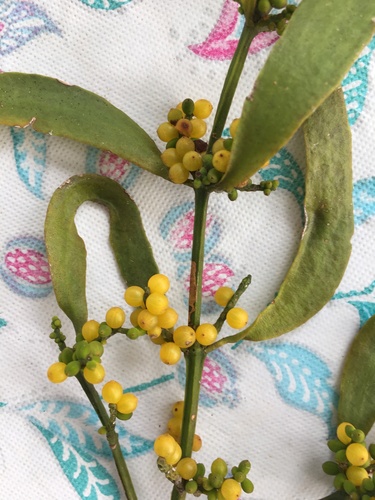
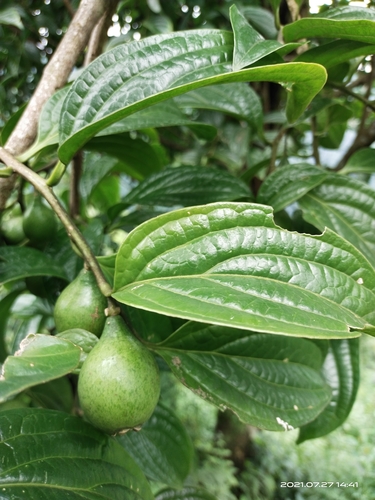
Santalum austrocaledonicum
Vieill.
Sandalwood
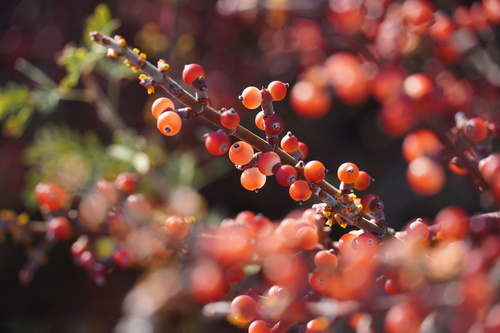
iNaturalist· cc-by-nc
(c) Pierre-Louis Stenger, some rights reserved (CC BY-NC), uploaded by Pierre-Louis Stenger
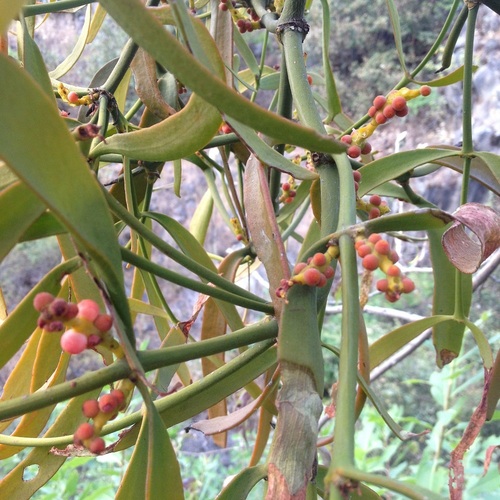
iNaturalist· cc-by-nc
(c) johana_shein, some rights reserved (CC BY-NC)
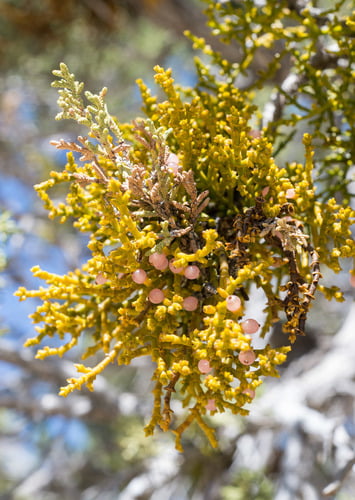
iNaturalist· cc-by-nc
(c) johana_shein, some rights reserved (CC BY-NC)
Summary
Source: WikipediaSantalum austrocaledonicum, or New Caledonia sandalwood, is a sandalwood tree from the family Santalaceae. It is a small tree with gray bark and green leaves, and is parasitic. Most have been removed from their habitat due to logging; very few trees remain in the wild.
Description
Slow-growing evergreen tree reaching 10 m in height and spread. Hardy to UK zone 10. Prefers light sandy and medium loamy well-drained soils with mildly acid, neutral, mildly alkaline, or very acid pH. Requires full sun and cannot tolerate shade. Tolerates dry or moist soil and is drought-resistant. Yellow, scented, fine-grained, durable heartwood. Pioneer species spreading by bird-dispersed seeds.
Edible Uses
No edible uses are known for this plant.
Medicinal Uses
A decoction of sandalwood combined with Homolanthus leaves is taken to treat elephantiasis (lymphatic filariasis).
Distribution
It is a tropical plant.
Where It Grows
New Caledonia, Pacific, Vanuatu,
Cultivation
The plant grows naturally in warm to hot lowland areas in the tropics at elevations up to 800 metres, but usually below 300 metres. It prefers a mean annual temperature in the range 23 - 27°c. It is found in areas where the mean annual rainfall is in the range 1,250 - 1,750mm (though it can tolerate 800 - 2,500mm), and there is a distinct dry season of 3 - 5 months. Requires a position in full sun or bright shade. Requires a light to medium, well-drained soil. Prefers a wwell-drainedneutral to slightly alkaline soil. Tolerates poor, shallow soils. It grows more quickly in fertile soils but is then more at risk of being shaded out by taller, faster-growing trees. Prefers a circumneutral soil with a pH of pH 6.1 - 7.4, but can tolerate 4 - 7.4. The plant has a capacity for invasiveness in disturbed places, but this is rarely considered a problem. A semi-parasitic plant, obtaining some of its nutriment from the roots of other plants. The plant has green leaves containing chlorophyll, and is thus able to photosynthesize - it relies on host plants only for water and soil nutrients, not for sugars, which it can produce itself. In a natural situation, the plant seems to rely on nnitrogen-fixingtrees such as Acacia and Casuarina, though it is known to parasitize many other legumes, shrubs, herbs and grasses. It normally has more than one host at a time. Acacia spirorbis makes a good long-term host plant under both natural conditions and in plantations. For ultramafic soils, other good nitrogen-fixing host species are Casuarina collina and Gymnostoma deplancheana. A fairly slow-growing plant, increasing in height by about 30 - 70cm per year. Under good conditions plants begin fruiting from an early age, typically about 3 - 4 years, but heavy fruiting may take 7 - 10 years. The species can produce substantial quantities of its valuable heartwood on a rotation of about 25 - 40 years. Plants generally respond well to coppicing. Plants are capable of producing root suckers - following harvesting, clumps of suckers may regenerate in a circular pattern several meters away from the original stump. Because sandalwood is hemiparasitic and requires one or more host plants, intercropping is not only possible, but necessary.
Propagation
Sow seed fresh for best results — viability is highest shortly after harvest, with 80–90% germination achieved within 2–3 months. Scarification improves germination rates. Sow in a covered nursery seedbed at 28–31°C. Prick out seedlings into individual pots once they have 2–4 leaves. Acacia species, Calliandra calothyrsus, and Casuarina spp. can serve as host plants in pots, though Calliandra needs frequent cutting back to prevent it from overtopping the sandalwood. Plant out into permanent positions when seedlings reach 20–25 cm tall, approximately 5–6 months after germination.
Other Uses
This species is a pioneer plant that spreads freely into grassland and similar habitats via bird-dispersed seeds. An essential oil extracted from the heartwood is high quality and widely used in cosmetics, perfumery, incense, and religious ceremonies. The grated wood is traditionally used to scent coconut oil. The heartwood is yellow and fragrant, and the wood itself is fine-grained and durable, used for making boxes, carvings, and small decorative articles. Because of its high value as a source of essential oil, the wood is rarely exploited as a general timber.
Notes
It is an unresolved name in The Plant List. It has some medicinal benefits.
Synonyms
Also Known As
Ghaibunbuni
References (2)
- Cabalion, P. and Morat, P., 1983, Introduction le vegetation, la flore et aux noms vernaculaires de l'ile de Pentcoste (Vanuatu), In: Journal d'agriculture traditionnelle et de botanique appliquee JATBA Vol. 30, 3-4
- INFOODSUpdatedFGU-list.xls