Santalum ellipticum
Gaudich.
Hawaiian sandalwood
iNaturalist· cc-by-nc
(c) A. Moore, some rights reserved (CC BY-NC), uploaded by A. Moore
iNaturalist· cc0
no rights reserved
iNaturalist· cc-by-nc-nd
(c) sea-kangaroo, some rights reserved (CC BY-NC-ND), uploaded by sea-kangaroo
Summary
Source: WikipediaSantalum ellipticum, commonly known as ʻIliahialoʻe (Hawaiian) or coastal sandalwood, is a species of flowering plant in the mistletoe family, Santalaceae, that is endemic to the Hawaiian Islands. It is a sprawling shrub to small tree, typically reaching a height of 1–5 m (3.3–16.4 ft) and a canopy spread of 1–3 m (3.3–9.8 ft), but is extremely variable in size and shape. Like other members of the genus, S. ellipticum is a hemi-parasite, deriving some of its nutrients from the host plant by attaching to its roots.
Description
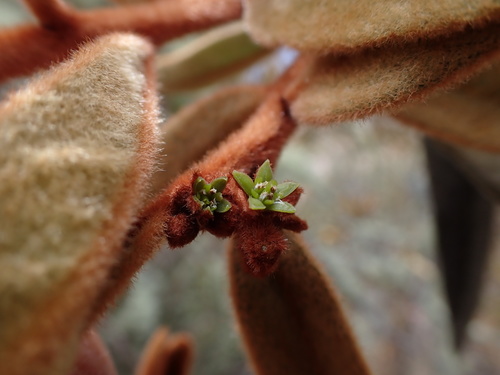
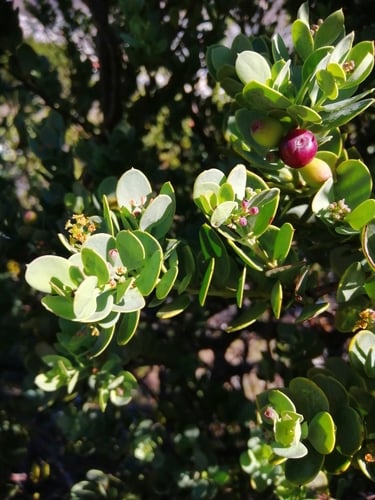
A bushy shrub or a small tree with several stems. It grows 5-10 m high. It has roots that grow attached to other plants from which is gets nutrients. The leaves are greyish green and 3-6 cm long. They are 2-4 cm wide. They can be leathery or soft. They usually have a fine white powder that can easily be rubbed off. The flowers are green and in compound groups. They have a sweet smell. The fruit are about 1 cm across and have a ring at the top. The fruit are purple to black when ripe. They contain one seed.
Edible Uses
The seeds are tasty, though their scarcity and high value for propagation make using them as food somewhat impractical.
Traditional Uses
The seeds are edible and tasty.
This uses section is brief — help expand it
Medicinal Uses
A drink made from finely ground heartwood powder, combined with Piper methysticum, Eugenia reinwardtiana, Bobea species, and Alphitonia ponderosa, followed by a laxative, was traditionally used to treat venereal diseases in both males and females. For severe sores, the powdered wood is combined with wood from Melicope hawaiensis and Bobea species, along with Piper methysticum and the bark of Syzygium malaccense. A shampoo made from a leaf infusion — sometimes with added ashes of Myoporum sandwicense — has been used to treat dandruff and eliminate head lice.
Distribution
It grows in Hawaii near the coastline and on rocky slopes. It can grow up to 950 m altitude.
Where It Grows
Asia, China, Hawaii*, India, Japan, Korea, Pacific, Singapore, Taiwan, USA,
Cultivation
Santalum ellipticum is a plant of arid lowland habitats in the Hawaiian Islands, growing at elevations up to 560 metres, exceptionally to 960 metres. It grows in frost-free areas; the mean annual rainfall can range from 50 - 1,300mm, usually with a dry season of 2 - 5 months and often with a summer drought. Prefers a position with moderate side shade, but little overhead shade; it grows poorly in deeper shade, but can do well in full sun if attached to a suitable host. Tolerant of a range of soil conditions, including infertile and shallow soils, but grows best in a light to medium, well-drained soil. Prefers a neutral to slightly alkaline soil with a pH 6.1 - 7.4, but can tolerate 4 - 7.4. Established plants are able to survive a long dry season (up to 5 - 6 months) when attached parasitically to suitably drought_tolerant host plants. Tolerant of strong, salt-laden winds. Although the tree has become much less common in its native habitat due to the ravages of introduced grazing animals and rats, the tree does actually have the potential to become invasive, spreading by seeds and root suckers. However, this has not been seen as a problem in the past, mainly due to the high value of the wood and the ease with which they can be shaded out by taller trees. A slow-growing species, showing annual height increases of 30 - 70cm a year when young. Growth is faster in fertile soils but the tree is then at risk of being shaded out or overtopped by taller, faster growing trees on such sites. Under good conditions, plants begin flowering from an early age, typically about 3 - 4 years, but heavy flowering and fruiting may take 7 - 10 years. Trees can flower and produce fruit throughout the year, usually with two peaks. The flowers produce a strong fragrance. Trees produce root suckers, especially if cut down, when a ring of suckers will often appear several metres away from the original stump. A semi-parasitic plant, obtaining some of its nutriment from the roots of other plants. The plant has green leaves containing chlorophyll, and is thus able to photosynthesize - it relies on host plants only for water and soil nutrients, not for sugars, which it can produce itself. It normally has more than one host at a time. The species is flexible in the plants it can use as a host, being found in association with species such as Wikstroemia sandwicensis, Pritchardia remota, Chenopodium oahuense, Chamaesyce hypericifolia, and various introduced grass species. In the field, seedlings should be planted near potential host plants. Seedlings are generally planted within existing vegetation near potentially suitable hosts. Success is generally good, especially in locations where seedlings can be watered occasionally and weed competition is controlled. Periodic trimming of the secondary host may benefit seedlings. Flowering Time: Late Spring/Early Summer Mid Summer. Bloom Color: Bright Yellow. Spacing: 15-20 ft. (4.7-6 m) 20-30 ft. (6-9 m) 30-40 ft. (9-12 m).
Propagation
Seed viability is fairly short, so sow as soon as the seed is ripe in a shady position in nursery trays. Optimum germination temperature is 28–31°C. Nicking the seedcoat without damaging the embryo can accelerate germination; with fresh seed and nicking, up to 90% can sprout within three weeks. Prick out into individual containers when large enough to handle, optionally placing a host plant in the same pot. Gradually increase light levels as the seedling grows. Plant out when approximately 20–25 cm tall, and ensure container-grown plants are placed close to a host tree within 6 months of germination.
Other Uses
A high-quality essential oil obtained from the heartwood is highly valued today for perfumery, cosmetics, incense sticks, and aromatherapy. Traditionally it was used to scent coconut oil for application to hair and body, and to perfume cultural artifacts such as tapa cloth. A mixture of powdered heartwood and sapwood is made into incense or joss sticks for eastern religious ceremonies, using sawdust, carving shavings, or post-distillation wood residue. The finest sandalwood goes toward carving religious statues, handicrafts, art objects, and decorative furniture, with larger basal pieces and roots preferred. In Hawaii it has also been used to craft musical instruments such as the musical bow. Though it burns well, it does not produce useful charcoal; small amounts are added to fires for their scent and as a mosquito repellent. Because of its scarcity and high cash value the wood is rarely used traditionally today, though historically it served for canoe paddles, carvings, medicine, and insect repellent. Powdered heartwood was also sprinkled over new tapa cloth to perfume it and make it waterproof.
Notes
It is an endangered plant.
Synonyms
Also Known As
Sandalo
References (4)
- Elevitch, C.R.(ed.), 2006, Traditional Trees of the Pacific Islands: Their Culture, Environment and Use. Permanent Agriculture Resources, Holualoa, Hawaii. p 695
- http://www.ntbg.org/plants/plant details.php
- Voy. Uranie 442. 1827
- www.worldagroforestrycentre.org/treedb/